
葡萄牙工人握力的标准参考值。
Normative reference values of the handgrip strength for the Portuguese workers.
作者信息
Bernardes Sarah Moreira Fernandes, Assunção Ana, Fujão Carlos, Carnide Filomena
机构信息
Biomechanics and Functional Morphology Laboratory, CIPER, Sports & Health Department, Faculty of Human Kinetics, University of Lisbon, Lisbon, Portugal.
Volkswagen Autoeuropa-Area of Industrial Engineering and Lean Management, Palmela, Portugal.
出版信息
PLoS One. 2020 Aug 5;15(8):e0236555. doi: 10.1371/journal.pone.0236555. eCollection 2020.
INTRODUCTION
The active workforce is increasingly aging. However workload, as well as working time and intensity, sometimes remains unchanged. This can be an even more critical situation in older people, since occupational exposure associated with aging, will further reduce the muscle's ability to generate energy, which in turn facilitates the development of these age-related syndromes. This study aims to identify the normative values of handgrip strength for Portuguese workers in the automotive industry.
METHODS
About 1225 employees were invited to participate in the study. The final sample consisted of 656 employees in the assembly area. The handgrip strength was measured in kilograms (kg) using the Jamar digital dynamometer. Sex-specific profiles of handgrip strength were designed by the Ordinary Least Square regression (OLS) analysis, where height, age, age squared, and height squared are entered into the models as determining factors of the maximum grip strength in both female and male groups.
RESULTS
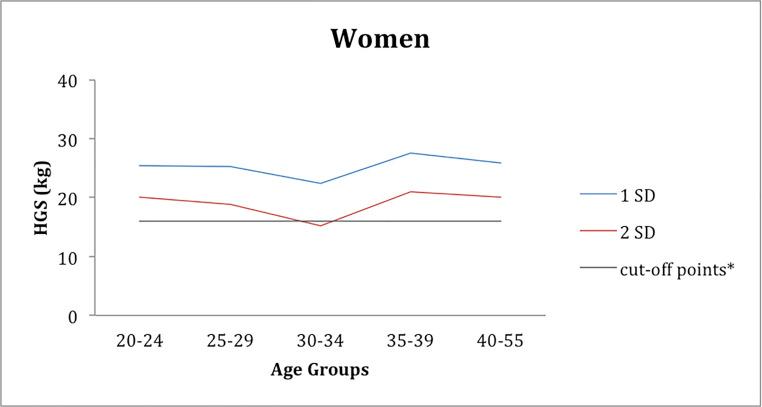
The peak mean values of handgrip strength in the group of women was 34 kg in the age group of 35-39 years, and in the group of men the peak mean was 52 kg in the age group of 25-34 years. The most pronounced decline in the female group appears in the age of 30-34 years of about 4 kg and the male group the decline occurs at 2kg below the peak force, in the age group of 40-57 year-olds. This study used a cut-off at 2 SD below by the sex-specific peak mean.
CONCLUSION
Normative values can help delineate the career path of workers because they portray risk values according to age, height, and gender. The normative values assist health and engineering professionals and ergonomists in adjusting task demands to the morphological and strength characteristics of the workers.
引言
在职劳动力老龄化现象日益严重。然而,工作量、工作时间和强度有时却保持不变。这对老年人来说可能是更为严峻的情况,因为与衰老相关的职业暴露会进一步降低肌肉产生能量的能力,进而促使这些与年龄相关的综合征的发展。本研究旨在确定葡萄牙汽车行业工人握力的标准值。
方法
约1225名员工受邀参与研究。最终样本包括装配区的656名员工。使用Jamar数字测力计以千克(kg)为单位测量握力。通过普通最小二乘法回归(OLS)分析设计握力的性别特异性概况,将身高、年龄、年龄平方和身高平方作为女性和男性组最大握力的决定因素纳入模型。
结果
女性组握力峰值平均值在35 - 39岁年龄组为34 kg,男性组在25 - 34岁年龄组为52 kg。女性组最明显的下降出现在30 - 34岁,下降约4 kg,男性组在40 - 57岁年龄组,下降幅度为比峰值力量低2 kg。本研究采用低于性别特异性峰值平均值2个标准差作为临界值。
结论
标准值有助于描绘工人的职业发展路径,因为它们根据年龄、身高和性别描绘了风险值。这些标准值有助于健康和工程专业人员以及人体工程学家根据工人的形态和力量特征调整任务要求。


 Zotero 插件