Missio Dandara Meurer, Dias Maria Fernanda Reis Gavazzoni, Trüeb Ralph Michel
Department of Dermatology, Center for Medical Sciences, Fluminense Federal University, University Hospital Antonio Pedro, Niterói, Rio de Janeiro, Brazil.
Center for Dermatology and Hair Diseases Professor Trüeb, Zurich-Wallisellen, Switzerland.
Int J Trichology. 2017 Jul-Sep;9(3):130-134. doi: 10.4103/ijt.ijt_59_17.
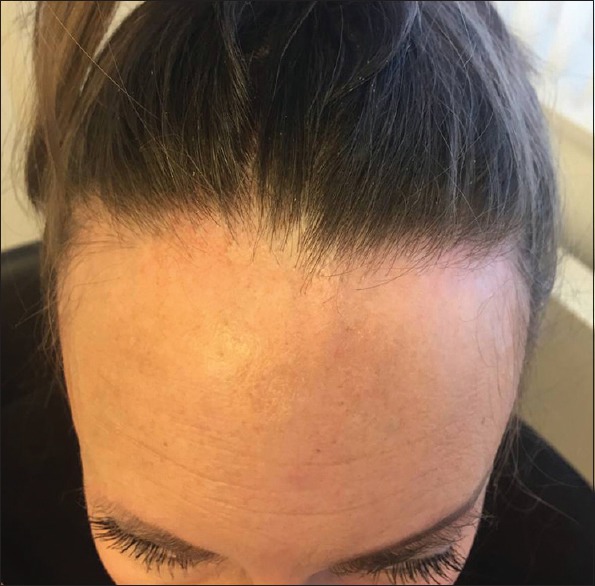
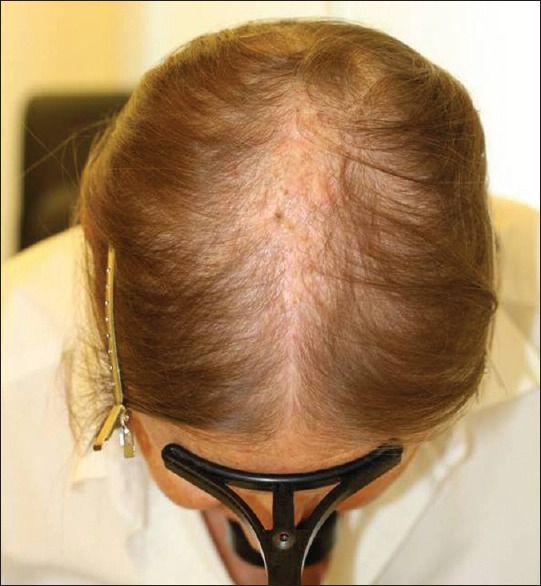
Frontal fibrosing alopecia (FFA) and fibrosing alopecia in a pattern distribution (FAPD) as originally reported by Kossard in 1994 and by Zinkernagel and Trüeb in 2000, respectively, represent two distinct patterns of cicatricial pattern hair loss. Both share a patterned distribution and histological evidence of a lichenoid follicular inflammation with fibrosis. FFA is characterized by a marginal alopecia along the frontotemporal hairline, and FAPD by a progressive alopecia of the centroparietal scalp. Since the original reports, evidence has accumulated that there exists considerable clinical overlap among FFA, FAPD, and lichen planopilaris, with coexistence of features of the three conditions within the same individual. Moreover, familial cases of FFA have been reported, pointing to a possible genetic background to the condition. Our observation of familial occurrence of FFA and FAPD in daughter and mother, respectively, further underscore a nosologic relationship between the two conditions with respect to both an androgenetic background and the (lichenoid) inflammatory reaction pattern.
额部纤维性秃发(FFA)和模式分布性纤维性秃发(FAPD),最初分别由科萨德于1994年以及津克纳格尔和特吕布于2000年报道,它们代表瘢痕性脱发的两种不同模式。两者都具有模式化分布以及苔藓样毛囊炎症伴纤维化的组织学证据。FFA的特征是沿额颞发际线的边缘性脱发,而FAPD的特征是头顶中央头皮的进行性脱发。自最初报道以来,越来越多的证据表明FFA、FAPD和扁平苔藓样秃发之间存在相当大的临床重叠,同一个体中可同时存在这三种情况的特征。此外,已有FFA家族病例的报道,表明该病可能存在遗传背景。我们观察到女儿患FFA、母亲患FAPD的家族性发病情况,进一步强调了这两种情况在雄激素性背景和(苔藓样)炎症反应模式方面的疾病分类学关系。