a School of Life Sciences , Tokyo University of Pharmacy and Life Sciences , Hachioji , Tokyo , Japan.
Autophagy. 2017;13(11):2008-2009. doi: 10.1080/15548627.2017.1371395. Epub 2017 Sep 28.
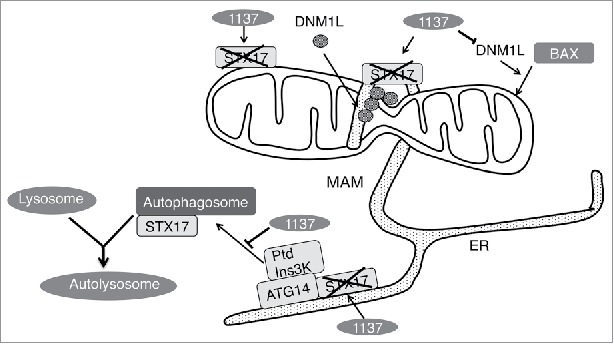
Pathogens subvert host defense systems including autophagy and apoptosis for their survival and proliferation. Legionella pneumophila is a Gram-negative bacterium that grows in alveolar macrophages and causes severe pneumonia. Early during infection Legionella secretes effector proteins that convert the plasma membrane-derived vacuole containing Legionella into an endoplasmic reticulum (ER)-like replicative vacuole. These vacuoles ultimately fuse with the ER, where the pathogen replicates. Recently, we showed that one of the effectors, Lpg1137, is a serine protease that targets the mitochondria-associated ER membrane (MAM) and degrades STX17 (syntaxin 17), a SNARE implicated in macroautophagy/autophagy as well as mitochondria dynamics and membrane trafficking in fed cells. Degradation of STX17 blocks autophagy and BAX-induced apoptosis.
病原体颠覆宿主防御系统,包括自噬和细胞凋亡,以实现其生存和增殖。嗜肺军团菌是一种革兰氏阴性菌,在肺泡巨噬细胞中生长并引起严重肺炎。在感染早期,军团菌分泌效应蛋白,将含有军团菌的质膜衍生的空泡转化为内质网(ER)样复制空泡。这些空泡最终与内质网融合,病原体在其中复制。最近,我们发现其中一种效应蛋白 Lpg1137 是一种丝氨酸蛋白酶,它靶向线粒体相关内质网膜(MAM)并降解 STX17(突触融合蛋白 17),该蛋白参与巨自噬/自噬以及在进食细胞中线粒体动力学和膜运输。STX17 的降解阻止了自噬和 BAX 诱导的细胞凋亡。