Hackinger Sophie, Trajanoska Katerina, Styrkarsdottir Unnur, Zengini Eleni, Steinberg Julia, Ritchie Graham R S, Hatzikotoulas Konstantinos, Gilly Arthur, Evangelou Evangelos, Kemp John P, Evans David, Ingvarsson Thorvaldur, Jonsson Helgi, Thorsteinsdottir Unnur, Stefansson Kari, McCaskie Andrew W, Brooks Roger A, Wilkinson Jeremy M, Rivadeneira Fernando, Zeggini Eleftheria
Human Genetics, Wellcome Trust Sanger Institute, Hinxton CB10 1HH, UK.
Departments of Internal Medicine and Epidemiology, Erasmus University Medical Center, Rotterdam 3000 CA, The Netherlands.
Hum Mol Genet. 2017 Oct 1;26(19):3850-3858. doi: 10.1093/hmg/ddx285.
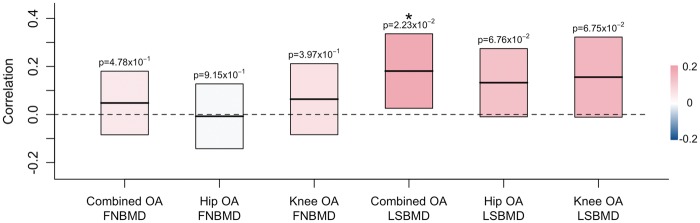
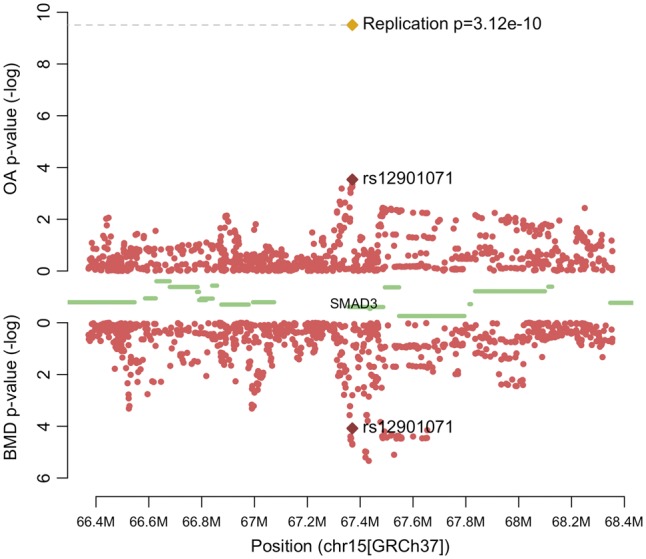
Osteoarthritis (OA) is a common complex disease with high public health burden and no curative therapy. High bone mineral density (BMD) is associated with an increased risk of developing OA, suggesting a shared underlying biology. Here, we performed the first systematic overlap analysis of OA and BMD on a genome wide scale. We used summary statistics from the GEFOS consortium for lumbar spine (n = 31,800) and femoral neck (n = 32,961) BMD, and from the arcOGEN consortium for three OA phenotypes (hip, ncases=3,498; knee, ncases=3,266; hip and/or knee, ncases=7,410; ncontrols=11,009). Performing LD score regression we found a significant genetic correlation between the combined OA phenotype (hip and/or knee) and lumbar spine BMD (rg=0.18, P = 2.23 × 10⁻²), which may be driven by the presence of spinal osteophytes. We identified 143 variants with evidence for cross-phenotype association which we took forward for replication in independent large-scale OA datasets, and subsequent meta-analysis with arcOGEN for a total sample size of up to 23,425 cases and 236,814 controls. We found robustly replicating evidence for association with OA at rs12901071 (OR 1.08 95% CI 1.05-1.11, Pmeta=3.12 × 10⁻¹⁰), an intronic variant in the SMAD3 gene, which is known to play a role in bone remodeling and cartilage maintenance. We were able to confirm expression of SMAD3 in intact and degraded cartilage of the knee and hip. Our findings provide the first systematic evaluation of pleiotropy between OA and BMD, highlight genes with biological relevance to both traits, and establish a robust new OA genetic risk locus at SMAD3.
骨关节炎(OA)是一种常见的复杂疾病,具有较高的公共卫生负担且尚无治愈方法。高骨矿物质密度(BMD)与患OA风险增加相关,提示存在共同的潜在生物学机制。在此,我们在全基因组范围内对OA和BMD进行了首次系统性重叠分析。我们使用了GEFOS联盟关于腰椎(n = 31,800)和股骨颈(n = 32,961)BMD的汇总统计数据,以及arcOGEN联盟关于三种OA表型(髋关节,病例数=3,498;膝关节,病例数=3,266;髋关节和/或膝关节,病例数=7,410;对照数=11,009)的汇总统计数据。通过进行连锁不平衡评分回归,我们发现联合OA表型(髋关节和/或膝关节)与腰椎BMD之间存在显著的遗传相关性(rg = 0.18,P = 2.23×10 -2),这可能是由脊柱骨赘的存在所驱动。我们鉴定出143个具有跨表型关联证据的变异体,将其在独立的大规模OA数据集中进行复制,并随后与arcOGEN进行荟萃分析,总样本量高达23,425例病例和236,814例对照。我们在rs12901071(优势比1.08,95%置信区间1.05 - 1.11,Pmeta = 3.12×10 -10)处发现了与OA关联的强有力的复制证据,该位点是SMAD3基因的一个内含子变异体,已知其在骨重塑和软骨维持中起作用。我们能够证实SMAD3在膝关节和髋关节完整及退变软骨中的表达。我们的研究结果首次对OA和BMD之间的多效性进行了系统性评估,突出了与这两个性状均具有生物学相关性的基因,并在SMAD3处建立了一个强有力的新的OA遗传风险位点。