MRC Integrative Epidemiology Unit, Population Health Sciences, Bristol Medical School, University of Bristol, Bristol, UK.
Musculoskeletal Research Unit, Translational Health Sciences, Bristol Medical School, University of Bristol, Bristol, UK.
Int J Epidemiol. 2022 Aug 10;51(4):1254-1267. doi: 10.1093/ije/dyab251.
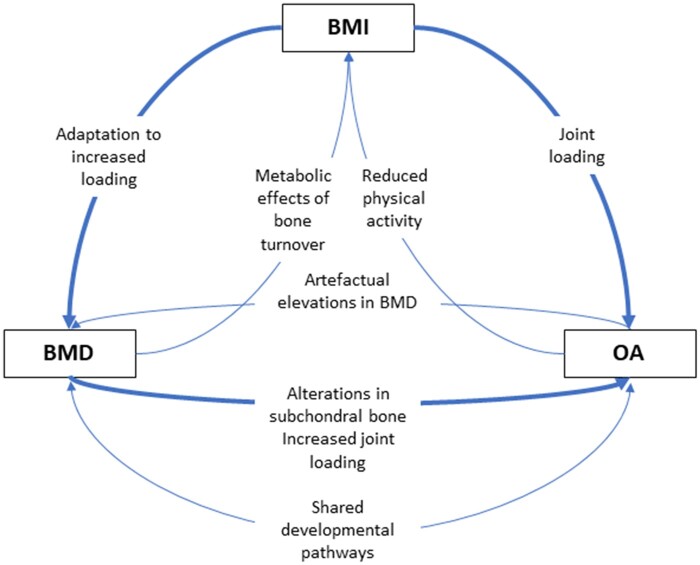
Observational analyses suggest that high bone mineral density (BMD) is a risk factor for osteoarthritis (OA); it is unclear whether this represents a causal effect or shared aetiology and whether these relationships are body mass index (BMI)-independent. We performed bidirectional Mendelian randomization (MR) to uncover the causal pathways between BMD, BMI and OA.
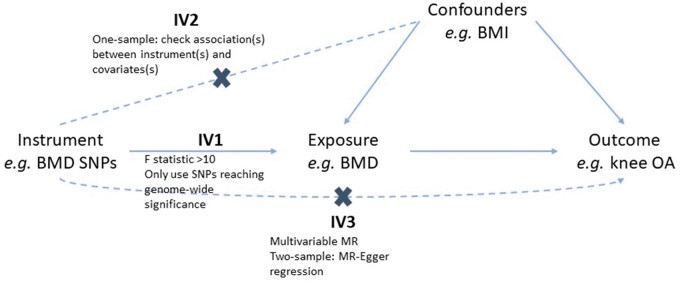
One-sample (1S)MR estimates were generated by two-stage least-squares regression. Unweighted allele scores instrumented each exposure. Two-sample (2S)MR estimates were generated using inverse-variance weighted random-effects meta-analysis. Multivariable MR (MVMR), including BMD and BMI instruments in the same model, determined the BMI-independent causal pathway from BMD to OA. Latent causal variable (LCV) analysis, using weight-adjusted femoral neck (FN)-BMD and hip/knee OA summary statistics, determined whether genetic correlation explained the causal effect of BMD on OA.
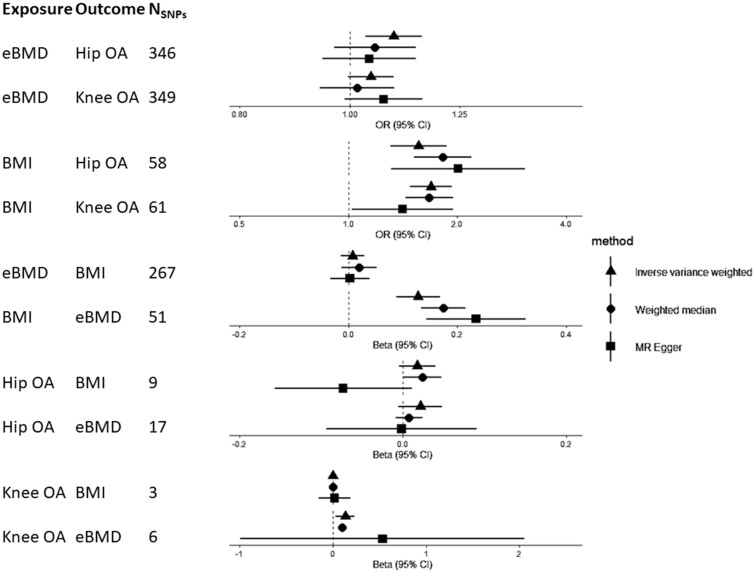
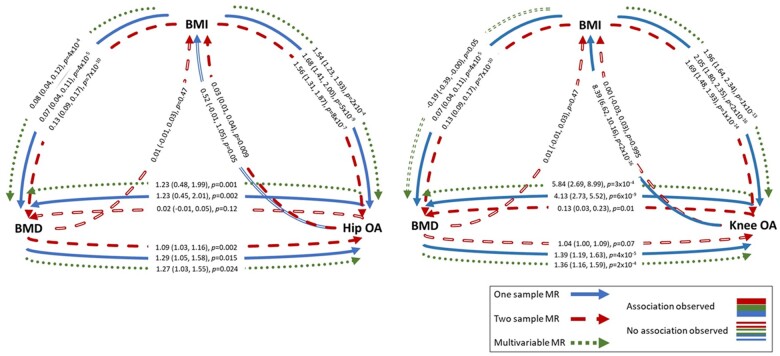
1SMR provided strong evidence for a causal effect of BMD estimated from heel ultrasound (eBMD) on hip and knee OA {odds ratio [OR]hip = 1.28 [95% confidence interval (CI) = 1.05, 1.57], p = 0.02, ORknee = 1.40 [95% CI = 1.20, 1.63], p = 3 × 10⁻⁵, OR per standard deviation [SD] increase}. 2SMR effect sizes were consistent in direction. Results suggested that the causal pathways between eBMD and OA were bidirectional (βhip = 1.10 [95% CI = 0.36, 1.84], p = 0.003, βknee = 4.16 [95% CI = 2.74, 5.57], p = 8 × 10⁻⁹, β = SD increase per doubling in risk). MVMR identified a BMI-independent causal pathway between eBMD and hip/knee OA. LCV suggested that genetic correlation (i.e. shared genetic aetiology) did not fully explain the causal effects of BMD on hip/knee OA.
These results provide evidence for a BMI-independent causal effect of eBMD on OA. Despite evidence of bidirectional effects, the effect of BMD on OA did not appear to be fully explained by shared genetic aetiology, suggesting a direct action of bone on joint deterioration.
观察分析表明,骨密度(BMD)高是骨关节炎(OA)的危险因素;目前尚不清楚这是否代表因果关系还是共同病因,以及这些关系是否与体重指数(BMI)无关。我们进行了双向孟德尔随机化(MR)分析,以揭示 BMD、BMI 和 OA 之间的因果关系。
采用两阶段最小二乘法回归生成单样本(1S)MR 估计值。加权等位基因评分作为每个暴露因素的工具变量。使用逆方差加权随机效应荟萃分析生成两样本(2S)MR 估计值。多变量 MR(MVMR)将 BMD 和 BMI 仪器纳入同一模型,确定了从 BMD 到 OA 的 BMI 独立的因果途径。使用加权股骨颈(FN)-BMD 和髋/膝关节 OA 汇总统计数据的潜在因果变量(LCV)分析,确定遗传相关性是否解释了 BMD 对 OA 的因果效应。
1S-MR 提供了强有力的证据表明,足跟超声(eBMD)估计的 BMD 对髋部和膝部 OA 具有因果影响{比值比(OR)髋=1.28 [95%置信区间(CI)=1.05, 1.57],p=0.02,OR 膝=1.40 [95%CI=1.20, 1.63],p=3×10⁻⁵,OR 每标准偏差(SD)增加}。2S-MR 效应大小的方向一致。结果表明,eBMD 和 OA 之间的因果关系是双向的(β髋=1.10 [95%CI=0.36, 1.84],p=0.003,β膝=4.16 [95%CI=2.74, 5.57],p=8×10⁻⁹,β=SD 每增加一倍风险)。MVMR 确定了 eBMD 和髋/膝关节 OA 之间 BMI 独立的因果途径。LCV 表明,遗传相关性(即共同遗传病因)并不能完全解释 BMD 对髋/膝关节 OA 的因果效应。
这些结果为 eBMD 对 OA 具有 BMI 独立的因果影响提供了证据。尽管存在双向效应的证据,但 BMD 对 OA 的影响似乎并非完全由共同遗传病因解释,这表明骨骼对关节恶化有直接作用。