• 文献检索
  • 文档翻译
  • 深度研究
  • 学术资讯
  • Suppr Zotero 插件Zotero 插件
  • 邀请有礼
  • 套餐&价格
  • 历史记录
应用&插件
Suppr Zotero 插件Zotero 插件浏览器插件Mac 客户端Windows 客户端微信小程序
定价
高级版会员购买积分包购买API积分包
服务
文献检索文档翻译深度研究API 文档MCP 服务
关于我们
关于 Suppr公司介绍联系我们用户协议隐私条款
关注我们

Suppr 超能文献

核心技术专利:CN118964589B侵权必究
粤ICP备2023148730 号-1Suppr @ 2026

文献检索

告别复杂PubMed语法,用中文像聊天一样搜索,搜遍4000万医学文献。AI智能推荐,让科研检索更轻松。

立即免费搜索

文件翻译

保留排版,准确专业,支持PDF/Word/PPT等文件格式,支持 12+语言互译。

免费翻译文档

深度研究

AI帮你快速写综述,25分钟生成高质量综述,智能提取关键信息,辅助科研写作。

立即免费体验

肉食性狸藻属植物(狸藻科)的陷阱多样性与特征演化。

Trap diversity and character evolution in carnivorous bladderworts (Utricularia, Lentibulariaceae).

机构信息

Plant Biomechanics Group, Botanic Garden, University of Freiburg, Schänzlestraße 1, D-79104, Freiburg im Breisgau, Germany.

Freiburg Center for Interactive Materials and Bioinspired Technologies (FIT), University of Freiburg, Georges-Köhler-Allee 105, D-79110, Freiburg im Breisgau, Germany.

出版信息

Sci Rep. 2017 Sep 21;7(1):12052. doi: 10.1038/s41598-017-12324-4.

DOI:10.1038/s41598-017-12324-4
PMID:28935893
原文链接:https://pmc.ncbi.nlm.nih.gov/articles/PMC5608911/
Abstract

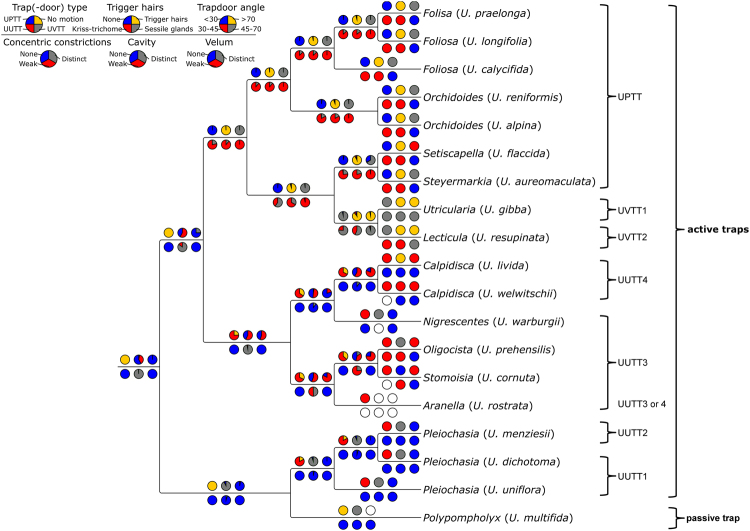
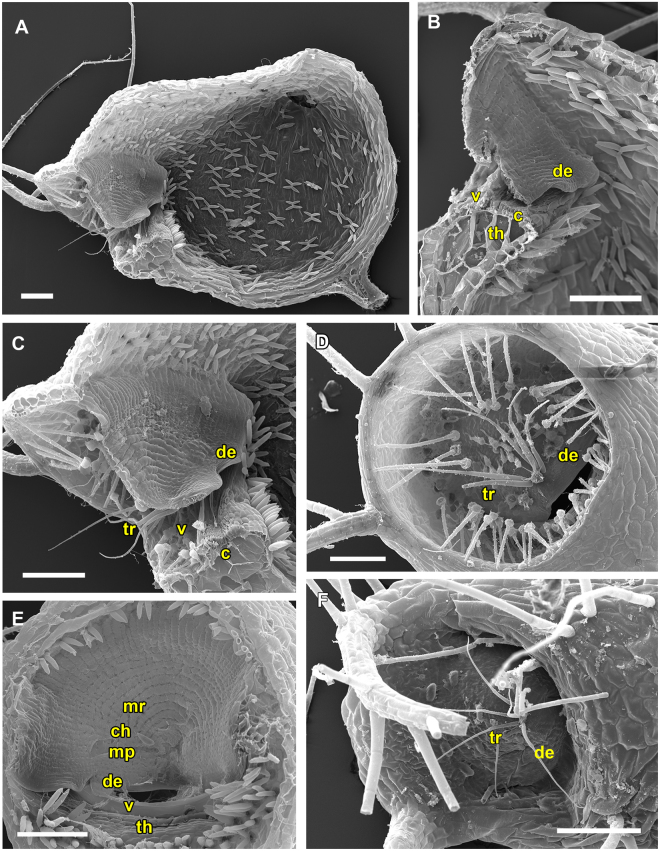
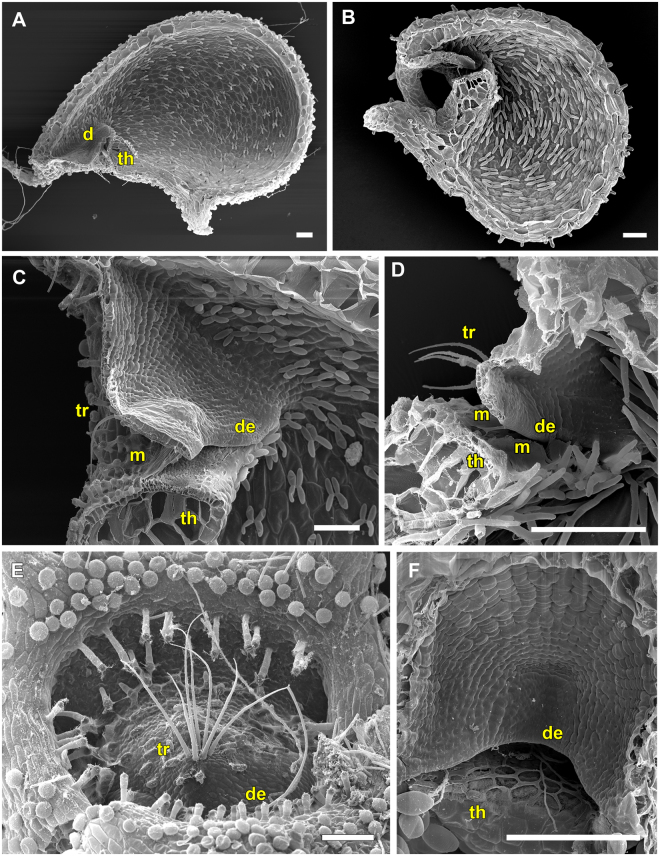
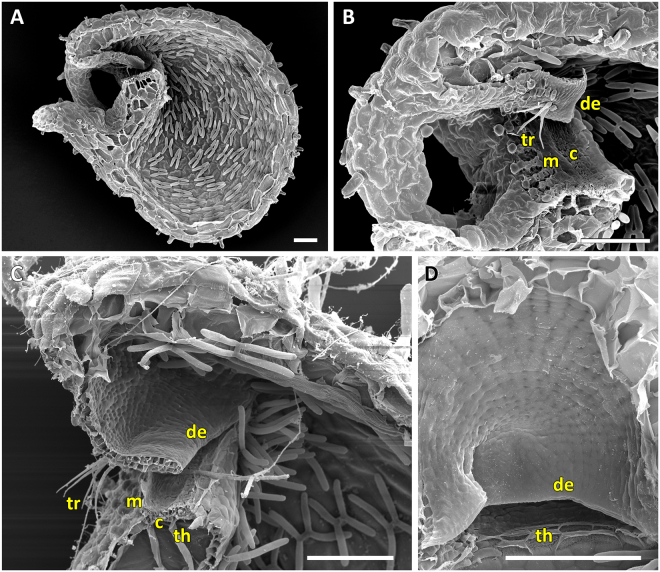
Bladderworts (Utricularia, Lentibulariaceae, Lamiales) constitute the largest genus of carnivorous plants but only aquatic species (about one fifth of the genus) have so far been thoroughly studied as to their suction trap functioning. In this study, we comparatively investigated trap biomechanics in 19 Utricularia species to examine correlations between life-forms, trapping mechanisms, and functional-morphological traits. Our investigations show the existence of two functional trap principles (passive trap in U. multifida vs. active suction traps), and - in active suction traps - three main trapdoor movement types (with several subtypes). The trapdoor movement types and their corresponding functional-morphological features most presumably represent adaptations to the respective habitat. We furthermore give insights into fluid dynamics during suction in three representatives of the main types of trapdoor movement. The results on functional morphology and trapdoor movement were mapped onto a new phylogenetic reconstruction of the genus, derived from the rapidly evolving chloroplast regions trnK, rps16 and trnQ-rps16 and a sampling of 105 Utricularia species in total. We discuss potential scenarios of trap character evolution and species radiation, highlighting possible key innovations that enable such a unique carnivorous lifestyle in different habitats.

摘要

狸藻科(Utricularia,狸藻科,唇形目)是最大的食虫植物属,但迄今为止,只有大约五分之一的水生物种对其吸力陷阱的功能进行了深入研究。在这项研究中,我们比较研究了 19 种狸藻的陷阱生物力学,以检验生活形态、捕虫机制和功能形态特征之间的相关性。我们的研究表明,存在两种功能陷阱原理(多歧狸藻的被动陷阱与主动吸力陷阱),并且 - 在主动吸力陷阱中 - 有三种主要的活门运动类型(有几个亚型)。活门运动类型及其相应的功能形态特征最有可能代表对各自栖息地的适应。我们还深入研究了三种主要活门运动类型中的三种代表在吸力过程中的流体动力学。功能形态学和活门运动的结果被映射到一个新的属系统发育重建上,该重建基于快速进化的叶绿体区域 trnK、rps16 和 trnQ-rps16,以及总共 105 种狸藻的采样。我们讨论了陷阱特征进化和物种辐射的潜在情景,强调了可能的关键创新,使这种独特的食虫生活方式在不同的栖息地成为可能。

https://cdn.ncbi.nlm.nih.gov/pmc/blobs/6dbf/5608911/1e5a175ef9c3/41598_2017_12324_Fig18_HTML.jpg
https://cdn.ncbi.nlm.nih.gov/pmc/blobs/6dbf/5608911/524720fb08de/41598_2017_12324_Fig1_HTML.jpg
https://cdn.ncbi.nlm.nih.gov/pmc/blobs/6dbf/5608911/75de4792288b/41598_2017_12324_Fig2_HTML.jpg
https://cdn.ncbi.nlm.nih.gov/pmc/blobs/6dbf/5608911/456895d6475e/41598_2017_12324_Fig3_HTML.jpg
https://cdn.ncbi.nlm.nih.gov/pmc/blobs/6dbf/5608911/46473436ca7e/41598_2017_12324_Fig4_HTML.jpg
https://cdn.ncbi.nlm.nih.gov/pmc/blobs/6dbf/5608911/63144f3a80f1/41598_2017_12324_Fig5_HTML.jpg
https://cdn.ncbi.nlm.nih.gov/pmc/blobs/6dbf/5608911/fd20910df681/41598_2017_12324_Fig6_HTML.jpg
https://cdn.ncbi.nlm.nih.gov/pmc/blobs/6dbf/5608911/7aff4aba9241/41598_2017_12324_Fig7_HTML.jpg
https://cdn.ncbi.nlm.nih.gov/pmc/blobs/6dbf/5608911/27576508aaf0/41598_2017_12324_Fig8_HTML.jpg
https://cdn.ncbi.nlm.nih.gov/pmc/blobs/6dbf/5608911/6693a5f77034/41598_2017_12324_Fig9_HTML.jpg
https://cdn.ncbi.nlm.nih.gov/pmc/blobs/6dbf/5608911/386b1a991838/41598_2017_12324_Fig10_HTML.jpg
https://cdn.ncbi.nlm.nih.gov/pmc/blobs/6dbf/5608911/6cabf038c568/41598_2017_12324_Fig11_HTML.jpg
https://cdn.ncbi.nlm.nih.gov/pmc/blobs/6dbf/5608911/56b400aaddea/41598_2017_12324_Fig12_HTML.jpg
https://cdn.ncbi.nlm.nih.gov/pmc/blobs/6dbf/5608911/bf92124f6bcc/41598_2017_12324_Fig13_HTML.jpg
https://cdn.ncbi.nlm.nih.gov/pmc/blobs/6dbf/5608911/5bba23242bb9/41598_2017_12324_Fig14_HTML.jpg
https://cdn.ncbi.nlm.nih.gov/pmc/blobs/6dbf/5608911/376969667dc5/41598_2017_12324_Fig15_HTML.jpg
https://cdn.ncbi.nlm.nih.gov/pmc/blobs/6dbf/5608911/eccb18899077/41598_2017_12324_Fig16_HTML.jpg
https://cdn.ncbi.nlm.nih.gov/pmc/blobs/6dbf/5608911/45ee2446ea38/41598_2017_12324_Fig17_HTML.jpg
https://cdn.ncbi.nlm.nih.gov/pmc/blobs/6dbf/5608911/1e5a175ef9c3/41598_2017_12324_Fig18_HTML.jpg
https://cdn.ncbi.nlm.nih.gov/pmc/blobs/6dbf/5608911/524720fb08de/41598_2017_12324_Fig1_HTML.jpg
https://cdn.ncbi.nlm.nih.gov/pmc/blobs/6dbf/5608911/75de4792288b/41598_2017_12324_Fig2_HTML.jpg
https://cdn.ncbi.nlm.nih.gov/pmc/blobs/6dbf/5608911/456895d6475e/41598_2017_12324_Fig3_HTML.jpg
https://cdn.ncbi.nlm.nih.gov/pmc/blobs/6dbf/5608911/46473436ca7e/41598_2017_12324_Fig4_HTML.jpg
https://cdn.ncbi.nlm.nih.gov/pmc/blobs/6dbf/5608911/63144f3a80f1/41598_2017_12324_Fig5_HTML.jpg
https://cdn.ncbi.nlm.nih.gov/pmc/blobs/6dbf/5608911/fd20910df681/41598_2017_12324_Fig6_HTML.jpg
https://cdn.ncbi.nlm.nih.gov/pmc/blobs/6dbf/5608911/7aff4aba9241/41598_2017_12324_Fig7_HTML.jpg
https://cdn.ncbi.nlm.nih.gov/pmc/blobs/6dbf/5608911/27576508aaf0/41598_2017_12324_Fig8_HTML.jpg
https://cdn.ncbi.nlm.nih.gov/pmc/blobs/6dbf/5608911/6693a5f77034/41598_2017_12324_Fig9_HTML.jpg
https://cdn.ncbi.nlm.nih.gov/pmc/blobs/6dbf/5608911/386b1a991838/41598_2017_12324_Fig10_HTML.jpg
https://cdn.ncbi.nlm.nih.gov/pmc/blobs/6dbf/5608911/6cabf038c568/41598_2017_12324_Fig11_HTML.jpg
https://cdn.ncbi.nlm.nih.gov/pmc/blobs/6dbf/5608911/56b400aaddea/41598_2017_12324_Fig12_HTML.jpg
https://cdn.ncbi.nlm.nih.gov/pmc/blobs/6dbf/5608911/bf92124f6bcc/41598_2017_12324_Fig13_HTML.jpg
https://cdn.ncbi.nlm.nih.gov/pmc/blobs/6dbf/5608911/5bba23242bb9/41598_2017_12324_Fig14_HTML.jpg
https://cdn.ncbi.nlm.nih.gov/pmc/blobs/6dbf/5608911/376969667dc5/41598_2017_12324_Fig15_HTML.jpg
https://cdn.ncbi.nlm.nih.gov/pmc/blobs/6dbf/5608911/eccb18899077/41598_2017_12324_Fig16_HTML.jpg
https://cdn.ncbi.nlm.nih.gov/pmc/blobs/6dbf/5608911/45ee2446ea38/41598_2017_12324_Fig17_HTML.jpg
https://cdn.ncbi.nlm.nih.gov/pmc/blobs/6dbf/5608911/1e5a175ef9c3/41598_2017_12324_Fig18_HTML.jpg

相似文献

1
Trap diversity and character evolution in carnivorous bladderworts (Utricularia, Lentibulariaceae).肉食性狸藻属植物(狸藻科)的陷阱多样性与特征演化。
Sci Rep. 2017 Sep 21;7(1):12052. doi: 10.1038/s41598-017-12324-4.
2
Fastest predators in the plant kingdom: functional morphology and biomechanics of suction traps found in the largest genus of carnivorous plants.植物王国中速度最快的捕食者:在最大的食肉植物属中发现的捕虫囊的功能形态学与生物力学
AoB Plants. 2015 Nov 24;8:plv140. doi: 10.1093/aobpla/plv140.
3
The Chloroplast Genome of Utricularia reniformis Sheds Light on the Evolution of the ndh Gene Complex of Terrestrial Carnivorous Plants from the Lentibulariaceae Family.肾形狸藻的叶绿体基因组为狸藻科陆生食虫植物ndh基因复合体的进化提供了线索。
PLoS One. 2016 Oct 20;11(10):e0165176. doi: 10.1371/journal.pone.0165176. eCollection 2016.
4
Molecular phylogeny of bladderworts: A wide approach of Utricularia (Lentibulariaceae) species relationships based on six plastidial and nuclear DNA sequences.狸藻的分子系统发育:基于六个质体和核DNA序列对狸藻属(狸藻科)物种关系的广泛研究。
Mol Phylogenet Evol. 2018 Jan;118:244-264. doi: 10.1016/j.ympev.2017.10.010. Epub 2017 Oct 18.
5
The Structure and Occurrence of a Velum in Traps ().捕虫器中膜的结构与出现情况()
Front Plant Sci. 2019 Mar 22;10:302. doi: 10.3389/fpls.2019.00302. eCollection 2019.
6
Phylogeny of the 'orchid-like' bladderworts (gen. Utricularia sect. Orchidioides and Iperua: Lentibulariaceae) with remarks on the stolon-tuber system.“兰花状”狸藻(狸藻属兰花狸藻组和伊佩鲁狸藻组:狸藻科)的系统发育及对匍匐茎-块茎系统的说明
Ann Bot. 2017 Nov 10;120(5):709-723. doi: 10.1093/aob/mcx056.
7
Snapshot prey spectrum analysis of the phylogenetically early-diverging carnivorous Utricularia multifida from U. section Polypompholyx (Lentibulariaceae). snapshot 猎物谱分析的系统发育早期分化肉食性 Utricularia multifida 从 U. 节 polypompholyx (狸藻科)。
PLoS One. 2021 Apr 7;16(4):e0249976. doi: 10.1371/journal.pone.0249976. eCollection 2021.
8
The Trap Architecture of and (subg. ).[具体物种名称1]和[具体物种名称2]([亚属名称]亚属)的陷阱结构
Front Plant Sci. 2019 Mar 26;10:336. doi: 10.3389/fpls.2019.00336. eCollection 2019.
9
Floral micromorphology and nectar composition of the early evolutionary lineage Utricularia (subgenus Polypompholyx, Lentibulariaceae).狸藻属(Polypompholyx 亚属,玄参科)早期进化谱系的花部微形态和花蜜组成。
Protoplasma. 2019 Nov;256(6):1531-1543. doi: 10.1007/s00709-019-01401-2. Epub 2019 Jun 12.
10
The Localization of Cell Wall Components in the Quadrifids of Whole-Mount Immunolabeled Traps.整体免疫标记陷阱的四分体中细胞壁成分的定位。
Int J Mol Sci. 2023 Dec 19;25(1):56. doi: 10.3390/ijms25010056.

引用本文的文献

1
Homogalacturonans and Hemicelluloses in the External Glands of Traps.捕虫器外部腺体中的同型半乳糖醛酸聚糖和半纤维素
Int J Mol Sci. 2024 Dec 6;25(23):13124. doi: 10.3390/ijms252313124.
2
Speaking valve with integrated biomimetic overpressure release and acoustic warning signal.带集成仿生超压释放和声学警告信号的发音阀。
Sci Rep. 2024 Nov 4;14(1):26655. doi: 10.1038/s41598-024-77595-0.
3
The smallest angiosperm genomes may be the price for effective traps of bladderworts.最小的被子植物基因组可能是狸藻类植物有效陷阱的代价。

本文引用的文献

1
Biomechanical analysis of prey capture in the carnivorous Southern bladderwort (Utricularia australis).肉食性南方狸藻(Utricularia australis)的捕食行为的生物力学分析。
Sci Rep. 2017 May 11;7(1):1776. doi: 10.1038/s41598-017-01954-3.
2
Mechanical sensitivity and the dynamics of evolutionary rate shifts in biomechanical systems.生物力学系统中的机械敏感性与进化速率变化的动力学
Proc Biol Sci. 2017 Jan 25;284(1847). doi: 10.1098/rspb.2016.2325.
3
Fastest predators in the plant kingdom: functional morphology and biomechanics of suction traps found in the largest genus of carnivorous plants.
Ann Bot. 2024 Dec 31;134(7):1131-1138. doi: 10.1093/aob/mcae107.
4
Do Arabinogalactan Proteins Occur in the Transfer Cells of ?阿拉伯半乳聚糖蛋白是否存在于? 的转移细胞中?
Int J Mol Sci. 2024 Jun 16;25(12):6623. doi: 10.3390/ijms25126623.
5
The Localization of Cell Wall Components in the Quadrifids of Whole-Mount Immunolabeled Traps.整体免疫标记陷阱的四分体中细胞壁成分的定位。
Int J Mol Sci. 2023 Dec 19;25(1):56. doi: 10.3390/ijms25010056.
6
Laboratory scale evaluation of the feasibility of locally found bladderworts as biological agents to control dengue vector, Aedes aegypti in Sri Lanka.斯里兰卡本土狸藻作为生物制剂控制登革热传播媒介埃及伊蚊的实验室规模可行性评估。
BMC Plant Biol. 2023 Oct 4;23(1):461. doi: 10.1186/s12870-023-04454-x.
7
Alternative or cytochrome? Respiratory pathways in traps of aquatic carnivorous bladderwort .水生食虫狸藻的陷阱中的替代或细胞色素?呼吸途径。
Plant Signal Behav. 2022 Dec 31;17(1):2134967. doi: 10.1080/15592324.2022.2134967.
8
Facing the Green Threat: A Water Flea's Defenses against a Carnivorous Plant.直面绿色威胁:水蚤应对肉食植物的防御策略。
Int J Mol Sci. 2022 Jun 9;23(12):6474. doi: 10.3390/ijms23126474.
9
A Historical Perspective of Bladderworts (): Traps, Carnivory and Body Architecture.狸藻的历史视角():捕虫器、食肉习性与身体结构
Plants (Basel). 2021 Dec 3;10(12):2656. doi: 10.3390/plants10122656.
10
3D Reticulated Actuator Inspired by Plant Up-Righting Movement Through a Cortical Fiber Network.受植物通过皮层纤维网络直立运动启发的3D网状致动器
Biomimetics (Basel). 2021 May 27;6(2):33. doi: 10.3390/biomimetics6020033.
植物王国中速度最快的捕食者:在最大的食肉植物属中发现的捕虫囊的功能形态学与生物力学
AoB Plants. 2015 Nov 24;8:plv140. doi: 10.1093/aobpla/plv140.
4
Evolution of unusual morphologies in Lentibulariaceae (bladderworts and allies) and Podostemaceae (river-weeds): a pictorial report at the interface of developmental biology and morphological diversification.狸藻科(狸藻及其近缘植物)和川苔草科(河苔草类)中异常形态的演化:发育生物学与形态多样性界面的图文报告
Ann Bot. 2016 Apr;117(5):811-32. doi: 10.1093/aob/mcv172. Epub 2015 Nov 20.
5
Capture of algae promotes growth and propagation in aquatic Utricularia.捕捉藻类促进水生狸藻的生长和繁殖。
Ann Bot. 2015 Feb;115(2):227-36. doi: 10.1093/aob/mcu236. Epub 2014 Dec 18.
6
Genome size and genomic GC content evolution in the miniature genome-sized family Lentibulariaceae.狸藻科小型基因组家族的基因组大小和基因组GC含量进化
New Phytol. 2014 Jul;203(1):22-8. doi: 10.1111/nph.12790. Epub 2014 Mar 24.
7
Architecture and evolution of a minute plant genome.微小植物基因组的结构与演化。
Nature. 2013 Jun 6;498(7452):94-8. doi: 10.1038/nature12132. Epub 2013 May 12.
8
Fiji: an open-source platform for biological-image analysis.斐济:一个用于生物影像分析的开源平台。
Nat Methods. 2012 Jun 28;9(7):676-82. doi: 10.1038/nmeth.2019.
9
Spontaneous firings of carnivorous aquatic Utricularia traps: temporal patterns and mechanical oscillations.肉食性水生狸藻陷阱的自发触发:时间模式和机械振荡。
PLoS One. 2011;6(5):e20205. doi: 10.1371/journal.pone.0020205. Epub 2011 May 27.
10
Ultra-fast underwater suction traps.超快水下抽吸陷阱。
Proc Biol Sci. 2011 Oct 7;278(1720):2909-14. doi: 10.1098/rspb.2010.2292. Epub 2011 Feb 16.