Boujemaa-Paterski Rajaa, Suarez Cristian, Klar Tobias, Zhu Jie, Guérin Christophe, Mogilner Alex, Théry Manuel, Blanchoin Laurent
CytomorphoLab, Biosciences & Biotechnology Institute of Grenoble, Laboratoire de Physiologie Cellulaire & Végétale, Université Grenoble-Alpes/CEA/CNRS/INRA, 38054, Grenoble, France.
Courant Institute of Mathematical Sciences and Department of Biology, New York University, New York, NY, 10012, USA.
Nat Commun. 2017 Sep 21;8(1):655. doi: 10.1038/s41467-017-00455-1.
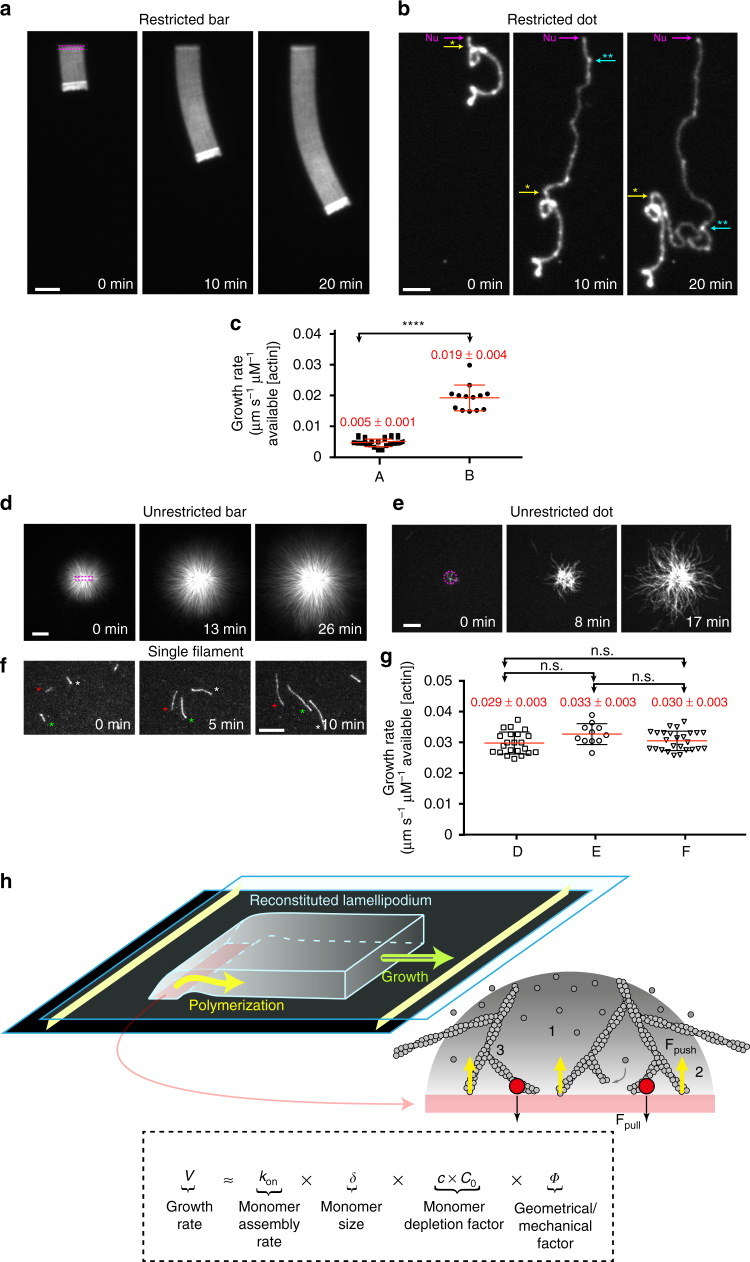
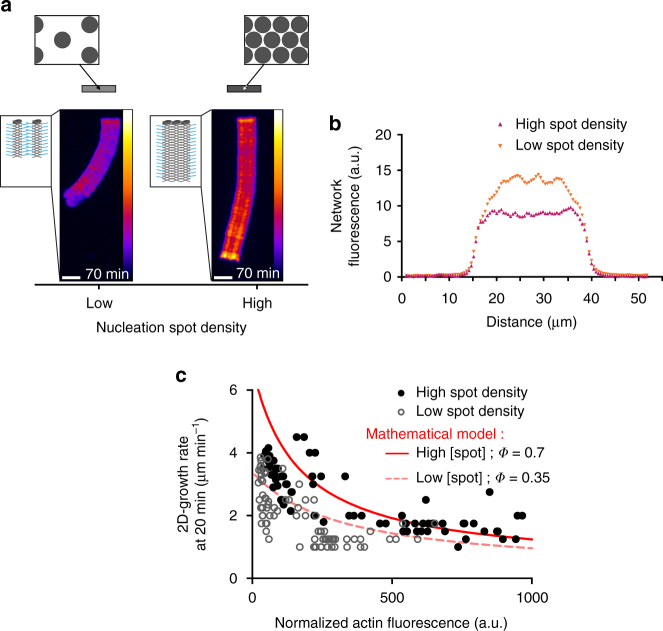
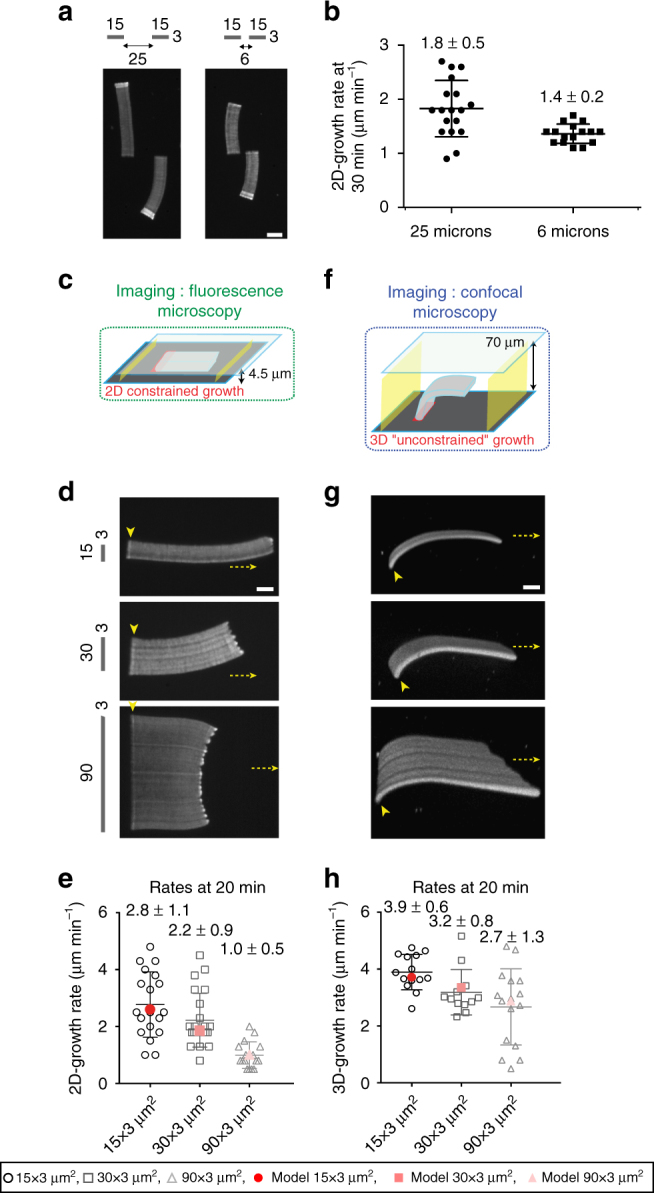
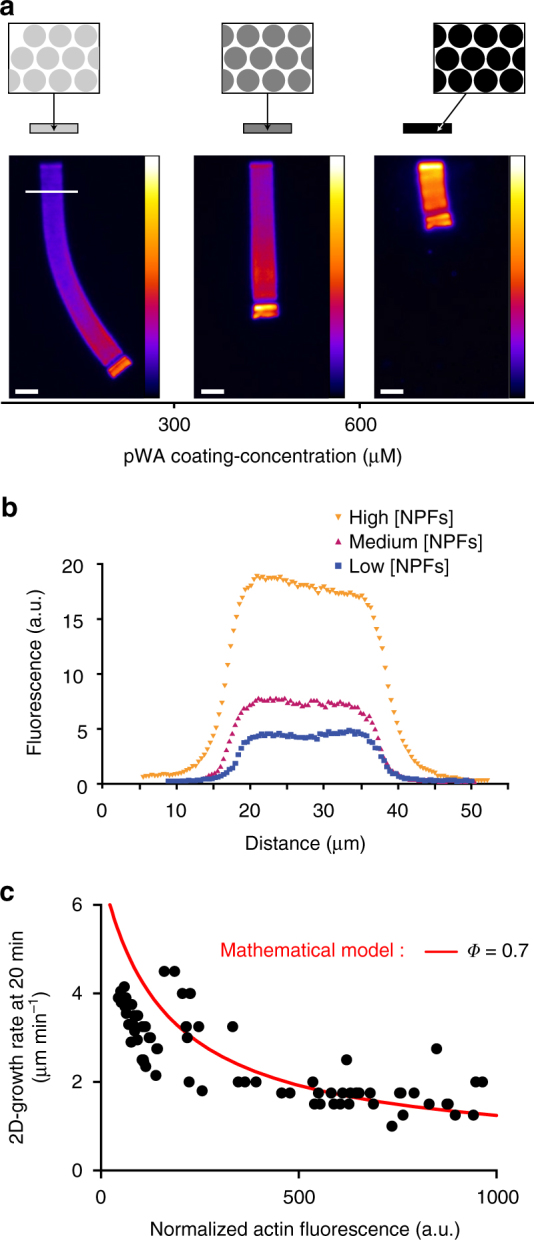
The growth of branched actin networks powers cell-edge protrusions and motility. A heterogeneous density of actin, which yields to a tunable cellular response, characterizes these dynamic structures. We study how actin organization controls both the rate and the steering during lamellipodium growth. We use a high-resolution surface structuration assay combined with mathematical modeling to describe the growth of a reconstituted lamellipodium. We demonstrate that local monomer depletion at the site of assembly negatively impacts the network growth rate. At the same time, network architecture tunes the protrusion efficiency, and regulates the rate of growth. One consequence of this interdependence between monomer depletion and network architecture effects is the ability of heterogeneous network to impose steering during motility. Therefore, we have established that the general principle, by which the cell can modulate the rate and the direction of a protrusion, is by varying both density and architecture of its actin network.Protrusive cellular structures contain a heterogeneous density of actin, but whether this influences motility is not known. Using an in vitro system and modelling, here the authors show that local actin monomer depletion and network architecture can tune the rate of network growth to impose steering during motility.
分支肌动蛋白网络的生长驱动着细胞边缘的突出和运动。肌动蛋白密度的异质性产生了可调节的细胞反应,这是这些动态结构的特征。我们研究了肌动蛋白组织如何在片足生长过程中控制速率和方向。我们使用高分辨率表面结构化分析结合数学建模来描述重组片足的生长。我们证明,组装位点处的局部单体消耗对网络生长速率有负面影响。同时,网络结构调节突出效率,并调节生长速率。单体消耗和网络结构效应之间这种相互依赖的一个结果是异质网络在运动过程中施加方向控制的能力。因此,我们确定了细胞调节突出速率和方向的一般原则,即通过改变其肌动蛋白网络的密度和结构。突出的细胞结构含有异质密度的肌动蛋白,但这是否影响运动尚不清楚。通过体外系统和建模,作者在此表明局部肌动蛋白单体消耗和网络结构可以调节网络生长速率,从而在运动过程中施加方向控制。