Patel Ami, DiGiandomenico Antonio, Keller Ashley E, Smith Trevor R F, Park Daniel H, Ramos Stephanie, Schultheis Katherine, Elliott Sarah T C, Mendoza Janess, Broderick Kate E, Wise Megan C, Yan Jian, Jiang Jingjing, Flingai Seleeke, Khan Amir S, Muthumani Kar, Humeau Laurent, Cheng Lily I, Wachter-Rosati Leslie, Stover C Kendall, Sardesai Niranjan Y, Weiner David B
The Wistar Institute of Anatomy & Biology, Philadelphia, PA, 19104, USA.
MedImmune, Gaithersburg, MD, 20878, USA.
Nat Commun. 2017 Sep 21;8(1):637. doi: 10.1038/s41467-017-00576-7.
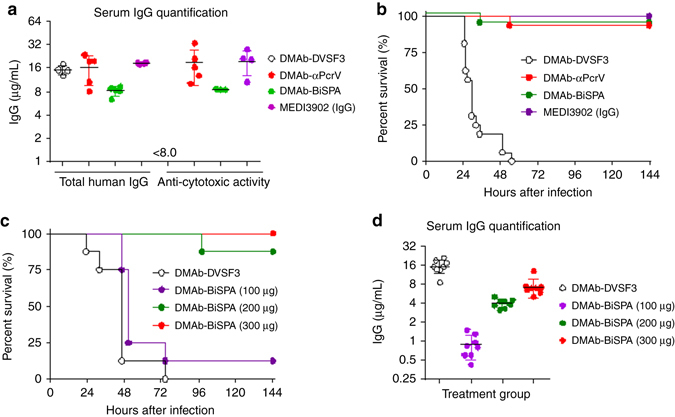
The impact of broad-spectrum antibiotics on antimicrobial resistance and disruption of the beneficial microbiome compels the urgent investigation of bacteria-specific approaches such as antibody-based strategies. Among these, DNA-delivered monoclonal antibodies (DMAbs), produced by muscle cells in vivo, potentially allow the prevention or treatment of bacterial infections circumventing some of the hurdles of protein IgG delivery. Here, we optimize DNA-delivered monoclonal antibodies consisting of two potent human IgG clones, including a non-natural bispecific IgG1 candidate, targeting Pseudomonas aeruginosa. The DNA-delivered monoclonal antibodies exhibit indistinguishable potency compared to bioprocessed IgG and protect against lethal pneumonia in mice. The DNA-delivered monoclonal antibodies decrease bacterial colonization of organs and exhibit enhanced adjunctive activity in combination with antibiotics. These studies support DNA-delivered monoclonal antibodies delivery as a potential strategy to augment the host immune response to prevent serious bacterial infections, and represent a significant advancement toward broader practical delivery of monoclonal antibody immunotherapeutics for additional infectious pathogens.DNA-delivered monoclonal antibodies (DMAbs) can be produced by muscle cells in vivo, potentially allowing prevention or treatment of infectious diseases. Here, the authors show that two DMAbs targeting Pseudomonas aeruginosa proteins confer protection against lethal pneumonia in mice.
广谱抗生素对抗菌药物耐药性的影响以及对有益微生物群的破坏,促使人们迫切研究针对特定细菌的方法,如基于抗体的策略。其中,由肌肉细胞在体内产生的DNA递送单克隆抗体(DMAbs),有可能预防或治疗细菌感染,规避蛋白质IgG递送的一些障碍。在此,我们优化了由两个强效人IgG克隆组成的DNA递送单克隆抗体,包括一个针对铜绿假单胞菌的非天然双特异性IgG1候选抗体。与生物加工的IgG相比,DNA递送单克隆抗体表现出难以区分的效力,并能保护小鼠免受致命性肺炎的侵害。DNA递送单克隆抗体减少了器官中的细菌定植,并与抗生素联合使用时表现出增强的辅助活性。这些研究支持将DNA递送单克隆抗体作为一种潜在策略,以增强宿主免疫反应来预防严重细菌感染,并且代表了在更广泛地实际递送针对其他传染性病原体的单克隆抗体免疫疗法方面的重大进展。DNA递送单克隆抗体(DMAbs)可由肌肉细胞在体内产生,有可能预防或治疗传染病。在此,作者表明,两种靶向铜绿假单胞菌蛋白的DMAbs能保护小鼠免受致命性肺炎的侵害。