Chandrasekharan Syam C, Menon Vikas, Wadwekar Vaibhav, Nair Pradeep Pankajakshan
MBBS Student, Jawaharlal Institute of Postgraduate Medical Education and Research, Puducherry, India.
Department of Psychiatry, Jawaharlal Institute of Postgraduate Medical Education and Research, Puducherry, India.
J Neurosci Rural Pract. 2017 Aug;8(Suppl 1):S13-S19. doi: 10.4103/jnrp.jnrp_21_17.
Assessment of comorbid burden of depression and associated factors among adult people living with epilepsy (PWE) has the potential to inform clinical evaluation and management to improve outcomes.
The aim of this study is to determine frequency of depressive symptoms and factors associated with it among PWE attending a tertiary care hospital.
This was a cross-sectional observational study conducted in the outpatient clinic of a tertiary care center.
One hundred and fifty patients with epilepsy were recruited between May 2016 and August 2016. For assessing depression, Tamil validated version of Patient Health Questionnaire-12 was used. Frequency of depression and its association with various sociodemographic and clinical factors were assessed.
Student -test and Chi-square test for univariate analysis and logistic regression for multivariate analysis were used for statistical analysis.
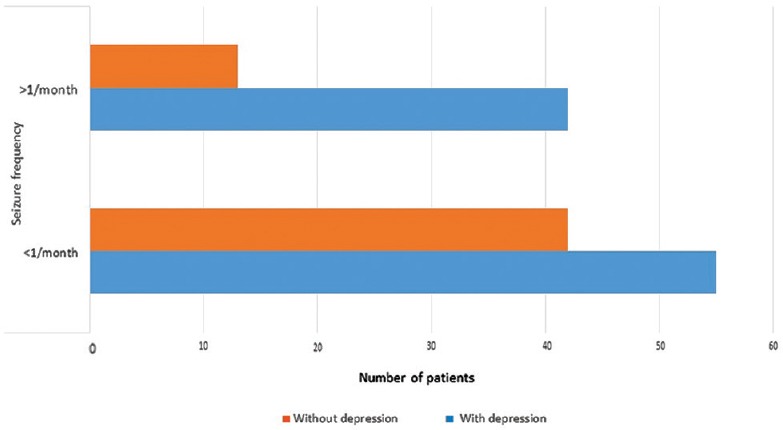
Of the 150 subjects, 89 (59.3%) were males. Generalized tonic-clonic seizures were present in 131 people (87.3%). Genetic and unknown epilepsies contributed higher proportion (44.7%) as compared to structural epilepsies (37.3%). Majority (88%) were on one or two antiepileptic drugs. Thirty-one people (20.3%) had less than one seizure per year. Depressive symptoms were present in 95 patients (63.3%). In multivariate regression analysis, secondary generalized seizures and seizure frequency >1/month emerged as significant predictors of depression ([OR]: 5.48 [95% (CI): 1.35-22.28] and OR: 2.53 [95% CI: 1.11-5.75], respectively).
Depression is prevalent in a majority of adult PWE. Hence, a routine screening for depression as part of comprehensive epilepsy care is advisable for PWE attending the outpatient clinic.
评估成年癫痫患者(PWE)中抑郁症的共病负担及其相关因素,可能为临床评估和管理提供信息,以改善治疗结果。
本研究的目的是确定在一家三级医院就诊的PWE中抑郁症状的发生率及其相关因素。
这是一项在三级医疗中心门诊进行的横断面观察性研究。
2016年5月至2016年8月招募了150例癫痫患者。为评估抑郁症,使用了泰米尔语验证版的患者健康问卷-12。评估抑郁症的发生率及其与各种社会人口统计学和临床因素的关联。
单因素分析采用学生t检验和卡方检验,多因素分析采用逻辑回归进行统计分析。
150名研究对象中,89名(59.3%)为男性。131人(87.3%)出现全身强直阵挛发作。与结构性癫痫(37.3%)相比,遗传性和不明原因的癫痫占比更高(44.7%)。大多数(88%)患者使用一种或两种抗癫痫药物。31人(20.3%)每年发作少于一次。95例患者(63.3%)存在抑郁症状。在多因素回归分析中,继发性全身发作和发作频率>1次/月是抑郁症的重要预测因素([比值比]:5.48 [95%(可信区间):1.35 - 22.28]和比值比:2.53 [95%可信区间:1.11 - 5.75])。
大多数成年PWE中抑郁症很常见。因此,对于在门诊就诊的PWE,建议将抑郁症的常规筛查作为综合癫痫治疗的一部分。