De Silva Tamishka, Prakash Anjali, Yarlagadda Sandhya, Johns Marjia Daniella, Sandy Kate, Hansen Vibeke, Phelan Sue, Pit Sabrina
Westmead Hospital, Westmead, Australia.
Concord Hospital, Sydney, Australia.
Int J Ment Health Syst. 2017 Sep 18;11:54. doi: 10.1186/s13033-017-0159-x. eCollection 2017.
Rural communities in Australia face significant disadvantages relating to geographical isolation and limited access to mental health services. Documenting general practitioners' (GP) experiences and perception of mental health services in rural Australia may be useful to gain insight into rural GP management of mild to moderate depression.
To explore GPs' experience and views on which factors influence access to mental health services for mild to moderate depression.
This qualitative study was conducted in 2014 in the Northern Rivers, NSW, Australia. Data were obtained from semi-structured in-depth face-to-face interviews with ten GPs, and analyses were performed using a general inductive method of thematic analysis.
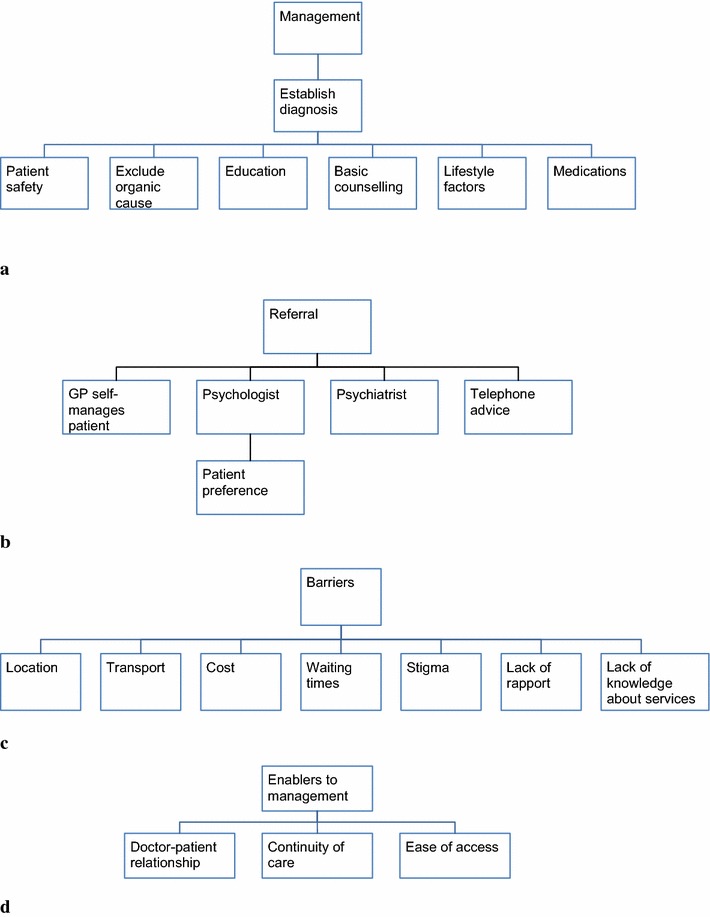
Most GPs believed that the current services for managing mild-moderate depression were adequate, however they also identified the need for better access and more services that were free for patients. GPs had a positive perception of management of depression in a rural setting, identifying advantages including better doctor-patient relationships, continuity of care and the proximity of services. However, GPs also identified several barriers to access to mental health services in a rural setting, including long waiting-times, inadequate patient rapport with referred professionals, cost of treatment, transportation, geographical location, stigma, and lack of education about available mental health services. As a result, GPs frequently self-managed patients in addition to referring them to other community mental health service providers where possible.
Overall, GPs appeared relatively satisfied with the resources available in their communities but also identified numerous barriers to access and room for improvement. Rural GPs often self-managed patients in addition to referring patients to other mental health services providers. This should be taken into account when designing mental health policies, developing new services or re-designing current services in rural communities.
澳大利亚农村社区面临着与地理隔离以及心理健康服务可及性有限相关的重大不利因素。记录澳大利亚农村地区全科医生(GP)对心理健康服务的经历和看法,可能有助于深入了解农村全科医生对轻度至中度抑郁症的管理情况。
探讨全科医生对于影响轻度至中度抑郁症患者获得心理健康服务的因素的经历和看法。
这项定性研究于2014年在澳大利亚新南威尔士州的北里弗斯地区开展。数据通过与十位全科医生进行半结构化深度面对面访谈获得,并采用一般归纳性主题分析法进行分析。
大多数全科医生认为,目前用于管理轻度至中度抑郁症的服务是足够的,但他们也指出需要更好的可及性以及更多对患者免费的服务。全科医生对农村地区抑郁症的管理持积极看法,认为其优势包括更好的医患关系、连续护理以及服务的便利性。然而,全科医生也指出了农村地区获得心理健康服务的若干障碍,包括等待时间长、患者与转诊专业人员之间缺乏融洽关系、治疗费用、交通、地理位置、污名以及对现有心理健康服务缺乏了解。因此,全科医生除了尽可能将患者转诊给其他社区心理健康服务提供者外,还经常自行管理患者。
总体而言,全科医生似乎对其所在社区可用的资源相对满意,但也指出了诸多可及性障碍和改进空间。农村全科医生除了将患者转诊给其他心理健康服务提供者外,还经常自行管理患者。在为农村社区设计心理健康政策、开发新服务或重新设计现有服务时,应考虑到这一点。