Bentzen Rebecca, Castellini J Margaret, Gaxiola-Robles Ramón, Zenteno-Savín Tania, Méndez-Rodríguez Lía Celina, O'Hara Todd
Department of Veterinary Medicine, College of Natural Science and Mathematics, University of Alaska Fairbanks, 900 Yukon Dr., Rm 348, P.O. Box 755940, Fairbanks, AK 99775-5940, USA.
School of Fisheries and Ocean Sciences, University of Alaska Fairbanks, 905 N. Koyukuk Dr., 245 O'Neill Building, P.O. Box 757220, Fairbanks, AK 99775-7220, USA.
Toxicol Rep. 2014;1:1115-1122. doi: 10.1016/j.toxrep.2014.09.014. Epub 2014 Oct 13.
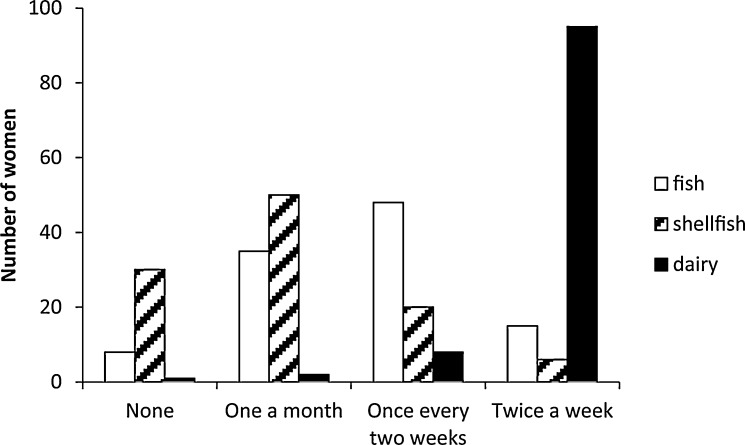
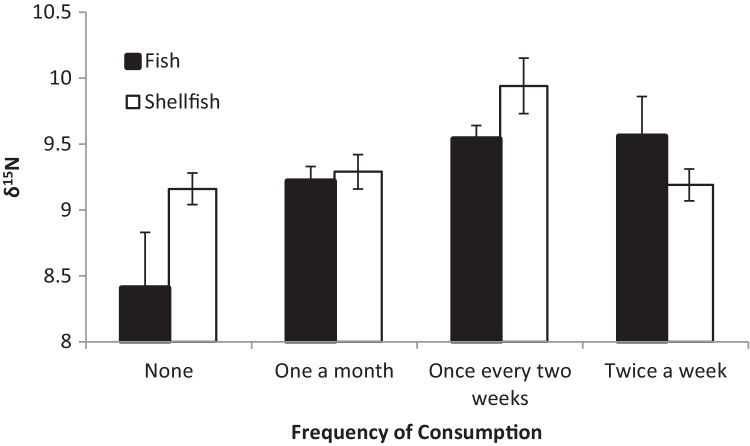
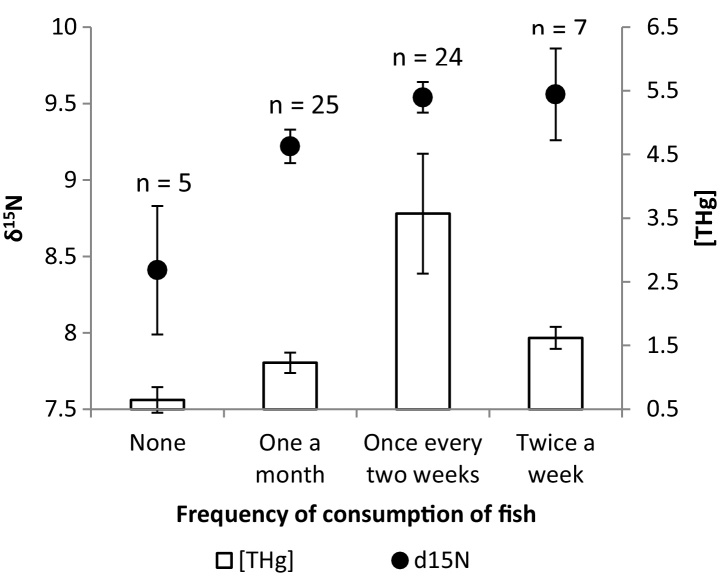
Seafood is a valuable source of nutrients important for fetal development. However, seafood consumption is the main route of exposure to monomethyl mercury (MeHg) for humans. MeHg is highly bioavailable and potentially adversely affects fetal neurodevelopment. MeHg exposure from fish consumption varies significantly by age and trophic level of fish consumed as well as the frequency and amount of fish consumed. This study investigates total Hg concentrations ([THg]) in hair segments of pregnant Mexican women in relation to (1) self-reported frequency of fish and shellfish consumption, (2) maternal trophic level and marine diet contributions, determined using hair carbon (C) and nitrogen (N) stable isotopes, and (3) relates [THg] to various hair advisory thresholds. We also examined whether variation in C and N isotope values is explained by self-reported frequency of fish and shellfish consumption. A significant proportion of hair samples had [THg] higher than suggested agency thresholds and, for women within the range of the various advisory thresholds (1-20 µg g), the specific statistic used and threshold applied are important considerations for assessing and communicating risk. Individuals enriched in N (δN values) had higher [THg] as did individuals that reported consuming fish and shellfish more frequently, suggesting that variation in [THg] can be explained by both consumer reported diet and diet as determined by C and N stable isotope assessment. However, at higher reported fish consumption levels the trophic level is maintained while [THg] is paradoxically lower. This suggests that THg exposure and assimilation are more complicated in higher fish frequency consumption categories. [THg] is more variable at the higher concentrations, possibly indicating some exposure to non-dietary Hg, heritable variations affecting Hg toxicodynamics, and BMI and tobacco exposure factors as outlined in our companion paper.
海鲜是对胎儿发育至关重要的营养物质的宝贵来源。然而,食用海鲜是人类接触甲基汞(MeHg)的主要途径。甲基汞具有很高的生物可利用性,并可能对胎儿神经发育产生不利影响。因食用鱼类而接触到的甲基汞量会因所食用鱼类的年龄、营养级以及食用鱼类的频率和数量而有显著差异。本研究调查了墨西哥孕妇头发段中的总汞浓度([THg])与以下因素的关系:(1)自我报告的鱼类和贝类消费频率;(2)母亲的营养级和海洋饮食贡献,通过头发碳(C)和氮(N)稳定同位素确定;(3)将[THg]与各种头发建议阈值相关联。我们还研究了鱼类和贝类消费的自我报告频率是否能解释碳和氮同位素值的变化。很大一部分头发样本的[THg]高于建议机构阈值,对于处于各种建议阈值范围内(1 - 20微克/克)的女性,所使用的确切统计数据和应用的阈值是评估和传达风险时的重要考虑因素。氮含量富集(δN值)的个体以及报告更频繁食用鱼类和贝类的个体的[THg]更高,这表明[THg]的变化可以由消费者报告的饮食以及通过碳和氮稳定同位素评估确定的饮食来解释。然而,在报告的鱼类消费水平较高时,营养级保持不变,而[THg]却反常地较低。这表明在较高鱼类消费频率类别中,总汞暴露和同化更为复杂。在较高浓度下,[THg]的变异性更大,这可能表明存在一些非饮食性汞暴露、影响汞毒理学动态的遗传变异以及我们的配套论文中概述的体重指数和烟草暴露因素。