Karimkhani Chante, Colombara Danny V, Drucker Aaron M, Norton Scott A, Hay Roderick, Engelman Daniel, Steer Andrew, Whitfeld Margot, Naghavi Mohsen, Dellavalle Robert P
Department of Dermatology, University of Colorado Anschutz Medical Campus, Aurora, CO, USA.
Institute for Health Metrics and Evaluation, University of Washington, Seattle, WA, USA.
Lancet Infect Dis. 2017 Dec;17(12):1247-1254. doi: 10.1016/S1473-3099(17)30483-8. Epub 2017 Sep 21.
Numerous population-based studies have documented high prevalence of scabies in overcrowded settings, particularly among children and in tropical regions. We provide an estimate of the global burden of scabies using data from the Global Burden of Disease (GBD) Study 2015.
We identified scabies epidemiological data sources from an extensive literature search and hospital insurance data and analysed data sources with a Bayesian meta-regression modelling tool, DisMod-MR 2·1, to yield prevalence estimates. We combined prevalence estimates with a disability weight, measuring disfigurement, itch, and pain caused by scabies, to produce years lived with disability (YLDs). With an assumed zero mortality from scabies, YLDs were equivalent to disability-adjusted life-years (DALYs). We estimated DALYs for 195 countries divided into 21 world regions, in both sexes and 20 age groups, between 1990 and 2015.
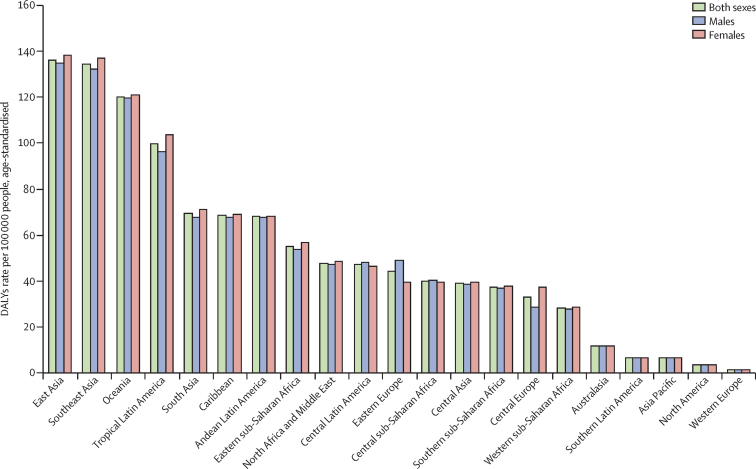
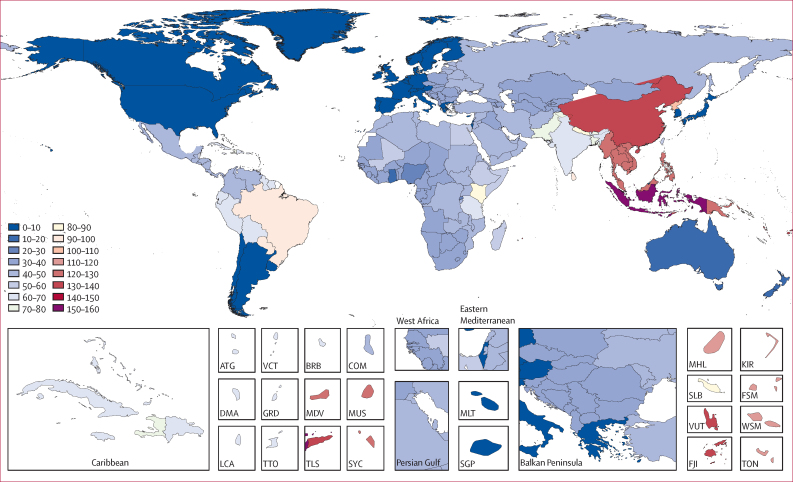
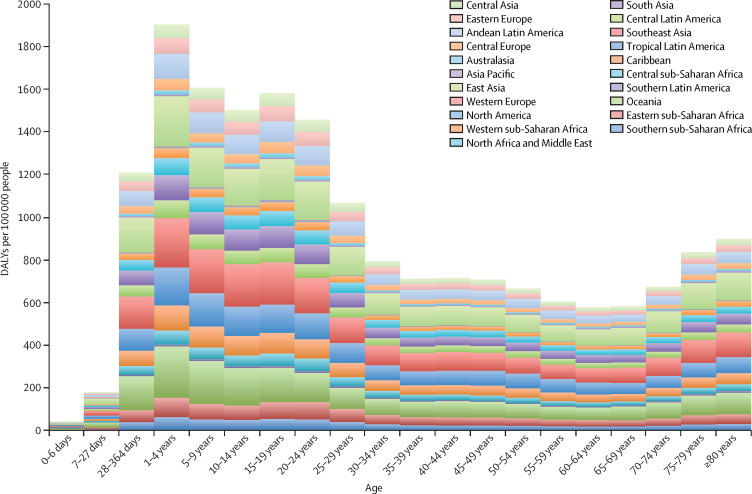
Scabies was responsible for 0·21% of DALYs from all conditions studied by GBD 2015 worldwide. The world regions of east Asia (age-standardised DALYs 136·32), southeast Asia (134·57), Oceania (120·34), tropical Latin America (99·94), and south Asia (69·41) had the greatest burden of DALYs from scabies. Mean percent change of DALY rate from 1990 to 2015 was less than 8% in all world regions, except North America, which had a 23·9% increase. The five individual countries with greatest scabies burden were Indonesia (age-standardised DALYs 153·86), China (138·25), Timor-Leste (136·67), Vanuatu (131·59), and Fiji (130·91). The largest standard deviations of age-standardised DALYs between the 20 age groups were observed in southeast Asia (60·1), Oceania (58·3), and east Asia (56·5), with the greatest DALY burdens in children, adolescents, and the elderly.
The burden of scabies is greater in tropical regions, especially in children, adolescents, and elderly people. As a worldwide epidemiological assessment, GBD 2015 provides broad and frequently updated measures of scabies burden in terms of skin effects. These global data might help guide research protocols and prioritisation efforts and focus scabies treatment and control measures.
Bill & Melinda Gates Foundation.
众多基于人群的研究记录了疥疮在拥挤环境中的高流行率,尤其是在儿童中以及热带地区。我们利用2015年全球疾病负担(GBD)研究的数据对全球疥疮负担进行了评估。
我们通过广泛的文献检索和医院保险数据确定疥疮流行病学数据源,并使用贝叶斯meta回归建模工具DisMod-MR 2·1分析数据源,以得出患病率估计值。我们将患病率估计值与一个残疾权重相结合,该权重衡量疥疮导致的毁容、瘙痒和疼痛,从而得出残疾生存年数(YLDs)。假设疥疮死亡率为零,YLDs等同于伤残调整生命年(DALYs)。我们估计了1990年至2015年期间195个国家(分为21个世界区域)、男女以及20个年龄组的DALYs。
疥疮占2015年全球疾病负担研究所有研究疾病DALYs的0·21%。东亚(年龄标准化DALYs为136·32)、东南亚(134·57)、大洋洲(120·34)、热带拉丁美洲(99·94)和南亚(69·41)等世界区域疥疮导致的DALYs负担最重。除北美洲DALY率从1990年到2015年增长了23·9%外,所有世界区域的DALY率平均变化百分比均小于8%。疥疮负担最重的五个国家分别是印度尼西亚(年龄标准化DALYs为153·86)、中国(138·25)、东帝汶(136·67)、瓦努阿图(131·59)和斐济(130·91)。在东南亚(60·1)、大洋洲(58·3)和东亚(56·5)观察到20个年龄组之间年龄标准化DALYs的最大标准差,儿童、青少年和老年人的DALY负担最重。
热带地区疥疮负担更大,尤其是在儿童、青少年和老年人中。作为一项全球流行病学评估,2015年全球疾病负担研究在皮肤影响方面提供了广泛且经常更新的疥疮负担衡量指标。这些全球数据可能有助于指导研究方案制定和优先排序工作,并聚焦疥疮治疗和控制措施。
比尔及梅琳达·盖茨基金会。