Lancet Neurol. 2019 May;18(5):459-480. doi: 10.1016/S1474-4422(18)30499-X. Epub 2019 Mar 14.
Neurological disorders are increasingly recognised as major causes of death and disability worldwide. The aim of this analysis from the Global Burden of Diseases, Injuries, and Risk Factors Study (GBD) 2016 is to provide the most comprehensive and up-to-date estimates of the global, regional, and national burden from neurological disorders.
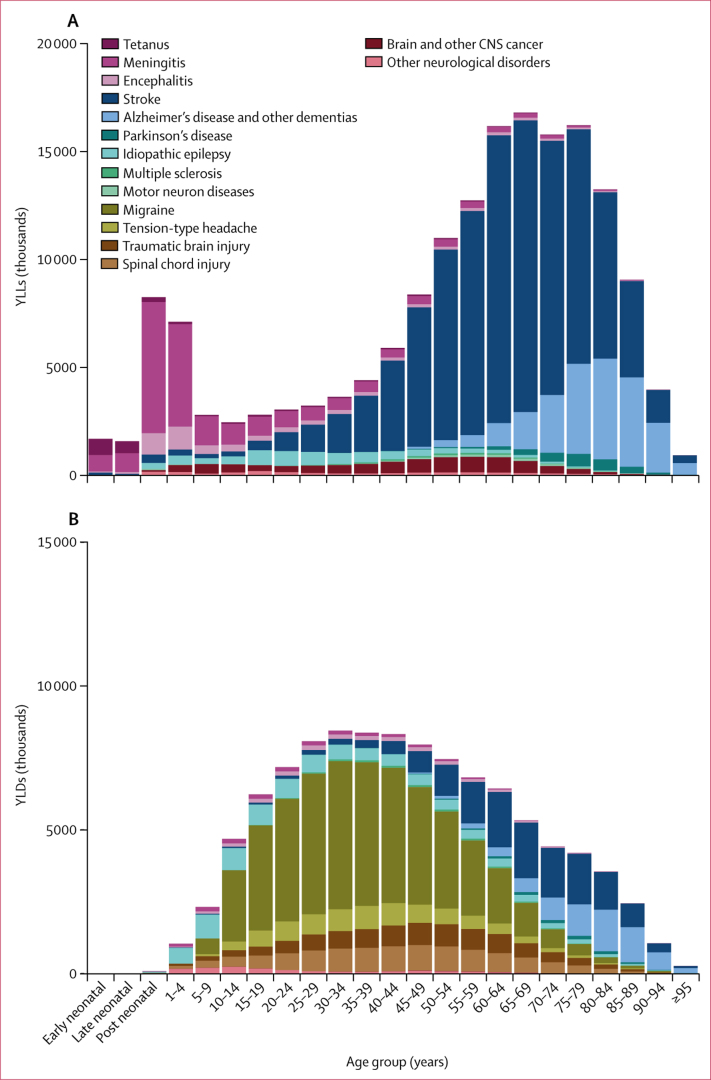
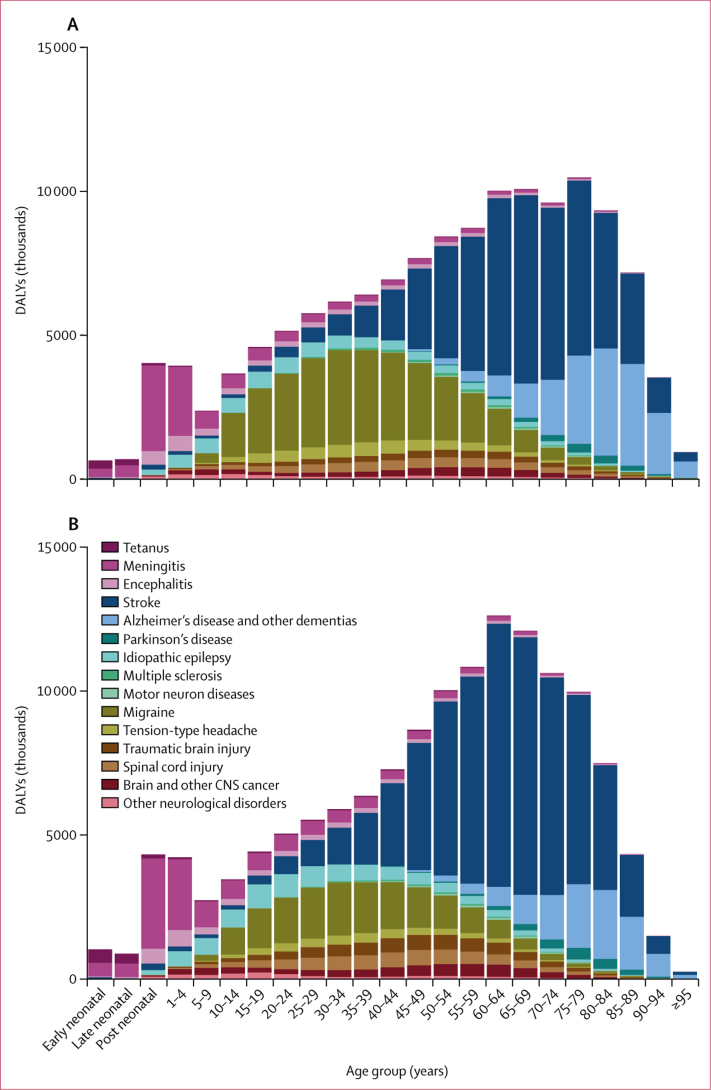
We estimated prevalence, incidence, deaths, and disability-adjusted life-years (DALYs; the sum of years of life lost [YLLs] and years lived with disability [YLDs]) by age and sex for 15 neurological disorder categories (tetanus, meningitis, encephalitis, stroke, brain and other CNS cancers, traumatic brain injury, spinal cord injury, Alzheimer's disease and other dementias, Parkinson's disease, multiple sclerosis, motor neuron diseases, idiopathic epilepsy, migraine, tension-type headache, and a residual category for other less common neurological disorders) in 195 countries from 1990 to 2016. DisMod-MR 2.1, a Bayesian meta-regression tool, was the main method of estimation of prevalence and incidence, and the Cause of Death Ensemble model (CODEm) was used for mortality estimation. We quantified the contribution of 84 risks and combinations of risk to the disease estimates for the 15 neurological disorder categories using the GBD comparative risk assessment approach.
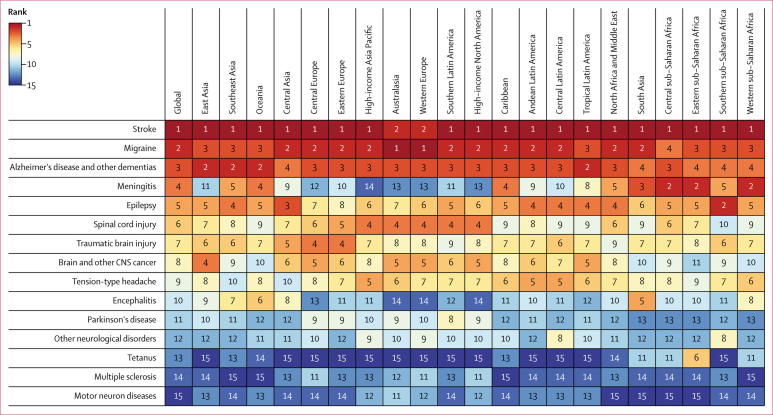
Globally, in 2016, neurological disorders were the leading cause of DALYs (276 million [95% UI 247-308]) and second leading cause of deaths (9·0 million [8·8-9·4]). The absolute number of deaths and DALYs from all neurological disorders combined increased (deaths by 39% [34-44] and DALYs by 15% [9-21]) whereas their age-standardised rates decreased (deaths by 28% [26-30] and DALYs by 27% [24-31]) between 1990 and 2016. The only neurological disorders that had a decrease in rates and absolute numbers of deaths and DALYs were tetanus, meningitis, and encephalitis. The four largest contributors of neurological DALYs were stroke (42·2% [38·6-46·1]), migraine (16·3% [11·7-20·8]), Alzheimer's and other dementias (10·4% [9·0-12·1]), and meningitis (7·9% [6·6-10·4]). For the combined neurological disorders, age-standardised DALY rates were significantly higher in males than in females (male-to-female ratio 1·12 [1·05-1·20]), but migraine, multiple sclerosis, and tension-type headache were more common and caused more burden in females, with male-to-female ratios of less than 0·7. The 84 risks quantified in GBD explain less than 10% of neurological disorder DALY burdens, except stroke, for which 88·8% (86·5-90·9) of DALYs are attributable to risk factors, and to a lesser extent Alzheimer's disease and other dementias (22·3% [11·8-35·1] of DALYs are risk attributable) and idiopathic epilepsy (14·1% [10·8-17·5] of DALYs are risk attributable).
Globally, the burden of neurological disorders, as measured by the absolute number of DALYs, continues to increase. As populations are growing and ageing, and the prevalence of major disabling neurological disorders steeply increases with age, governments will face increasing demand for treatment, rehabilitation, and support services for neurological disorders. The scarcity of established modifiable risks for most of the neurological burden demonstrates that new knowledge is required to develop effective prevention and treatment strategies.
Bill & Melinda Gates Foundation.
神经系统疾病日益成为全球范围内主要的死亡和致残原因。本分析来自全球疾病、伤害和危险因素研究(GBD)2016 年,旨在提供最全面和最新的全球、区域和国家神经系统疾病负担估计。
我们通过年龄和性别估计了 15 种神经系统疾病类别(破伤风、脑膜炎、脑炎、中风、脑和中枢神经系统癌症、创伤性脑损伤、脊髓损伤、阿尔茨海默病和其他痴呆、帕金森病、多发性硬化症、运动神经元疾病、特发性癫痫、偏头痛、紧张型头痛以及其他较不常见的神经系统疾病的残余类别)的患病率、发病率、死亡率和伤残调整生命年(DALYs;生命损失年[YLL]和残疾生活年[YLD]之和)。DisMod-MR 2.1 是患病率和发病率的主要估计方法,死因综合模型(CODEm)用于死亡率估计。我们使用 GBD 比较风险评估方法,对 15 种神经系统疾病类别疾病的 84 种风险和风险组合的贡献进行了量化。
在全球范围内,2016 年神经系统疾病是 DALYs(2.76 亿[95%UI 2.47-3.08])的主要原因,也是死亡的第二大原因(900 万[8.8-9.4])。所有神经系统疾病的死亡人数和 DALYs 绝对值都有所增加(死亡人数增加 39%[34-44],DALYs 增加 15%[9-21]),而其年龄标准化率却有所下降(死亡人数下降 28%[26-30],DALYs 下降 27%[24-31])。在 1990 年至 2016 年期间,死亡率和 DALYs 绝对数量下降的唯一神经系统疾病是破伤风、脑膜炎和脑炎。DALYs 中四个最大的贡献者是中风(42.2%[38.6-46.1])、偏头痛(16.3%[11.7-20.8])、阿尔茨海默病和其他痴呆(10.4%[9.0-12.1])和脑膜炎(7.9%[6.6-10.4])。对于合并的神经系统疾病,男性的年龄标准化 DALY 率明显高于女性(男女比 1.12[1.05-1.20]),但偏头痛、多发性硬化症和紧张型头痛更为常见,且女性的负担更大,男女比低于 0.7。GBD 中量化的 84 种风险,除中风外,对神经系统疾病的 DALY 负担的解释不到 10%,其中中风 88.8%(86.5-90.9)的 DALYs 归因于风险因素,而阿尔茨海默病和其他痴呆(22.3%[11.8-35.1]的 DALYs 归因于风险)和特发性癫痫(14.1%[10.8-17.5]的 DALYs 归因于风险)的情况则稍好一些。
在全球范围内,以 DALYs 绝对值衡量,神经系统疾病的负担仍在继续增加。随着人口的增长和老龄化,以及主要致残性神经系统疾病的患病率随年龄急剧上升,各国政府将面临对神经系统疾病治疗、康复和支持服务需求的增加。大多数神经系统疾病负担的既定可改变风险稀缺,这表明需要新的知识来制定有效的预防和治疗策略。
比尔和梅琳达·盖茨基金会。