Jirapinyo Pichamol, Abu Dayyeh Barham K, Thompson Christopher C
Division of Gastroenterology, Hepatology and Endoscopy, Brigham and Women's Hospital, Boston, Massachusetts, USA.
Harvard Medical School, Boston, Massachusetts, USA.
BMJ Open Gastroenterol. 2017 Sep 11;4(1):e000153. doi: 10.1136/bmjgast-2017-000153. eCollection 2017.
Despite initial successful weight loss, some patients may experience weight regain following Roux-en-Y gastric bypass (RYGB).
To assess the impact of weight regain on bariatric patients' quality of life (QoL).
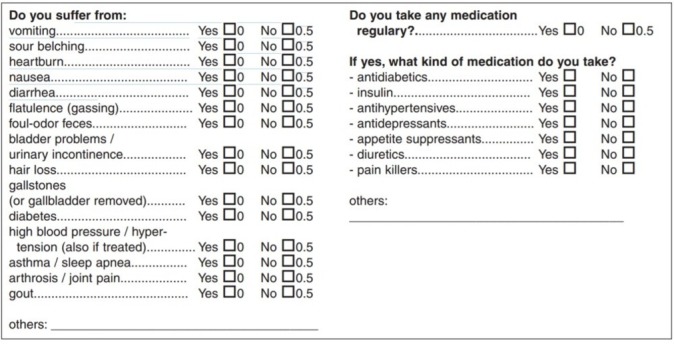
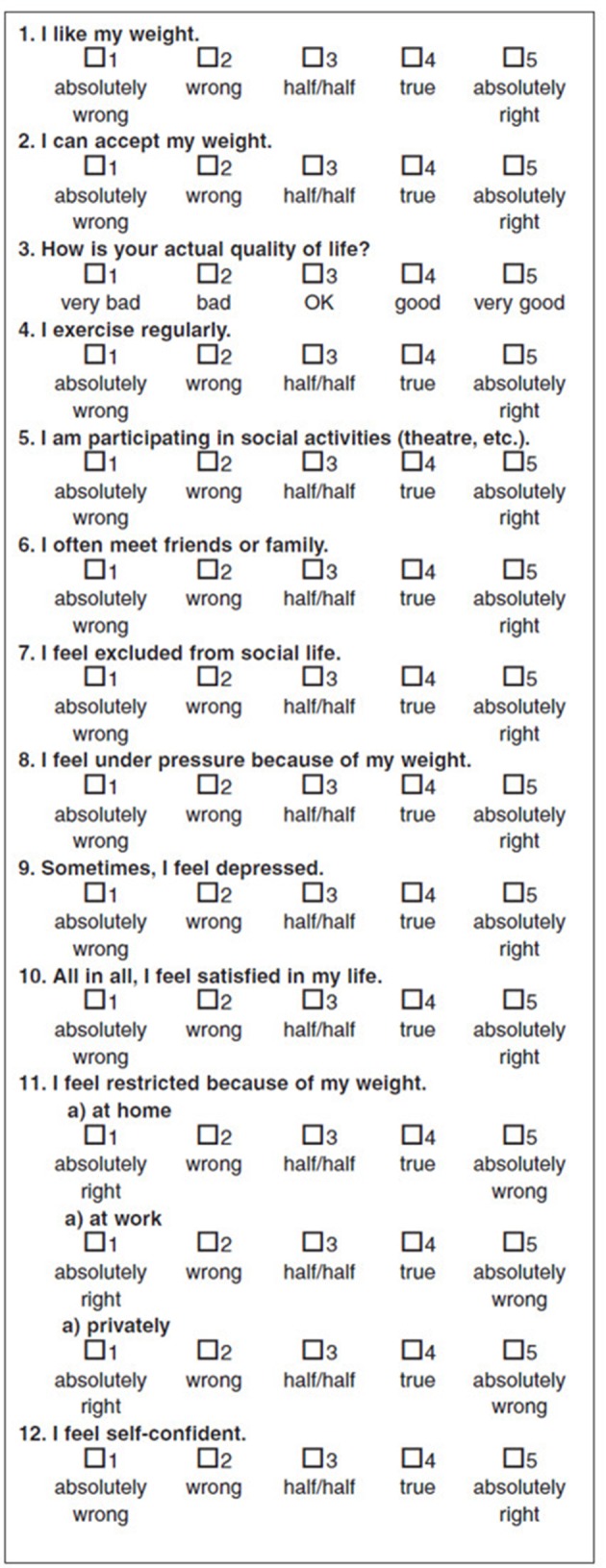
This was a prospective cross-sectional study. Fifty-six consecutive RYGB patients were recruited and divided into weight-regain and weight-stable cohorts. QoL was assessed using the Bariatric Quality of Life (BQL) questionnaire. The BQL Index scores of the weight-regain and weight-stable groups were compared using Student's -test. Additionally, the BQL Index score of the weight-regain group was compared with that of historical prebariatric patients. Predictors of BQL were assessed using univariate and multivariate linear regression analyses.
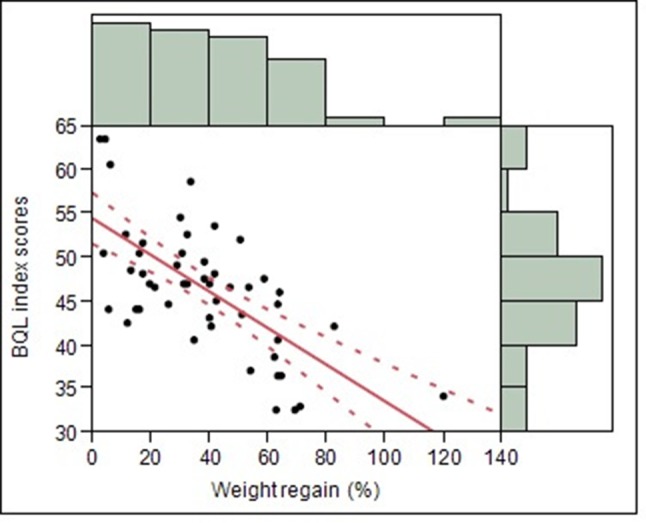
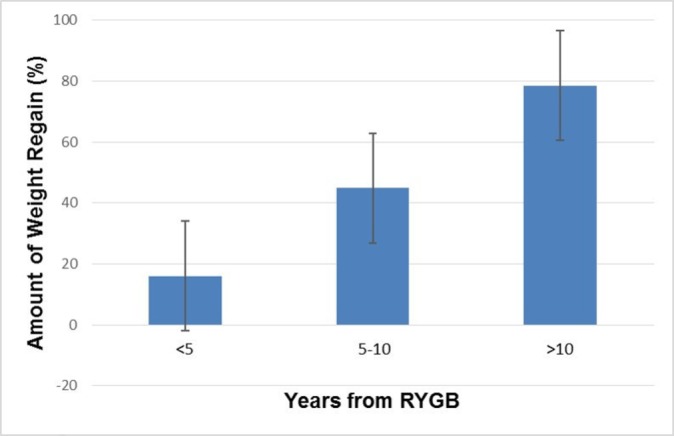
Of 56 RYGB patients, 41 (73%) had weight regain. On average, patients had body mass index (BMI) of 37 ±7.5 kg/m and gained 34 ±26% of maximal weight initially lost. Weight-regain patients had lower BQL Index scores than weight-stable patients (44.8±6 vs 53±7, p<0.001). Patients with weight regain had similar BQL Index scores as the prebariatric patients despite lower BMI (BMI of 39.7±6.8 vs 47.2±7.6, p<0.05; BQL Index of 44.8±6 vs 41.6±10.4, p=0.144, respectively). Years from RYGB, BMI and amount of weight regain were associated with BQL Index on a univariate analysis (β=-0.55,-0.52, -0.7; p<0.0001). Only weight regain was a significant predictor of BQL on a multivariate analysis (β =-0.56; p=0.001).
Weight regain had a negative impact on bariatric patients' QoL. Patients who regained at least 15% of maximal weight lost appeared to have as low QoL as those who had not undergone bariatric surgery despite a lower BMI.
尽管最初成功减重,但一些患者在接受Roux-en-Y胃旁路术(RYGB)后可能会出现体重反弹。
评估体重反弹对肥胖症患者生活质量(QoL)的影响。
这是一项前瞻性横断面研究。连续招募了56例RYGB患者,并将其分为体重反弹组和体重稳定组。使用肥胖症生活质量(BQL)问卷评估生活质量。使用学生t检验比较体重反弹组和体重稳定组的BQL指数得分。此外,将体重反弹组的BQL指数得分与肥胖症手术前的历史患者进行比较。使用单变量和多变量线性回归分析评估BQL的预测因素。
56例RYGB患者中,41例(73%)出现体重反弹。患者的平均体重指数(BMI)为37±7.5kg/m²,体重反弹量为最初减重最大值的34±26%。体重反弹患者的BQL指数得分低于体重稳定患者(44.8±6 vs 53±7,p<0.001)。尽管BMI较低,但体重反弹患者的BQL指数得分与肥胖症手术前患者相似(BMI分别为39.7±6.8 vs 47.2±7.6,p<0.05;BQL指数分别为44.8±6 vs 41.6±10.4,p=0.144)。单变量分析显示,RYGB术后的年限、BMI和体重反弹量与BQL指数相关(β=-0.55、-0.52、-0.7;p<0.0001)。多变量分析显示,只有体重反弹是BQL的显著预测因素(β=-0.56;p=0.001)。
体重反弹对肥胖症患者生活质量有负面影响。体重反弹至少达到最初减重最大值15%的患者,尽管BMI较低,但生活质量似乎与未接受肥胖症手术的患者一样低。