Kubin Markus, Kern Jan, Gul Sheraz, Kroll Thomas, Chatterjee Ruchira, Löchel Heike, Fuller Franklin D, Sierra Raymond G, Quevedo Wilson, Weniger Christian, Rehanek Jens, Firsov Anatoly, Laksmono Hartawan, Weninger Clemens, Alonso-Mori Roberto, Nordlund Dennis L, Lassalle-Kaiser Benedikt, Glownia James M, Krzywinski Jacek, Moeller Stefan, Turner Joshua J, Minitti Michael P, Dakovski Georgi L, Koroidov Sergey, Kawde Anurag, Kanady Jacob S, Tsui Emily Y, Suseno Sandy, Han Zhiji, Hill Ethan, Taguchi Taketo, Borovik Andrew S, Agapie Theodor, Messinger Johannes, Erko Alexei, Föhlisch Alexander, Bergmann Uwe, Mitzner Rolf, Yachandra Vittal K, Yano Junko, Wernet Philippe
Institute for Methods and Instrumentation for Synchrotron Radiation Research, Helmholtz-Zentrum Berlin für Materialien und Energie GmbH, 12489 Berlin, Germany.
Molecular Biophysics and Integrated Bioimaging Division, Lawrence Berkeley National Laboratory, Berkeley, California 94720, USA.
Struct Dyn. 2017 Sep 1;4(5):054307. doi: 10.1063/1.4986627. eCollection 2017 Sep.
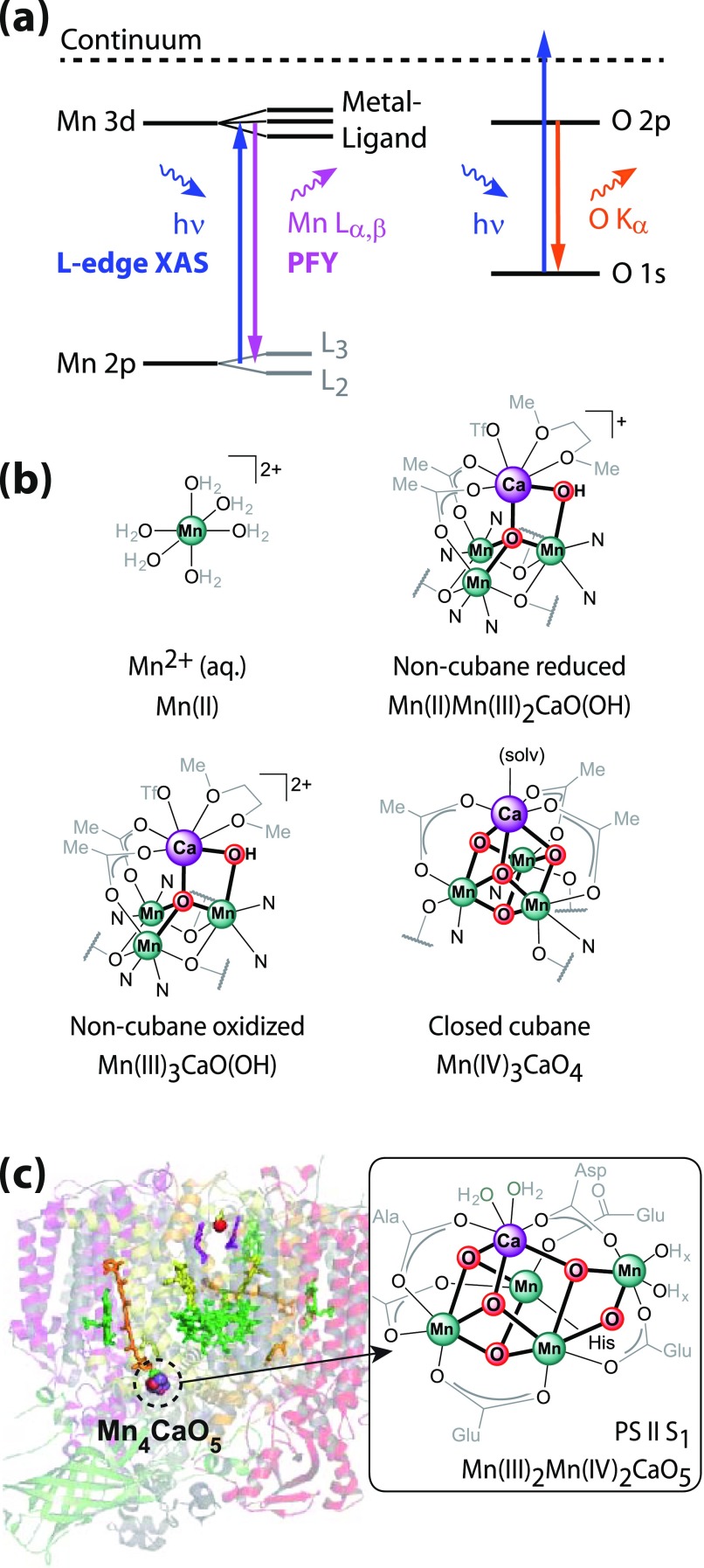
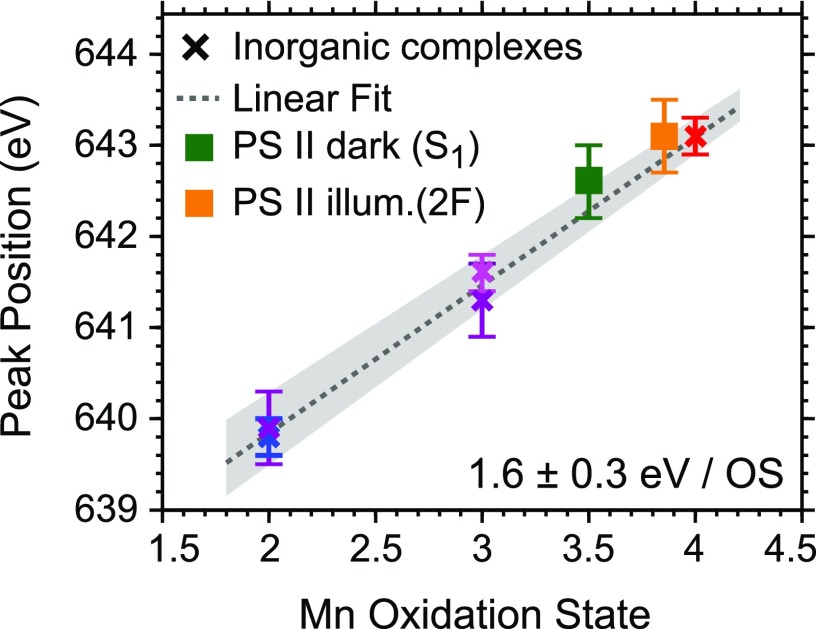
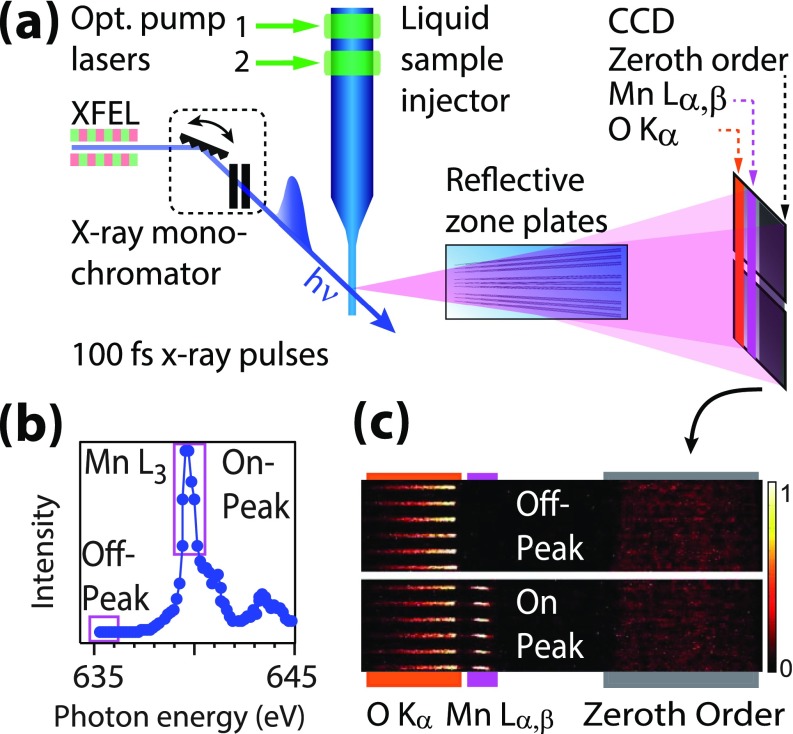
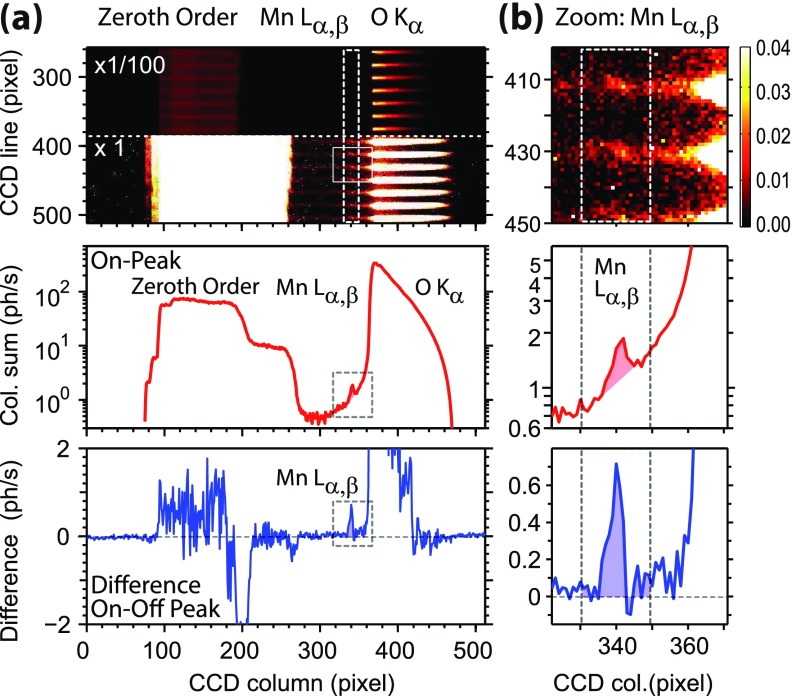
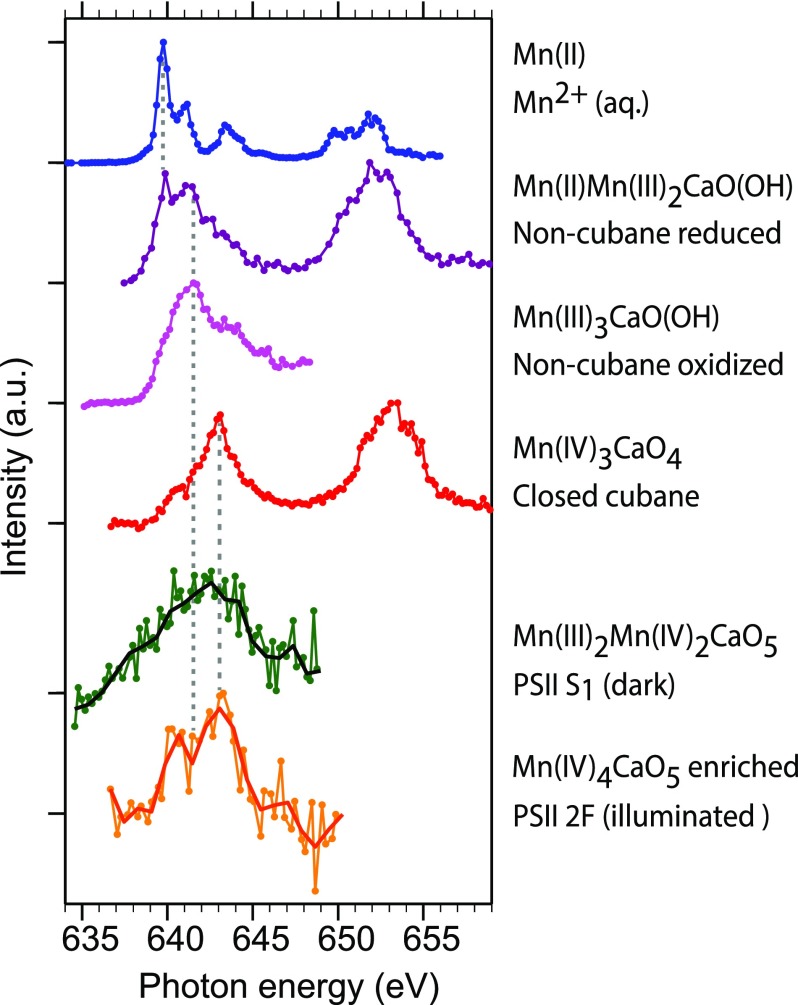
X-ray absorption spectroscopy at the L-edge of 3d transition metals provides unique information on the local metal charge and spin states by directly probing 3d-derived molecular orbitals through 2p-3d transitions. However, this soft x-ray technique has been rarely used at synchrotron facilities for mechanistic studies of metalloenzymes due to the difficulties of x-ray-induced sample damage and strong background signals from light elements that can dominate the low metal signal. Here, we combine femtosecond soft x-ray pulses from a free-electron laser with a novel x-ray fluorescence-yield spectrometer to overcome these difficulties. We present L-edge absorption spectra of inorganic high-valent Mn complexes (Mn ∼ 6-15 mmol/l) with no visible effects of radiation damage. We also present the first L-edge absorption spectra of the oxygen evolving complex (MnCaO) in Photosystem II (Mn < 1 mmol/l) at room temperature, measured under similar conditions. Our approach opens new ways to study metalloenzymes under functional conditions.
对3d过渡金属L边进行的X射线吸收光谱分析,通过2p - 3d跃迁直接探测源自3d的分子轨道,从而提供有关局部金属电荷和自旋态的独特信息。然而,由于X射线诱导的样品损伤以及来自轻元素的强背景信号(这些信号可能主导低金属信号)等困难,这种软X射线技术在同步加速器设施中很少用于金属酶的机理研究。在此,我们将来自自由电子激光的飞秒软X射线脉冲与一种新型X射线荧光产额光谱仪相结合,以克服这些困难。我们展示了无机高价锰配合物(锰浓度约为6 - 15 mmol/l)的L边吸收光谱,未观察到辐射损伤的明显影响。我们还展示了在室温下,在类似条件下测量的光系统II中析氧复合物(MnCaO)(锰浓度<1 mmol/l)的首个L边吸收光谱。我们的方法为在功能条件下研究金属酶开辟了新途径。