
对肯尼亚西部小学生调查中寄生虫种群的地理遗传学分析。
Geographic-genetic analysis of parasite populations from surveys of primary school children in Western Kenya.
作者信息
Omedo Irene, Mogeni Polycarp, Rockett Kirk, Kamau Alice, Hubbart Christina, Jeffreys Anna, Ochola-Oyier Lynette Isabella, de Villiers Etienne P, Gitonga Caroline W, Noor Abdisalan M, Snow Robert W, Kwiatkowski Dominic, Bejon Philip
机构信息
KEMRI-Wellcome Trust Research Programme, Centre for Geographic Medicine Research-Coast, Kilifi, Kenya.
Wellcome Trust Centre for Human Genetics, University of Oxford, Oxford, OX3 7BN, UK.
出版信息
Wellcome Open Res. 2017 Sep 5;2:29. doi: 10.12688/wellcomeopenres.11228.2. eCollection 2017.
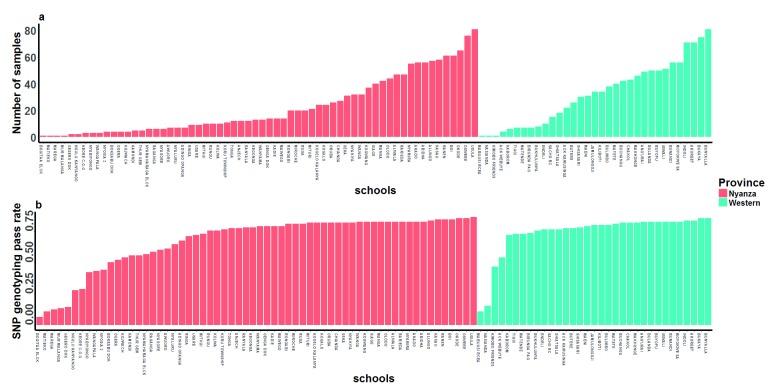
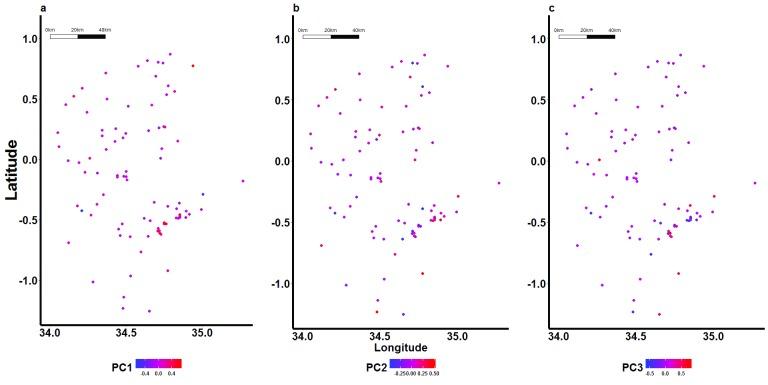
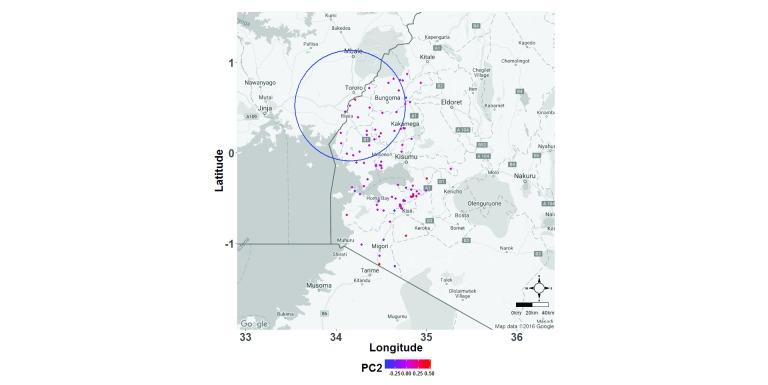
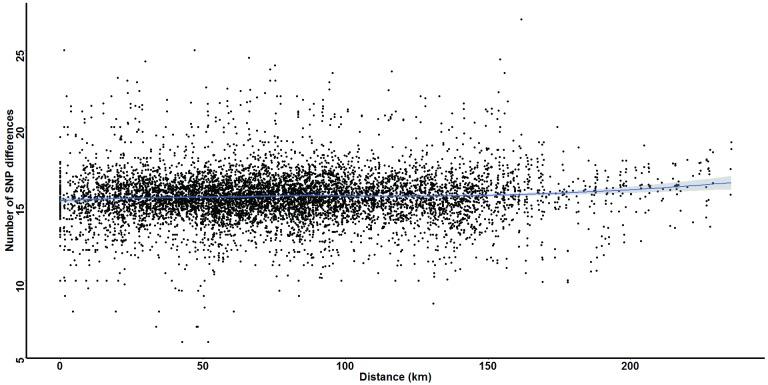
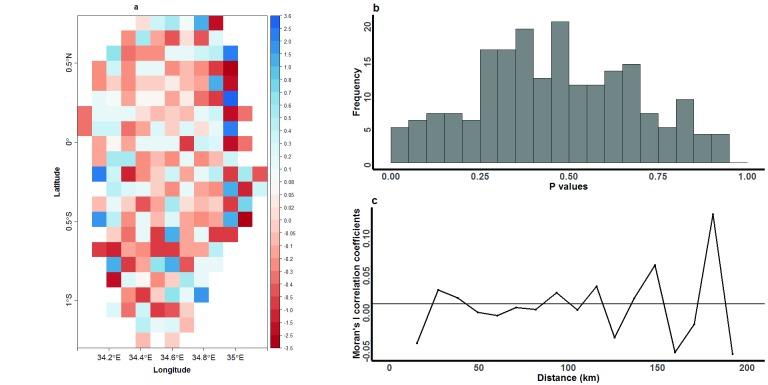
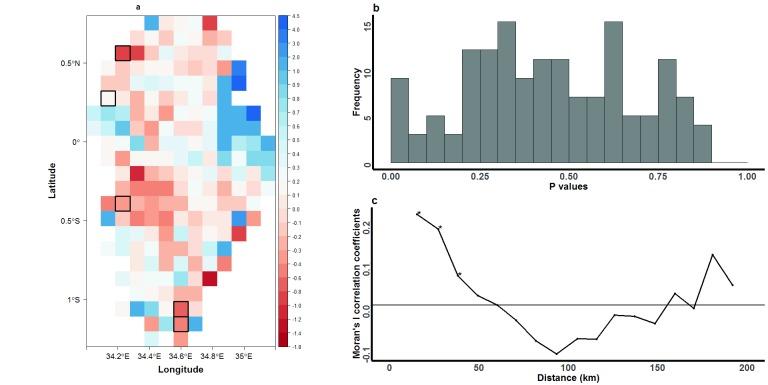
Malaria control, and finally malaria elimination, requires the identification and targeting of residual foci or hotspots of transmission. However, the level of parasite mixing within and between geographical locations is likely to impact the effectiveness and durability of control interventions and thus should be taken into consideration when developing control programs. In order to determine the geographic-genetic patterns of parasite populations at a sub-national level in Kenya, we used the Sequenom platform to genotype 111 genome-wide distributed single nucleotide polymorphic (SNP) positions in 2486 isolates collected from children in 95 primary schools in western Kenya. We analysed these parasite genotypes for genetic structure using principal component analysis and assessed local and global clustering using statistical measures of spatial autocorrelation. We further examined the region for spatial barriers to parasite movement as well as directionality in the patterns of parasite movement. We found no evidence of population structure and little evidence of spatial autocorrelation of parasite genotypes (correlation coefficients <0.03 among parasite pairs in distance classes of 1km, 2km and 5km; p value<0.01). An analysis of the geographical distribution of allele frequencies showed weak evidence of variation in distribution of alleles, with clusters representing a higher than expected number of samples with the major allele being identified for 5 SNPs. Furthermore, we found no evidence of the existence of spatial barriers to parasite movement within the region, but observed directional movement of parasites among schools in two separate sections of the region studied. Our findings illustrate a pattern of high parasite mixing within the study region. If this mixing is due to rapid gene flow, then "one-off" targeted interventions may not be currently effective at the sub-national scale in Western Kenya, due to the high parasite movement that is likely to lead to re-introduction of infection from surrounding regions. However repeated targeted interventions may reduce transmission in the surrounding regions.
疟疾控制乃至最终消除疟疾,需要识别并定位残留疫源地或传播热点。然而,地理位置内部及之间的寄生虫混合程度可能会影响控制干预措施的有效性和持久性,因此在制定控制计划时应予以考虑。为了确定肯尼亚国内某一地区寄生虫种群的地理遗传模式,我们使用Sequenom平台对从肯尼亚西部95所小学的儿童中收集的2486份分离株的111个全基因组分布的单核苷酸多态性(SNP)位点进行基因分型。我们使用主成分分析对这些寄生虫基因型的遗传结构进行分析,并使用空间自相关的统计量评估局部和全局聚类。我们进一步研究了该地区寄生虫移动的空间障碍以及寄生虫移动模式的方向性。我们没有发现种群结构的证据,寄生虫基因型的空间自相关证据也很少(在1公里、2公里和5公里距离类别的寄生虫对之间,相关系数<0.03;p值<0.01)。对等位基因频率地理分布的分析显示,等位基因分布变化的证据较弱,有5个SNP的聚类代表具有主要等位基因的样本数量高于预期。此外,我们没有发现该地区存在寄生虫移动空间障碍的证据,但观察到在所研究地区两个不同区域的学校之间寄生虫有方向性移动。我们的研究结果表明研究区域内寄生虫混合程度很高。如果这种混合是由于快速的基因流动,那么由于寄生虫的高移动性可能导致周围地区再次引入感染,目前“一次性”的针对性干预措施在肯尼亚西部的国内规模上可能无效。然而,反复的针对性干预措施可能会减少周围地区的传播。



 Zotero 插件