Department of Nephrology, Tianjin First Central Hospital, Tianjin 300192, P.R. China.
Mol Med Rep. 2017 Nov;16(5):7398-7404. doi: 10.3892/mmr.2017.7513. Epub 2017 Sep 19.
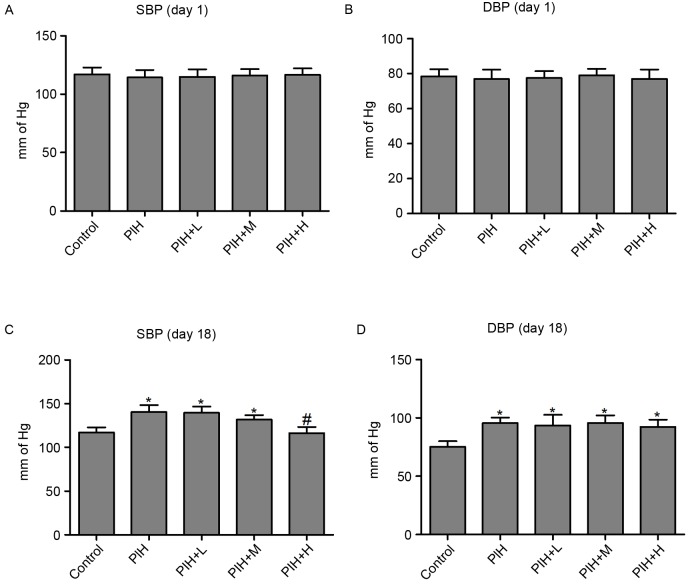
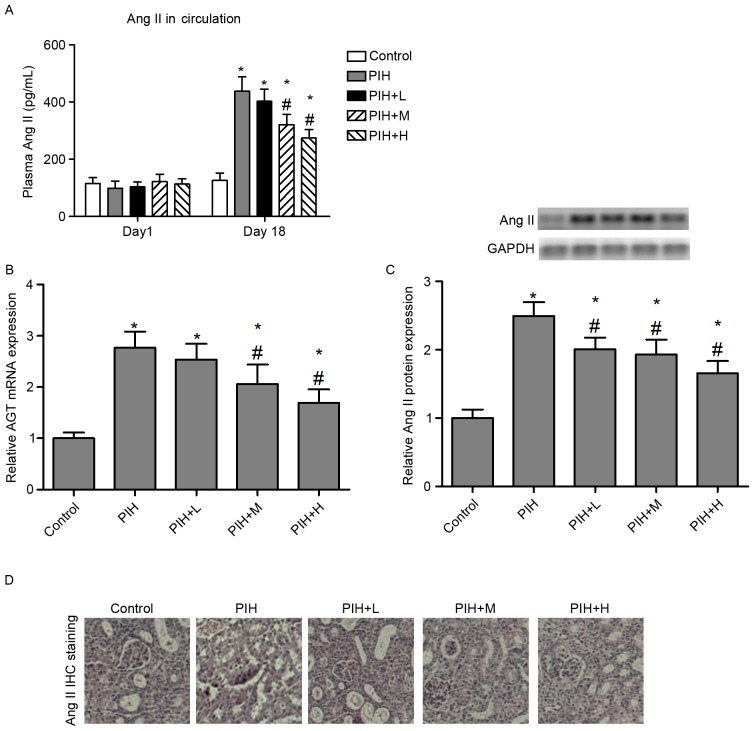
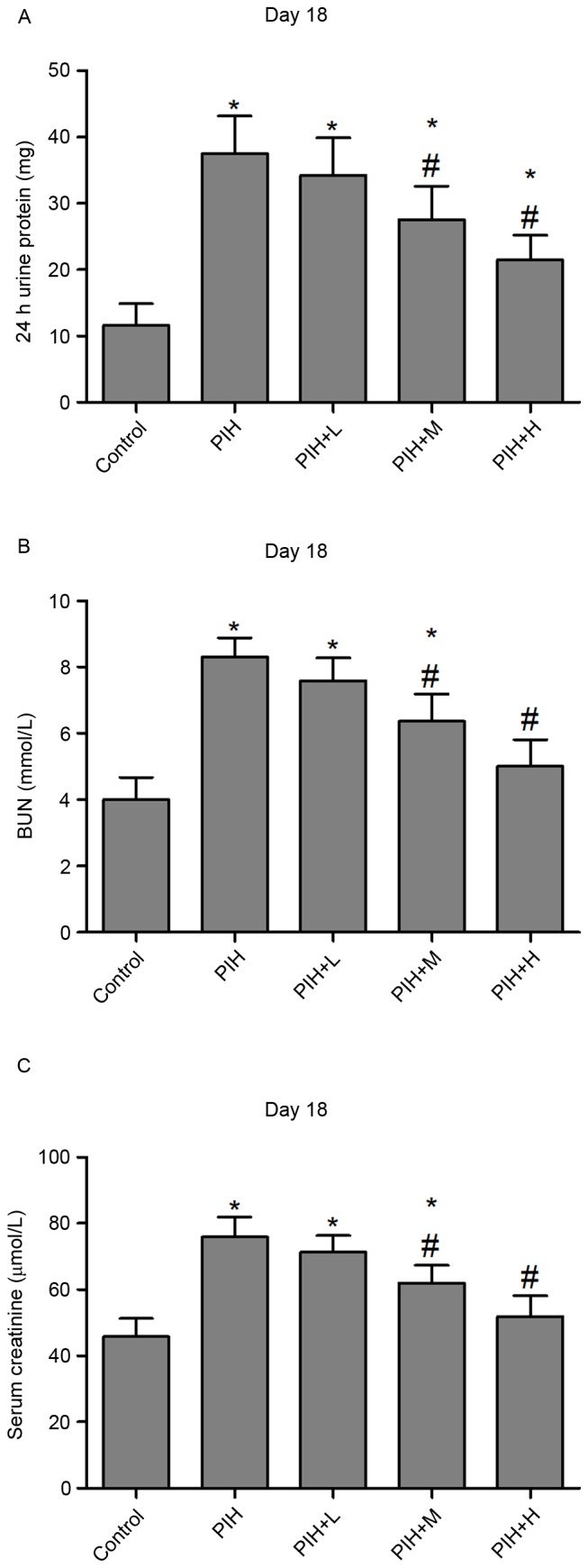
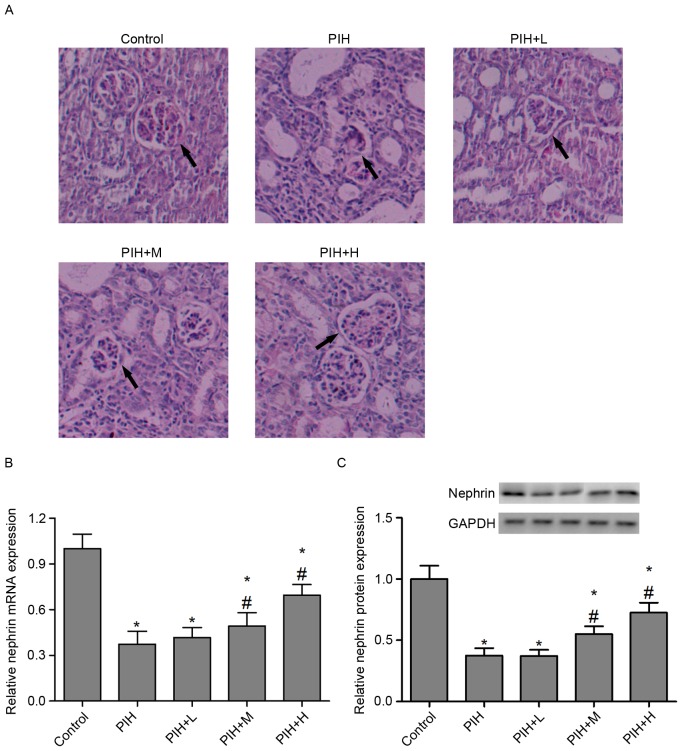
Icariin has previously been demonstrated to attenuate hyperglycemia‑induced renal injury, however the renoprotective effects of icariin in a rat model of pregnancy‑induced hypertension (PIH) remain to be elucidated. The present study aimed to investigate the effect of icariin on PIH‑induced acute kidney injury (AKI) and proteinuria. Following 18 days of icariin treatment between day 1 and day 18 of gestation, which was combined with NG‑nitro‑L‑arginine methyl ester (L‑NAME) treatment between day 12 and day 18 of gestation to induce PIH, the 24 h urine protein level, blood urea nitrogen and serum creatinine were measured by using the Coomassie Brilliant Blue method, a commercial enzymatic kit and the picric acid method, respectively. Renal tissues were collected at day 18 of gestation for hematoxylin and eosin staining and immunohistochemistry. The mRNA expression of AGT and protein expression of angiotensin II (Ang II) in the kidneys of control and PIH rats was investigated by reverse transcription‑quantitative polymerase chain reaction and western blot analysis, respectively, to determine the effect of icariin on components of the renin‑angiotensin system. The results demonstrated that L‑NAME treatment in pregnant rats resulted in significant increases in systolic blood pressure (SBP) and diastolic blood pressure, in addition to the induction of severe proteinuria. The significant increase in SBP and proteinuria in PIH rats was prevented by icariin. L‑NAME‑induced AKI resulted in profound renal histological alterations, including mesangial expansion and glomerular lesions. L‑NAME administration exerted a marked decrease in the mRNA and protein expression levels of nephrin in the kidneys from PIH rats compared with control group. Furthermore, upregulation of circulating and renal Ang II levels in PIH rats was observed. However, icariin treatment significantly reversed the L‑NAME‑induced downregulation of nephrin and upregulation of circulating and renal Ang II levels in PIH rats. These results demonstrated that icariin administration improved urinary protein excretion levels and renal tissue damage in PIH rats, and the underlying mechanism was mediated in part, via upregulation of nephrin expression and downregulation of Ang II.
朝藿定已被证实可减轻高血糖引起的肾损伤,然而,朝藿定在妊娠高血压(PIH)大鼠模型中的肾保护作用仍有待阐明。本研究旨在探讨朝藿定对 PIH 引起的急性肾损伤(AKI)和蛋白尿的影响。在妊娠第 1 天至第 18 天给予朝藿定治疗 18 天后,在妊娠第 12 天至第 18 天给予 NG-硝基-L-精氨酸甲酯(L-NAME)治疗以诱导 PIH,通过考马斯亮蓝法、商业酶试剂盒和苦味酸法分别测量 24 小时尿蛋白水平、血尿素氮和血清肌酐。在妊娠第 18 天收集肾脏组织进行苏木精和伊红染色和免疫组织化学染色。通过逆转录-定量聚合酶链反应和蛋白质印迹分析分别检测控制和 PIH 大鼠肾脏中 AGT 的 mRNA 表达和血管紧张素 II(Ang II)的蛋白表达,以确定朝藿定对肾素-血管紧张素系统成分的影响。结果表明,L-NAME 处理妊娠大鼠导致收缩压(SBP)和舒张压显著升高,此外还导致严重的蛋白尿。朝藿定可预防 PIH 大鼠 SBP 和蛋白尿的显著增加。L-NAME 诱导的 AKI 导致严重的肾脏组织学改变,包括系膜扩张和肾小球病变。与对照组相比,L-NAME 给药导致 PIH 大鼠肾脏中 nephrin 的 mRNA 和蛋白表达水平显著降低。此外,观察到循环和肾 Ang II 水平在 PIH 大鼠中上调。然而,朝藿定治疗显著逆转了 L-NAME 诱导的 PIH 大鼠中 nephrin 的下调和循环和肾 Ang II 水平的上调。这些结果表明,朝藿定给药可改善 PIH 大鼠的尿蛋白排泄水平和肾组织损伤,其作用机制部分通过上调 nephrin 表达和下调 Ang II 来介导。