Fallah-Fini Saeideh, Adam Atif, Cheskin Lawrence J, Bartsch Sarah M, Lee Bruce Y
Global Obesity Prevention Center, Bloomberg School of Public Health, Johns Hopkins University, Baltimore, Maryland, USA.
Industrial and Manufacturing Engineering Department, California State Polytechnic University, Pomona, California, USA.
Obesity (Silver Spring). 2017 Oct;25(10):1809-1815. doi: 10.1002/oby.21965.
This paper estimates specific additional disease outcomes and costs that could be prevented by helping a patient go from an obesity or overweight category to a normal weight category at different ages. This information could help physicians, other health care workers, patients, and third-party payers determine how to prioritize weight reduction.
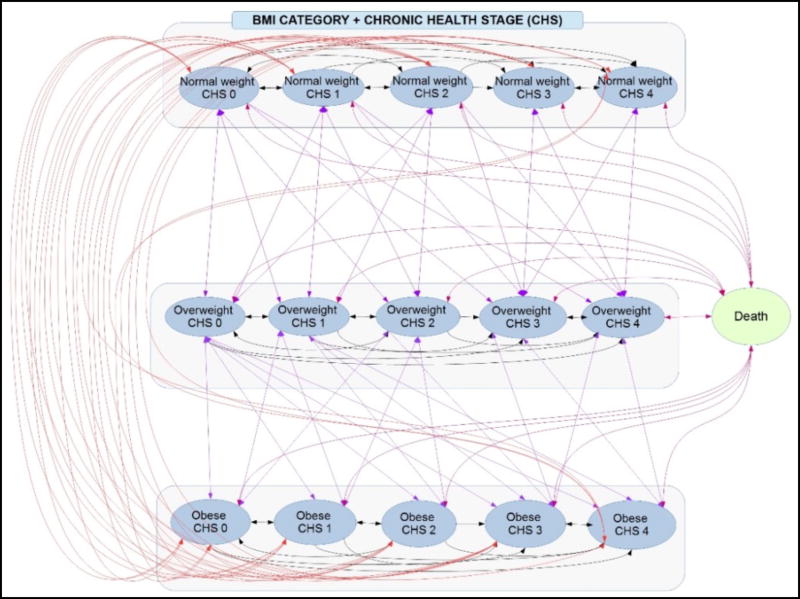
A computational Markov model was developed that represented the BMI status, chronic health states, health outcomes, and associated costs (from various perspectives) for an adult at different age points throughout his or her lifetime.
Incremental costs were calculated for adult patients with obesity or overweight (vs. normal weight) at different starting ages. For example, for a metabolically healthy 20-year-old, having obesity (vs. normal weight) added lifetime third-party payer costs averaging $14,059 (95% range: $13,956-$14,163), productivity losses of $14,141 ($13,969-$14,312), and total societal costs of $28,020 ($27,751-$28,289); having overweight vs. normal weight added $5,055 ($4,967-$5,144), $5,358 ($5,199-$5,518), and $10,365 ($10,140-$10,590). For a metabolically healthy 50-year-old, having obesity added $15,925 ($15,831-$16,020), $20,120 ($19,887-$20,352), and $36,278 ($35,977-$36,579); having overweight added $5,866 ($5,779-$5,953), $10,205 ($9,980-$10,429), and $16,169 ($15,899-$16,438).
Incremental lifetime costs of a patient with obesity or overweight (vs. normal weight) increased with the patient's age, peaked at age 50, and decreased with older ages. However, weight reduction even in older adults still yielded incremental cost savings.
本文估计了通过帮助患者在不同年龄从肥胖或超重类别转变为正常体重类别可预防的特定额外疾病结局和成本。这些信息可帮助医生、其他医护人员、患者和第三方支付者确定如何对减重进行优先级排序。
开发了一个计算马尔可夫模型,该模型代表了成年人在其一生中不同年龄点的体重指数(BMI)状态、慢性健康状况、健康结局以及相关成本(从各种角度)。
计算了不同起始年龄的肥胖或超重成年患者(相对于正常体重)的增量成本。例如,对于一名代谢健康的20岁成年人,肥胖(相对于正常体重)会使终身第三方支付者成本平均增加14,059美元(95%范围:13,956 - 14,163美元),生产力损失14,141美元(13,969 - 14,312美元),社会总成本28,020美元(27,751 - 28,289美元);超重(相对于正常体重)会使成本增加5,055美元(4,967 - 5,144美元)、5,358美元(5,199 - 5,518美元)和10,365美元(10,140 - 10,590美元)。对于一名代谢健康的50岁成年人,肥胖会使成本增加15,925美元(15,831 - 16,020美元)、20,120美元(19,887 - 20,352美元)和36,278美元(35,977 - 36,579美元);超重会使成本增加5,866美元(5,779 - 5,953美元)、10,205美元(9,980 - 10,429美元)和16,169美元(15,899 - 16,438美元)。
肥胖或超重患者(相对于正常体重)的终身增量成本随患者年龄增加而增加,在50岁时达到峰值,随后随年龄增长而下降。然而,即使是老年人减重仍能节省增量成本。