Guan Tao, Wang Xue, Zheng Li-Bin, Wu Hai-Jian, Yao Yu-Feng
Department of Ophthalmology, Taizhou Municipal Hospital, Taizhou, 318000, China.
Laboratory of Kidney Carcinoma, The Second Hospital of Ningbo Yinzhou, Ningbo, 315000, China.
BMC Ophthalmol. 2017 Sep 26;17(1):173. doi: 10.1186/s12886-017-0567-3.
Keratoconus normally presents as a sporadic disease. Although different studies have found sequence variants of the visual system homeobox 1 (VSX1) gene associated with keratoconus in humans, no research has detected such variants in sporadic keratoconus patients from China. To investigate the possibility of VSX1 being a candidate susceptibility gene for Chinese patients with sporadic keratoconus, we performed sequence screening of this gene in such patients.
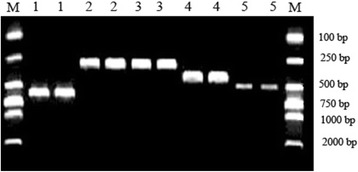
Whole DNA was obtained from the leukocytes in the peripheral venous blood of 50 patients with sporadic keratoconus and 50 control subjects without this ocular disorder. Polymerase chain reaction single-strand conformation polymorphism analysis and direct DNA sequencing technology were used to detect sequence variation in the five exons and splicing regions of the introns of the VSX1 gene. The sequencing results were analyzed using DNAstar software.
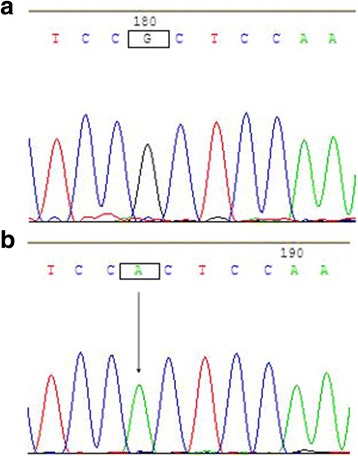
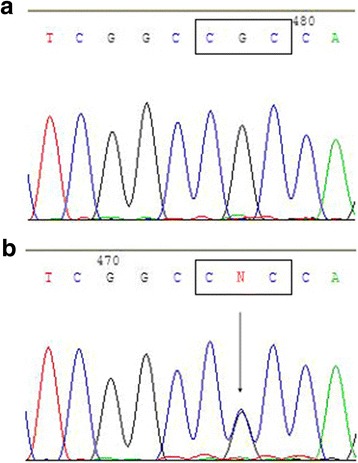
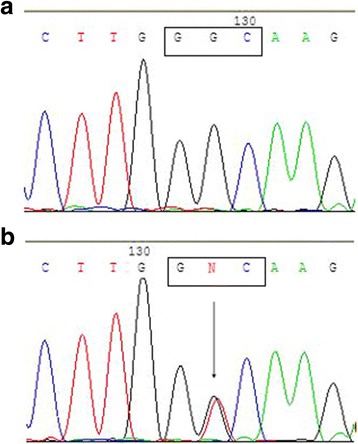
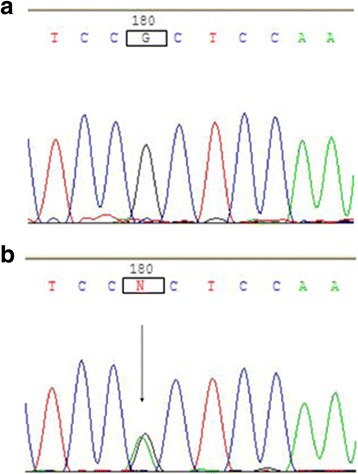
One novel missense heterozygous sequence variant (p.Arg131Pro) was found in the first exon of the VSX1 gene in one keratoconus patient. Another heterozygous sequence variant (p.Gly160Val) in the second exon was found in two keratoconus patients. These variants were not detected in the control subjects. In the third intron of the VSX1 gene, c.8326G > A nucleotide substitution (including heterozygous and homozygous change) was also discovered. The frequency of this variation did not differ significantly between patients and controls, it should belong to single-nucleotide polymorphism of the VSX1 gene. Bioinformatic analysis also predicted that one missense sequence variation (p.Arg131Pro) may not cause a pathogenic change.
In this study, we added one novel missense sequence variation (p.Arg131Pro) in the coding region of the VSX1 gene to the range of VSX1 coding region variations observed in patients with sporadic keratoconus from China. Our work suggests that VSX1 sequence variants might be involved in the pathogenesis of sporadic keratoconus, but their precise role in disease causation requires further investigation.
圆锥角膜通常表现为一种散发性疾病。尽管不同研究已发现视觉系统同源盒1(VSX1)基因的序列变异与人类圆锥角膜相关,但尚未有研究在中国散发性圆锥角膜患者中检测到此类变异。为了探究VSX1成为中国散发性圆锥角膜患者候选易感基因的可能性,我们对这类患者进行了该基因的序列筛查。
从50例散发性圆锥角膜患者及50例无眼部疾病的对照者的外周静脉血白细胞中获取全基因组DNA。采用聚合酶链反应单链构象多态性分析及直接DNA测序技术检测VSX1基因5个外显子及内含子剪接区域的序列变异。使用DNAstar软件分析测序结果。
在1例圆锥角膜患者的VSX1基因第一个外显子中发现了1个新的错义杂合序列变异(p.Arg131Pro)。在2例圆锥角膜患者的第二个外显子中发现了另一个杂合序列变异(p.Gly160Val)。对照者中未检测到这些变异。在VSX1基因的第三个内含子中,还发现了c.8326G>A核苷酸替换(包括杂合和纯合变化)。该变异在患者和对照者中的频率无显著差异,应属于VSX1基因的单核苷酸多态性。生物信息学分析还预测,1个错义序列变异(p.Arg131Pro)可能不会引起致病性改变。
在本研究中,我们在中国散发性圆锥角膜患者观察到的VSX1编码区变异范围内,在VSX1基因编码区增加了1个新的错义序列变异(p.Arg131Pro)。我们的研究提示,VSX1序列变异可能参与散发性圆锥角膜的发病机制,但其在疾病病因中的精确作用需要进一步研究。