Morphology, Surgery and Experimental Medicine Department, University of Ferrara, Via L. Borsari 46, 44122 Ferrara, Italy.
Physics and Heart Science Department, University of Ferrara, Via Giuseppe Saragat, 1, 44122 Ferrara, Italy.
Biomed Res Int. 2017;2017:5923609. doi: 10.1155/2017/5923609. Epub 2017 Aug 30.
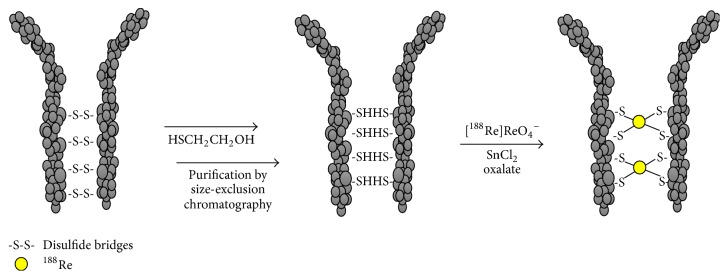
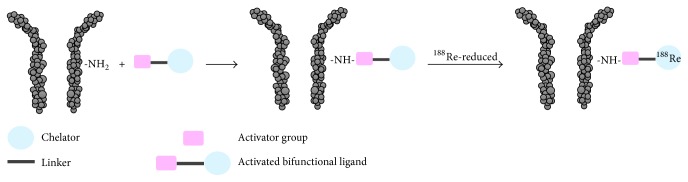
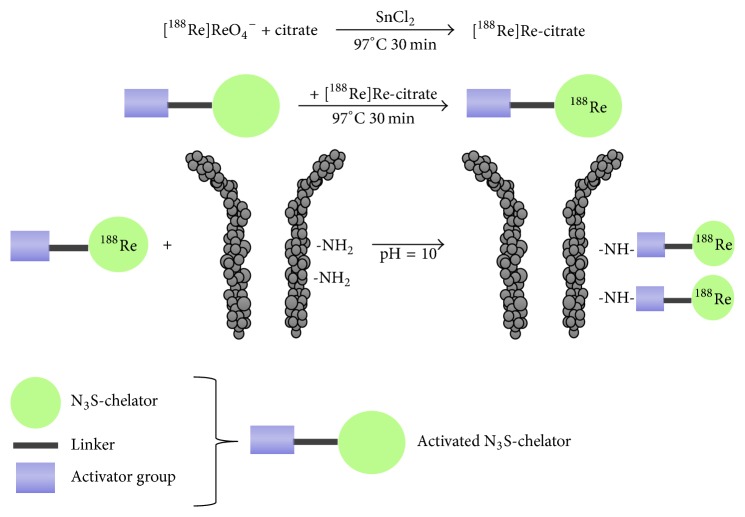
Rhenium-188, obtained from an alumina-based tungsten-188/rhenium-188 generator, is actually considered a useful candidate for labeling biomolecules such as antibodies, antibody fragments, peptides, and DNAs for radiotherapy. There is a widespread interest in the availability of labeling procedures that allow obtaining Re-labeled radiopharmaceuticals for various therapeutic applications, in particular for the rhenium attachment to tumor-specific monoclonal antibodies (Mo)Abs for immunotherapy. Different approaches have been developed in order to obtain Re-radioimmunoconjugates in high radiochemical purity starting from the generator eluted [Re]ReO. The aim of this paper is to provide a short overview on Re-labeled (Mo)Abs, focusing in particular on the radiolabeling methods, quality control of radioimmunoconjugates, and their in vitro stability for radioimmunotherapy (RIT), with particular reference to the most important contributions published in literature in this topic.
从基于氧化铝的钨-188/铼-188 发生器中获得的铼-188,实际上被认为是标记生物分子(如抗体、抗体片段、肽和 DNA)的有用候选物,用于放射治疗。人们广泛关注可获得标记程序,以便为各种治疗应用,特别是为铼与肿瘤特异性单克隆抗体(Mo)Abs 的免疫治疗相结合,获得放射性标记的放射性药物。为了从发生器洗脱的 [Re]ReO 开始获得高放射化学纯度的 Re 放射性免疫偶联物,已经开发了不同的方法。本文的目的是提供对 Re 标记的(Mo)Abs 的简要概述,特别关注放射性标记方法、放射性免疫偶联物的质量控制及其用于放射免疫治疗(RIT)的体外稳定性,特别参考了该主题中发表的最重要的文献贡献。