Nawasreh Zakariya, Logerstedt David, Cummer Kathleen, Axe Michael, Risberg May Arna, Snyder-Mackler Lynn
Department of Biomechanics and Movement Science program, College of Health Sciences, University of Delaware, Newark, Delaware, USA.
Division of Physical Therapy, Department of Rehabilitation Sciences, Faculty of Applied Medical Sciences, Jordan University of Science and Technology (JUST), Irbid, Jordan.
Br J Sports Med. 2018 Mar;52(6):375. doi: 10.1136/bjsports-2016-097095. Epub 2017 Sep 27.
Assessing athletes' readiness is a key component for successful outcomes after ACL reconstruction (ACLR).
To investigate whether return-to-activity criteria, individually or in combination, at 6 months after ACLR can predict return to participation in the same preinjury activity level at 12 and 24 months after ACLR.
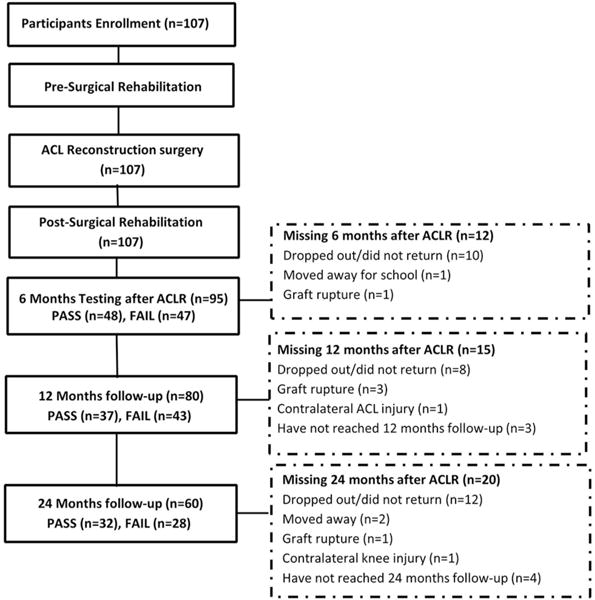
Ninety-five level I/II participants completed return-to-activity criteria testing (isometric quadriceps index, single-legged hop tests, Knee Outcome Survey-Activities of Daily Living Scale (KOS-ADLS) and Global Rating Score (GRS)) at 6 months after ACLR. The PASS group was defined as scoring 90% on all criteria and the FAIL group as scoring <90% on any criteria. At 12 and 24 months after ACLR, participants were asked if they had returned to participate in the same preinjury activity level or not. All return-to-activity criteria, except quadriceps index, were entered into the logistic regression model.
81% and 84.4% of the PASS group returned to participation in the same preinjury activity level, while only 44.2% and 46.4% of the FAIL group returned at 12 and 24 months, respectively, after ACLR. The 6-meter timed hop, single hop and triple hop limb symmetry indexes; GRS; and KOS-ADLS individually predicted the outcome of interest at 12 months after ACLR (range: R: 0.12-0.22, p0.024). In combination, they explained 27% of the variance (p=0.035). All hop tests, individually, predicted the outcome of interest at 24 months after ACLR (range: R: 0.26-0.37; p0.007); in combination they explained 45% of the variance (p0.001).
Return to participation in the same preinjury activity level at 12 and 24 months after ACLR was higher in those who passed the criteria compared with those who failed. Individual and combined return-to-activity criteria predicted the outcomes of interest, with the hop tests as consistent predictors at 12 and 24 months after ACLR.
评估运动员的恢复情况是前交叉韧带重建术(ACLR)后取得成功结果的关键因素。
研究ACLR术后6个月时的恢复活动标准(单独或综合使用)能否预测ACLR术后12个月和24个月时恢复到伤前相同活动水平的情况。
95名I/II级参与者在ACLR术后6个月完成了恢复活动标准测试(等长股四头肌指数、单腿跳测试、膝关节功能日常生活量表(KOS-ADLS)和总体评分(GRS))。通过组被定义为所有标准得分均达到90%,未通过组被定义为任何一项标准得分低于90%。在ACLR术后12个月和24个月时,询问参与者是否已恢复到伤前相同的活动水平。除股四头肌指数外,所有恢复活动标准均纳入逻辑回归模型。
通过组中分别有81%和84.4%的参与者恢复到伤前相同的活动水平,而未通过组在ACLR术后12个月和24个月时分别只有44.2%和46.4%的参与者恢复到该水平。6米定时单腿跳、单腿跳和双腿跳肢体对称指数;GRS;以及KOS-ADLS各自预测了ACLR术后12个月时的目标结果(范围:R:0.12 - 0.22,p<0.024)。综合起来,它们解释了27%的方差(p = 0.035)。所有单腿跳测试各自预测了ACLR术后24个月时的目标结果(范围:R:0.26 - 0.37;p<0.007);综合起来它们解释了45%的方差(p<0.001)。
与未通过标准的人相比,通过标准的人在ACLR术后12个月和24个月时恢复到伤前相同活动水平的比例更高。单独和综合的恢复活动标准预测了目标结果,其中单腿跳测试在ACLR术后12个月和24个月时是一致的预测指标。