Kaiser Ylva, Lakshmikanth Tadepally, Chen Yang, Mikes Jaromir, Eklund Anders, Brodin Petter, Achour Adnane, Grunewald Johan
Respiratory Medicine Unit, Department of Medicine, Solna and Center for Molecular Medicine, Karolinska Institutet and Karolinska University Hospital, Stockholm, Sweden.
Science for Life Laboratory, Department of Medicine, Karolinska Institutet, Stockholm, Sweden.
Front Immunol. 2017 Sep 12;8:1130. doi: 10.3389/fimmu.2017.01130. eCollection 2017.
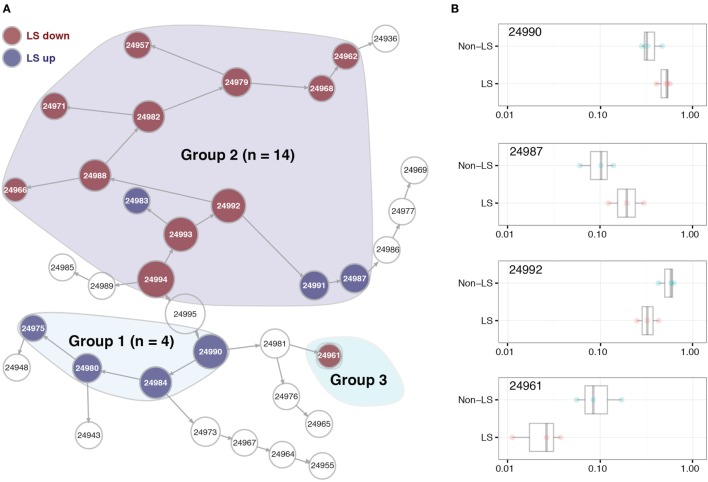
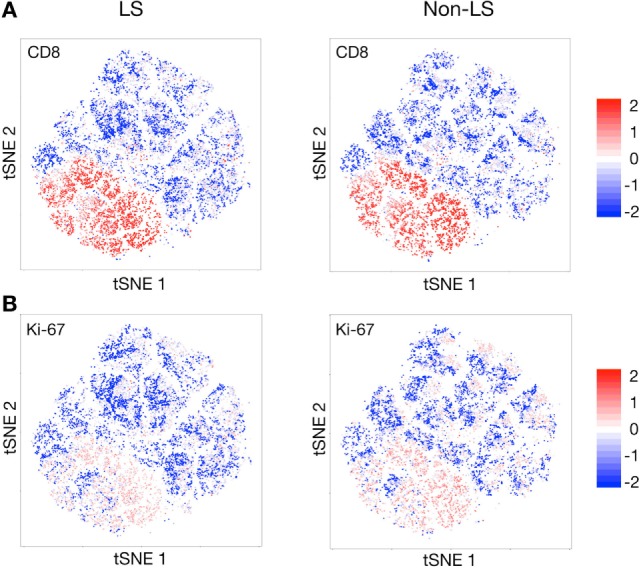
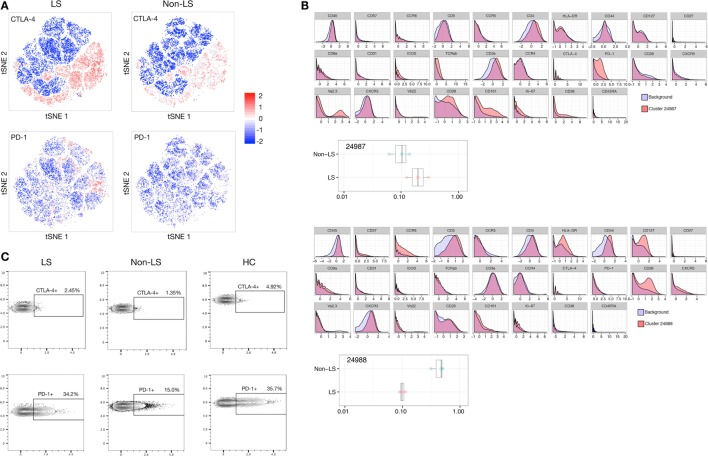
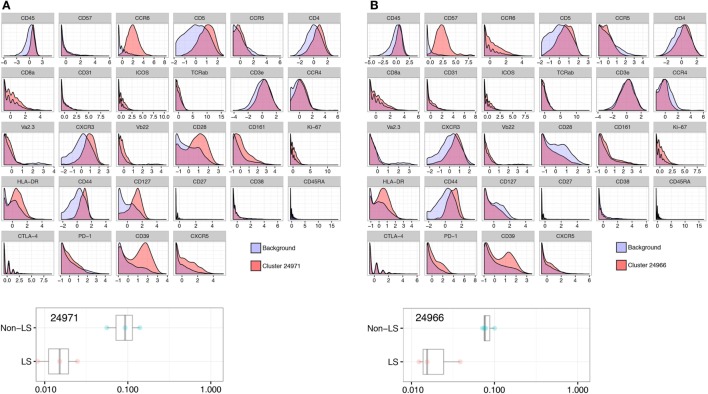
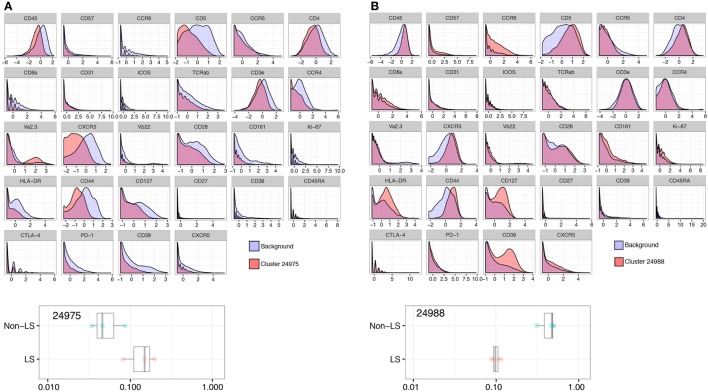
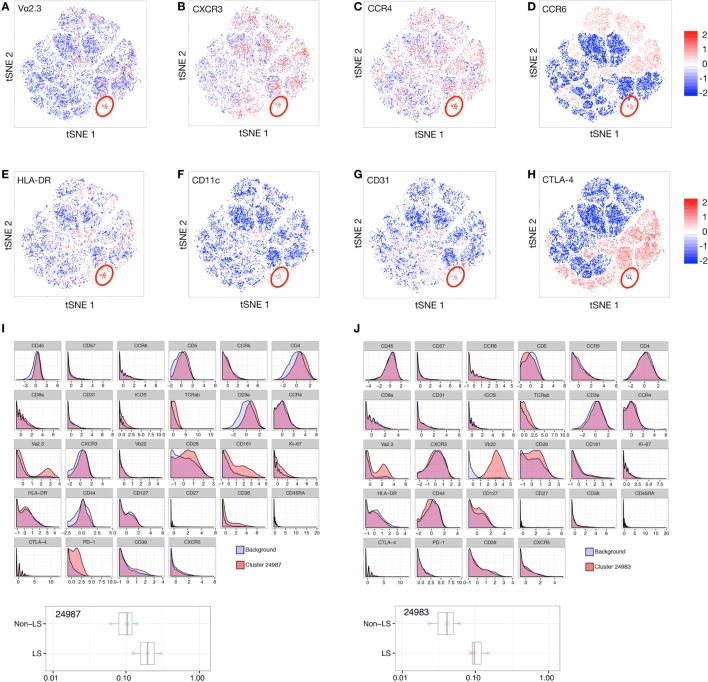
Sarcoidosis is a granulomatous disorder of unknown etiology, characterized by accumulation of activated CD4 T cells in the lungs. Disease phenotypes Löfgren's syndrome (LS) and "non-LS" differ in terms of clinical manifestations, genetic background, HLA association, and prognosis, but the underlying inflammatory mechanisms largely remain unknown. Bronchoalveolar lavage fluid cells from four HLA-DRB103 LS and four HLA-DRB103 non-LS patients were analyzed by mass cytometry, using a panel of 33 unique markers. Differentially regulated CD4 T cell populations were identified using the Citrus algorithm, and -stochastic neighborhood embedding was applied for dimensionality reduction and single-cell data visualization. We identified 19 individual CD4 T cell clusters differing significantly in abundance between LS and non-LS patients. Seven clusters more frequent in LS patients were characterized by significantly higher expression of regulatory receptors CTLA-4, PD-1, and ICOS, along with low expression of adhesion marker CD44. In contrast, 12 clusters primarily found in non-LS displayed elevated expression of activation and effector markers HLA-DR, CD127, CD39, as well as CD44. Hierarchical clustering further indicated functional heterogeneity and diverse origins of T cell receptor Vα2.3/Vβ22-restricted cells in LS. Finally, a near-complete overlap of CD8 and Ki-67 expression suggested larger influence of CD8 T cell activity on sarcoid inflammation than previously appreciated. In this study, we provide detailed characterization of pulmonary T cells and immunological parameters that define separate disease pathways in LS and non-LS. With direct association to clinical parameters, such as granuloma persistence, resolution, or chronic inflammation, these results provide a valuable foundation for further exploration and potential clinical application.
结节病是一种病因不明的肉芽肿性疾病,其特征是肺中活化的CD4 T细胞积聚。疾病表型 Löfgren综合征(LS)和“非LS”在临床表现、遗传背景、HLA关联和预后方面存在差异,但潜在的炎症机制在很大程度上仍然未知。使用一组33种独特标记物,通过质谱流式细胞术分析了4例HLA-DRB103 LS患者和4例HLA-DRB103非LS患者的支气管肺泡灌洗液细胞。使用Citrus算法鉴定差异调节的CD4 T细胞群体,并应用随机邻域嵌入进行降维和单细胞数据可视化。我们鉴定出19个个体CD4 T细胞簇,其在LS和非LS患者之间的丰度存在显著差异。LS患者中更常见的7个簇的特征是调节性受体CTLA-4、PD-1和ICOS的表达显著更高,同时粘附标记物CD44的表达较低。相比之下,主要在非LS中发现的12个簇显示活化和效应标记物HLA-DR、CD127、CD39以及CD44的表达升高。层次聚类进一步表明LS中T细胞受体Vα2.3/Vβ22限制细胞的功能异质性和不同起源。最后,CD8和Ki-67表达的几乎完全重叠表明CD8 T细胞活性对结节病炎症的影响比以前认识到的更大。在本研究中,我们提供了肺T细胞和免疫参数的详细特征,这些特征定义了LS和非LS中不同的疾病途径。这些结果与肉芽肿持续存在、消退或慢性炎症等临床参数直接相关,为进一步探索和潜在的临床应用提供了有价值的基础。