McLenachan Samuel, Hao Erwei, Zhang Dan, Zhang Ling, Edel Michael, Chen Fred
Centre for Ophthalmology and Visual Science, The University of Western Australia, Crawley, WA 6009, Australia.
Ocular Tissue Engineering Laboratory, Lions Eye Institute, 2 Verdun Street, Nedlands, WA 6009, Australia.
Biochem Biophys Rep. 2017 Mar 28;10:178-185. doi: 10.1016/j.bbrep.2017.03.008. eCollection 2017 Jul.
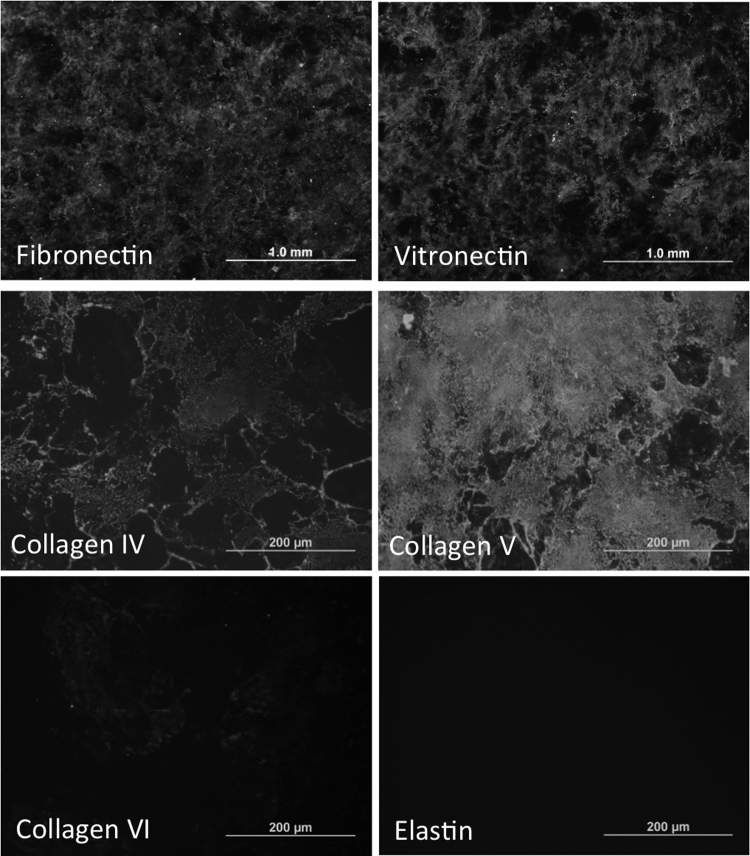
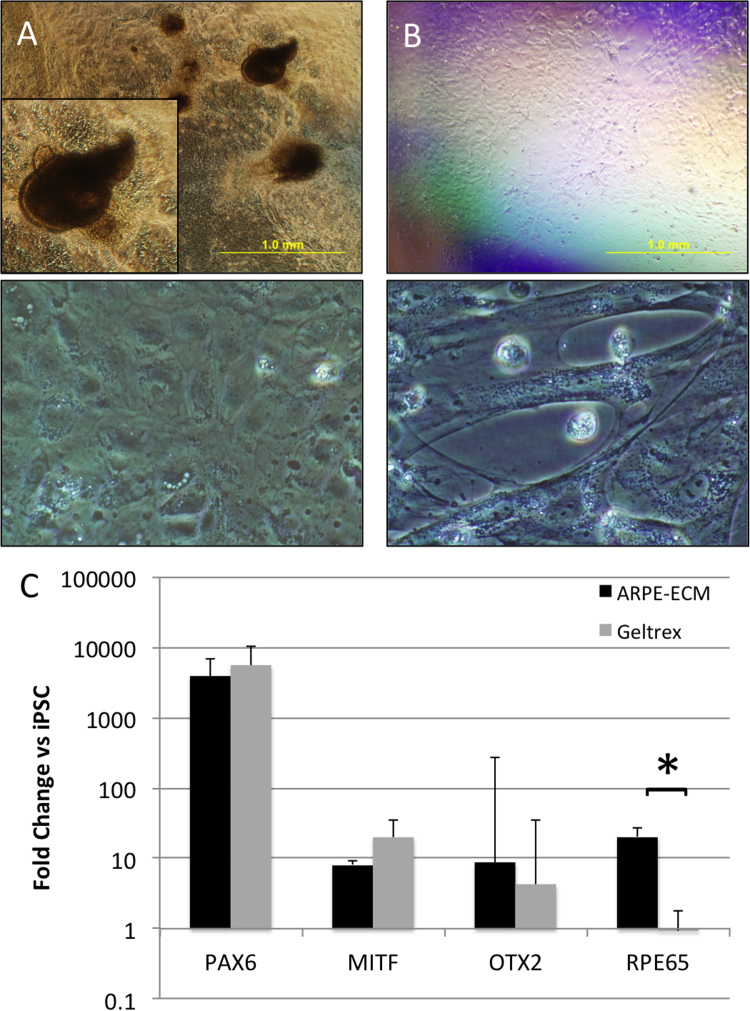
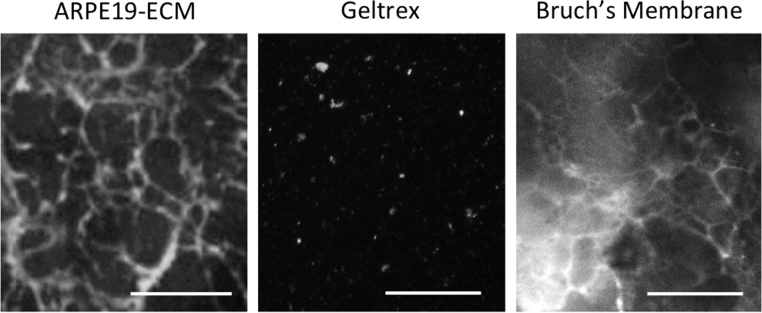
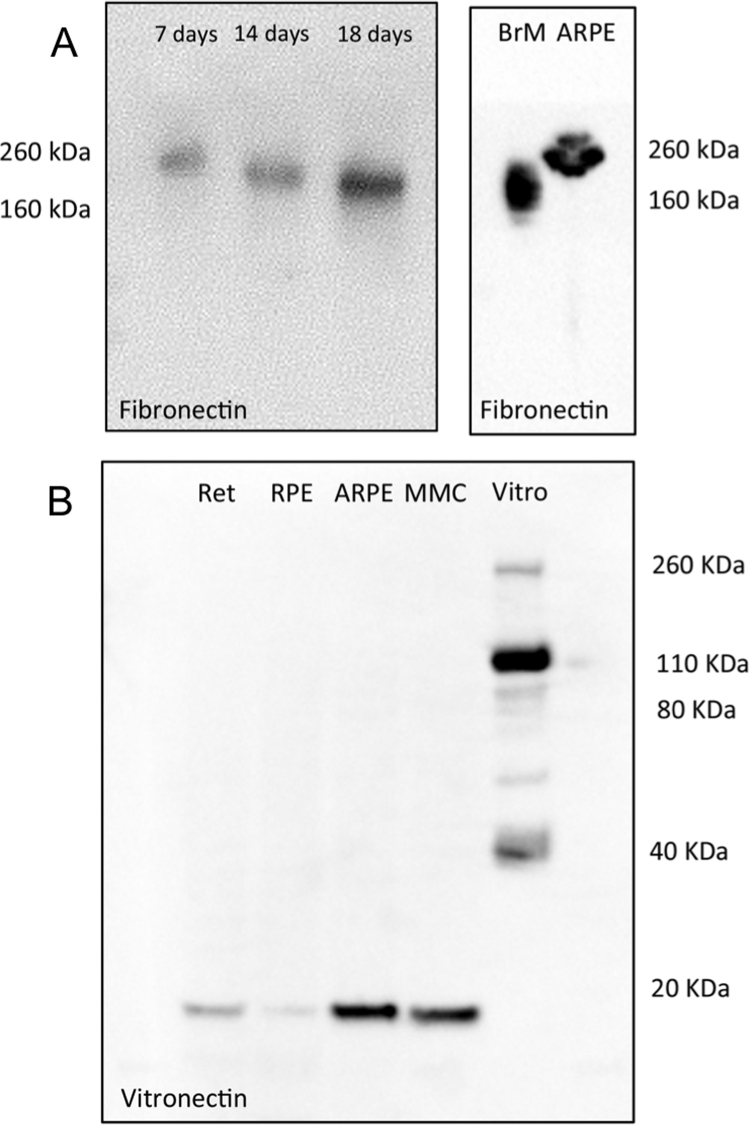
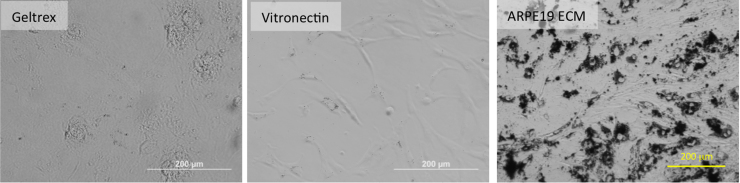
In the eye, the retinal pigment epithelium (RPE) adheres to a complex protein matrix known as Bruch's membrane (BrM). The aim of this study was to provide enriched conditions for RPE cell culture through the production of a BrM-like matrix. Our hypothesis was that a human RPE cell line would deposit an extracellular matrix (ECM) resembling BrM. The composition and structure of ECM deposited by ARPE19 cells (ARPE19-ECM) was characterized. To produce ARPE19-ECM, ARPE19 cells were cultured in the presence dextran sulphate. ARPE19-ECM was decellularized using deoxycholate and characterized by immunostaining and western blot analysis. Primary human RPE and induced pluripotent stem cells were seeded onto ARPE19-ECM or geltrex coated surfaces and examined by microscopy or RT-PCR. Culture of ARPE19 cells with dextran sulphate promoted nuclear localization of SOX2, formation of tight junctions and deposition of ECM. ARPE19 cells deposited ECM proteins found in the inner layers of BrM, including fibronectin, vitronectin, collagens IV and V as well as laminin-alpha-5, but not those found in the middle elastic layer (elastin) or the outer layers (collagen VI). ARPE19-ECM promoted pigmentation in human RPE and pluripotent stem cell cultures. Expression of RPE65 was significantly increased on ARPE19-ECM compared with geltrex in differentiating pluripotent stem cell cultures. ARPE19 cells deposit ECM with a composition and structure similar to BrM in the retina. Molecular cues present in ARPE19-ECM promote the acquisition and maintenance of the RPE phenotype. Together, these results demonstrate a simple method for generating a BrM-like surface for enriched RPE cell cultures.
在眼睛中,视网膜色素上皮(RPE)附着于一种称为布鲁赫膜(BrM)的复杂蛋白质基质上。本研究的目的是通过产生一种类似BrM的基质,为RPE细胞培养提供富集条件。我们的假设是,一种人RPE细胞系会沉积一种类似于BrM的细胞外基质(ECM)。对ARPE19细胞沉积的ECM(ARPE19 - ECM)的组成和结构进行了表征。为了产生ARPE19 - ECM,将ARPE19细胞在硫酸葡聚糖存在的情况下进行培养。使用脱氧胆酸盐对ARPE19 - ECM进行脱细胞处理,并通过免疫染色和蛋白质印迹分析进行表征。将原代人RPE细胞和诱导多能干细胞接种到ARPE19 - ECM或基质胶包被的表面上,并通过显微镜或逆转录 - 聚合酶链反应(RT - PCR)进行检测。用硫酸葡聚糖培养ARPE19细胞可促进SOX2的核定位、紧密连接的形成以及ECM的沉积。ARPE19细胞沉积了在BrM内层发现的ECM蛋白,包括纤连蛋白、玻连蛋白、IV型和V型胶原蛋白以及层粘连蛋白α - 5,但未沉积在中间弹性层(弹性蛋白)或外层(VI型胶原蛋白)中发现的蛋白。ARPE19 - ECM促进了人RPE和多能干细胞培养中的色素沉着。在分化的多能干细胞培养物中,与基质胶相比,ARPE19 - ECM上RPE65的表达显著增加。ARPE19细胞沉积的ECM在组成和结构上与视网膜中的BrM相似。ARPE19 - ECM中存在的分子信号促进了RPE表型的获得和维持。总之,这些结果证明了一种为富集RPE细胞培养生成类似BrM表面的简单方法。