
亚慢性镉暴露对大鼠肾皮质中铜、硒、锌、铁及其他必需金属水平的影响。
Effects of sub-chronic Cd exposure on levels of copper, selenium, zinc, iron and other essential metals in rat renal cortex.
作者信息
Prozialeck Walter C, Lamar Peter C, Edwards Joshua R
机构信息
Department of Pharmacology, Chicago College of Osteopathic Medicine, Midwestern University, Downers Grove, IL 60515, United States.
出版信息
Toxicol Rep. 2016 Sep 12;3:740-746. doi: 10.1016/j.toxrep.2016.09.005. eCollection 2016.
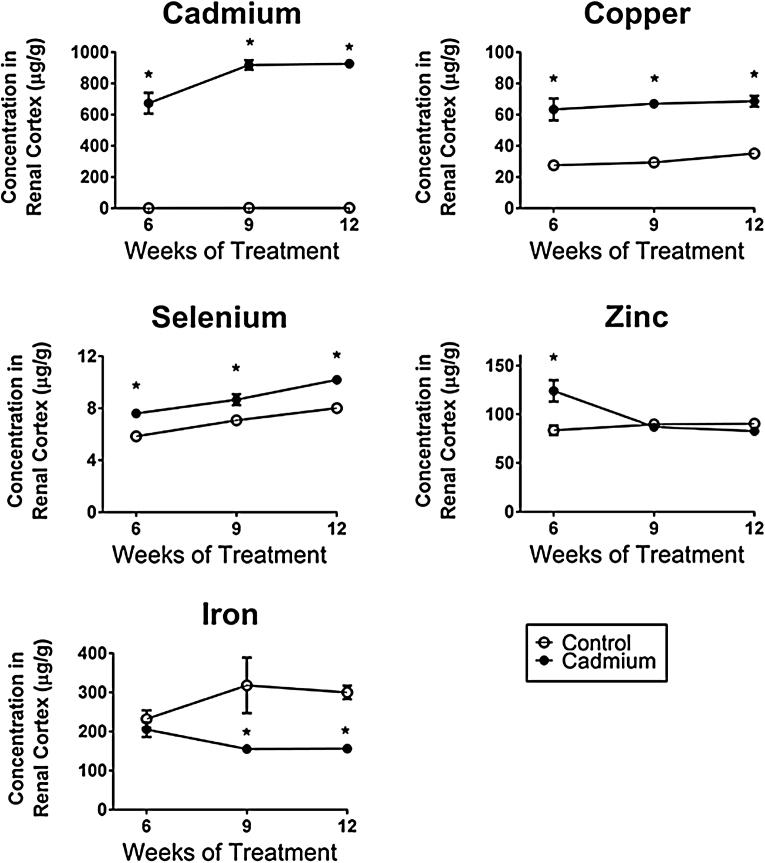
Cd (Cd) is a nephrotoxic environmental pollutant that causes generalized proximal tubule dysfunction. Even though the specific mechanisms by which Cd damages the kidney have yet to be fully elucidated, there is evidence to suggest that some of these nephrotoxic effects may result from the ability of Cd to alter the levels and function of metals such as Cu, Se, Zn and Fe within the kidney. In order to further explore this issue, we examined the effects of subchronic Cd exposure on tissue levels of a panel of metals (Ca, Cu, Fe, K, Mg, Na, Se and Zn) in the rat renal cortex. Adult male Sprague-Dawley rats were treated with CdCl (0.6 mg Cd/kg body weight in isotonic saline by subcutaneous injection, 5 days per week for 6, 9 or 12 weeks). At each time point, 24 h urine samples were collected and assayed for levels of protein, creatinine, β microglobulin and cystatin C. Samples of renal cortex were removed and assayed for levels of the metals of interest by inductively-coupled mass spectrometry at Michigan State University. Results showed that at 9 and 12 weeks, Cd caused significant increases in urine volume and urinary protein with no change in creatinine excretion. Increases in the excretion of the urinary biomarkers β microglobulin and cystatin C were evident after 6 weeks of Cd exposure. Results of the metal analyses showed that Cd caused significant increases in tissue levels of Cu and Se at all of the time points examined. Tissue levels of Zn were transiently elevated at 6 weeks but declined to control levels at 9 and 12 weeks. Cd caused a significant decrease in levels of Fe at 9 and 12 weeks. Cd had no effects on any of the other metals. Tissue levels of Cd were 530 ± 52, 863 ± 23, 837 ± 23 ppm dry weight at 6, 9 and 12 weeks, respectively. These results indicate that the early stages of Cd nephrotoxicity are associated with alterations in renal tissue levels of Cu, Se, Zn and Fe. The fact that the changes in levels of the metals occurred during the early stages of Cd toxicity raises the possibility that the alterations in renal cortical metal content may play some role in the pathophysiology or Cd-induced injury.
镉(Cd)是一种具有肾毒性的环境污染物,可导致广泛性近端肾小管功能障碍。尽管镉损害肾脏的具体机制尚未完全阐明,但有证据表明,其中一些肾毒性作用可能是由于镉改变肾脏中铜、硒、锌和铁等金属的水平及功能所致。为了进一步探讨这个问题,我们研究了亚慢性镉暴露对大鼠肾皮质中一组金属(钙、铜、铁、钾、镁、钠、硒和锌)组织水平的影响。成年雄性Sprague-Dawley大鼠接受氯化镉处理(通过皮下注射,以等渗盐水配制,剂量为0.6毫克镉/千克体重,每周5天,持续6、9或12周)。在每个时间点,收集24小时尿液样本,检测蛋白质、肌酐、β微球蛋白和胱抑素C的水平。取出肾皮质样本,由密歇根州立大学采用电感耦合质谱法检测相关金属的水平。结果显示,在9周和12周时,镉导致尿量和尿蛋白显著增加,而肌酐排泄量无变化。镉暴露6周后,尿生物标志物β微球蛋白和胱抑素C的排泄量明显增加。金属分析结果表明,在所有检测的时间点,镉均导致铜和硒的组织水平显著升高。锌的组织水平在6周时短暂升高,但在9周和12周时降至对照水平。在9周和12周时,镉导致铁的水平显著降低。镉对其他任何金属均无影响。在6、9和12周时,镉的组织水平分别为530±52、863±23、837±23 ppm干重。这些结果表明,镉肾毒性的早期阶段与肾组织中铜、硒、锌和铁水平的改变有关。金属水平的变化发生在镉毒性的早期阶段,这一事实增加了肾皮质金属含量改变可能在病理生理学或镉诱导的损伤中发挥某种作用的可能性。


 Zotero 插件