Lee Sung Woo, Lee Anna, Yu Mi Yeon, Kim Sun Wook, Kim Kwang Il, Na Ki Young, Chae Dong Wan, Kim Cheol Ho, Chin Ho Jun
Department of Internal Medicine, Seoul National University Postgraduate School, Seoul, Korea.
Department of Internal Medicine, Eulji General Hospital, Seoul, Korea.
J Korean Med Sci. 2017 Nov;32(11):1800-1806. doi: 10.3346/jkms.2017.32.11.1800.
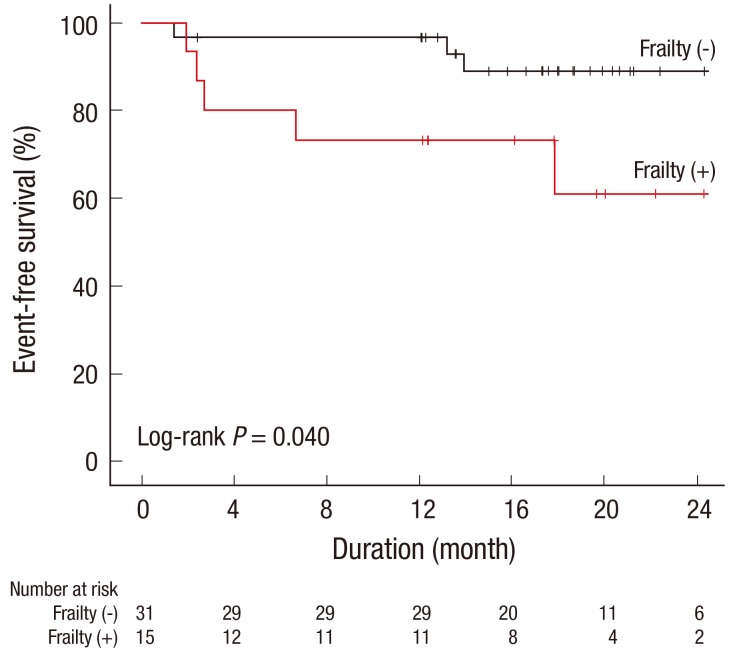
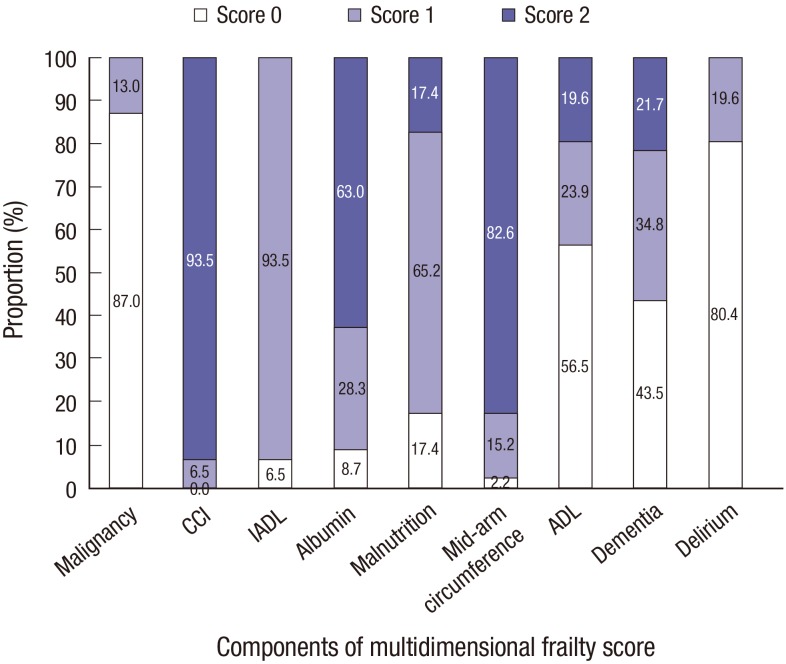
Little is known about the clinical significance of frailty and changes of frailty after dialysis initiation in elderly patients with end-stage renal disease (ESRD). We prospectively enrolled 46 elderly patients with incident ESRD at a dialysis center of a tertiary hospital between May 2013 and March 2015. Frailty was assessed by using a comprehensive geriatric assessment protocol and defined as a multidimensional frailty score of ≥ 10. The main outcome was the composite of all-cause death or cardiovascular hospitalization, as determined in June 2016. The median age of the 46 participants was 71.5 years, and 63.0% of them were men. During the median 17.7 months follow-up, the rate of composite outcome was 17.4%. In multivariate logistic regression analysis, after adjusting for age, sex, diabetes, body mass index (BMI), and time of predialytic nephrologic care, female sex, and increased BMI were associated with increased and decreased odds of frailty, respectively. In multivariate Cox proportional hazards analysis, after adjusting for age, sex, diabetes, BMI, and time of predialytic nephrologic care, frailty was significantly associated with the composite adverse outcome. In repeated frailty assessments, the multidimensional frailty score significantly improved 12 months after the initiation of dialysis, which largely relied on improved nutrition. Therefore, frailty needs to be assessed for risk stratification in elderly patients with incident ESRD.
关于老年终末期肾病(ESRD)患者的衰弱及其透析开始后的变化的临床意义,人们知之甚少。我们于2013年5月至2015年3月在一家三级医院的透析中心前瞻性纳入了46例初发ESRD的老年患者。使用综合老年评估方案评估衰弱情况,并将其定义为多维衰弱评分≥10分。主要结局是2016年6月确定的全因死亡或心血管住院的复合结局。46名参与者的中位年龄为71.5岁,其中63.0%为男性。在中位17.7个月的随访期间,复合结局的发生率为17.4%。在多因素逻辑回归分析中,在调整年龄、性别、糖尿病、体重指数(BMI)和透析前肾脏护理时间后,女性和BMI增加分别与衰弱几率增加和降低相关。在多因素Cox比例风险分析中,在调整年龄、性别、糖尿病、BMI和透析前肾脏护理时间后,衰弱与复合不良结局显著相关。在重复的衰弱评估中,透析开始12个月后多维衰弱评分显著改善,这在很大程度上依赖于营养改善。因此,对于初发ESRD的老年患者,需要评估衰弱情况以进行风险分层。