Bowles Center for Alcohol Studies, Chapel Hill, NC, USA.
Neuroscience Curriculum, Chapel Hill, NC, USA.
Addict Biol. 2018 Sep;23(5):1020-1031. doi: 10.1111/adb.12551. Epub 2017 Sep 27.
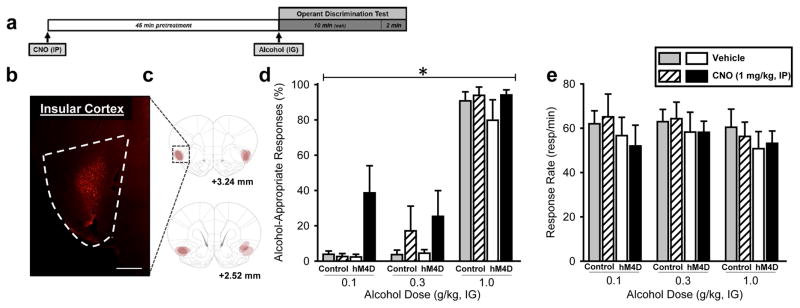
The insular cortex (IC) is a region proposed to modulate, in part, interoceptive states and motivated behavior. Interestingly, IC dysfunction and deficits in interoceptive processing are often found among individuals with substance-use disorders. Furthermore, the IC projects to the nucleus accumbens core (AcbC), a region known to modulate the discriminative stimulus/interoceptive effects of alcohol and other drug-related behaviors. Therefore, the goal of the present work was to investigate the possible role of the IC ➔ AcbC circuit in modulating the interoceptive effects of alcohol. Thus, we utilized a chemogenetic technique (hM4D designer receptor activation by designer drugs) to silence neuronal activity in the IC of rats trained to discriminate alcohol (1 g/kg, IG) versus water using an operant or Pavlovian alcohol discrimination procedure. Chemogenetic silencing of the IC or IC ➔ AcbC neuronal projections resulted in potentiated sensitivity to the interoceptive effects of alcohol in both the operant and Pavlovian tasks. Together, these data provide critical evidence for the nature of the complex IC circuitry and, specifically, suppression of the insular-striatal circuit in modulating behavior under a drug stimulus control.
脑岛(IC)被认为部分调节内脏状态和动机行为。有趣的是,在物质使用障碍个体中,常发现 IC 功能障碍和内脏加工缺陷。此外,IC 投射到伏隔核核心(AcbC),已知该区域调节酒精和其他与药物相关行为的辨别刺激/内脏效应。因此,本研究的目的是探讨 IC➔AcbC 回路在调节酒精内脏效应中的可能作用。因此,我们利用化学遗传技术(通过设计药物激活 hM4D 设计受体),沉默在通过操作性或巴甫洛夫式酒精辨别程序训练以辨别酒精(1g/kg,IG)与水的大鼠的 IC 中的神经元活动。IC 或 IC➔AcbC 神经元投射的化学遗传沉默导致在操作性和巴甫洛夫式任务中对酒精内脏效应的敏感性增强。这些数据共同为复杂的 IC 回路的性质提供了关键证据,特别是在药物刺激控制下调节行为时抑制脑岛纹状体回路。