Zhang Shuquan, Wu Minfei, Peng Chuangang, Zhao Guanjie, Gu Rui
Department of Orthopedics, Tianjing Nankai Hospital, Tianjin 300100, P.R. China.
Department of Orthopedics, The Second Hospital of Jilin University, Changchun, Jilin 130041, P.R. China.
Exp Ther Med. 2017 Sep;14(3):1905-1908. doi: 10.3892/etm.2017.4760. Epub 2017 Jul 10.
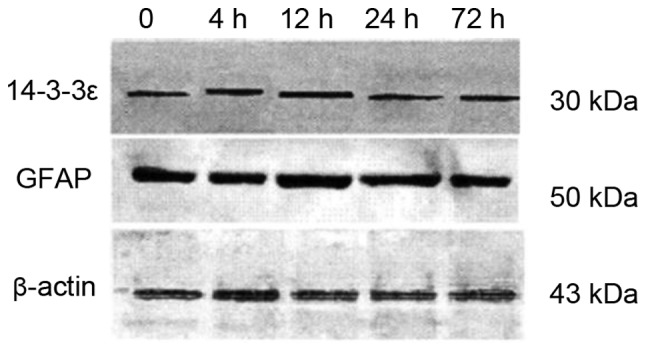
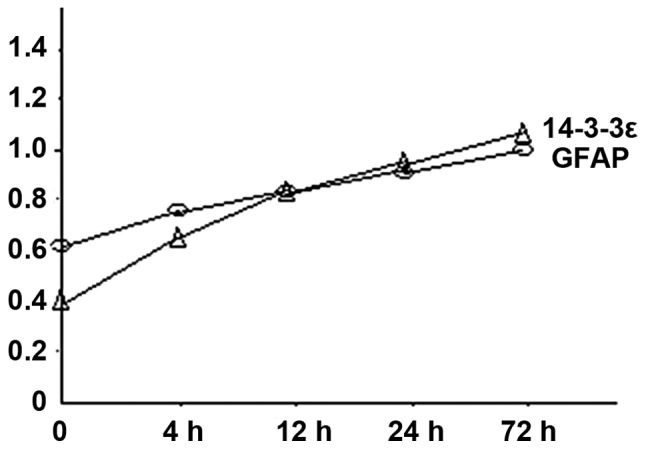
Glial fibrillary acidic protein (GFAP) is one of the best markers for the activation of astrocytes (AS) following injury or stress in the central nervous system (CNS). The purpose of this study was to examine the expression of GFAP and 14-3-3ε in rat AS subjected to hypoxia. We established primary cultures of AS from cerebral cortex of neonatal Sprague-Dawley rats as a model of glucose deficiency and hypoxia/ischemia-reperfusion. We analyzed the activated astrocyte markers GFAP and 14-3-3ε by western blot analysis and found that both increased over time, starting at 4 h and reaching the highest level at 72 h, at the end of the experiment. GFAP and 14-3-3ε protein localization by double-labeling immunofluorescence showed elevated expression and co-localization in the cytoplasm of AS. GFAP and 14-3-3ε expression remained elevated in AS 72 h after stress conditions, which is possibly related to the excessive activation and dysfunction of the CNS in chronic injuries.
胶质纤维酸性蛋白(GFAP)是中枢神经系统(CNS)损伤或应激后星形胶质细胞(AS)激活的最佳标志物之一。本研究的目的是检测缺氧大鼠AS中GFAP和14-3-3ε的表达。我们从新生Sprague-Dawley大鼠的大脑皮层建立了AS原代培养物,作为葡萄糖缺乏和缺氧/缺血再灌注的模型。我们通过蛋白质印迹分析来分析活化星形胶质细胞标志物GFAP和14-3-3ε,发现在实验结束时,二者均随时间增加,从4小时开始,在72小时达到最高水平。通过双标免疫荧光进行的GFAP和14-3-3ε蛋白定位显示,二者在AS细胞质中的表达升高且共定位。应激条件72小时后,AS中GFAP和14-3-3ε的表达仍然升高,这可能与慢性损伤中CNS的过度激活和功能障碍有关。