Romano Christine A, Zhou Mowei, Song Yang, Wysocki Vicki H, Dohnalkova Alice C, Kovarik Libor, Paša-Tolić Ljiljana, Tebo Bradley M
Institute of Environmental Health, Oregon Health & Science University, 3181 SW Sam Jackson Park Road, Portland, OR, 97239, USA.
Environmental Molecular Sciences Laboratory, Pacific Northwest National Laboratory, 3335 Innovation Blvd, Richland, WA, 99354, USA.
Nat Commun. 2017 Sep 29;8(1):746. doi: 10.1038/s41467-017-00896-8.
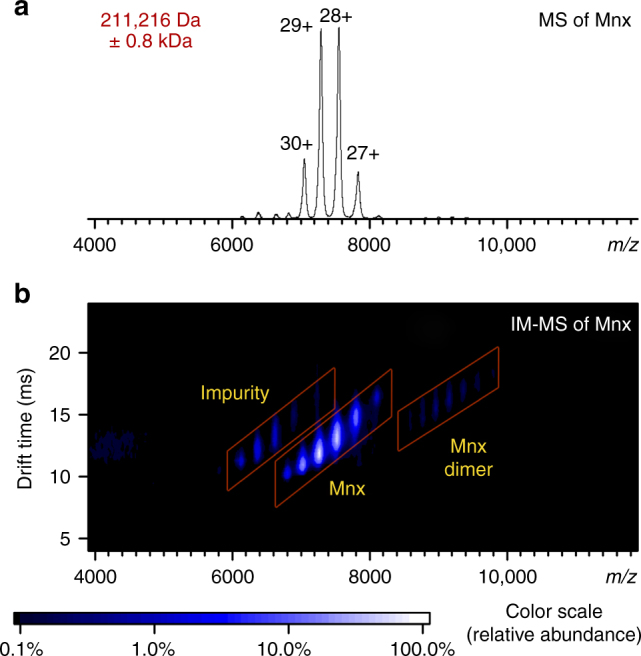
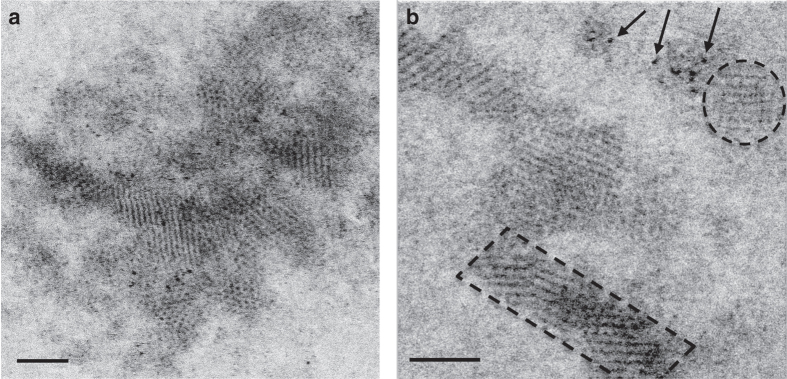
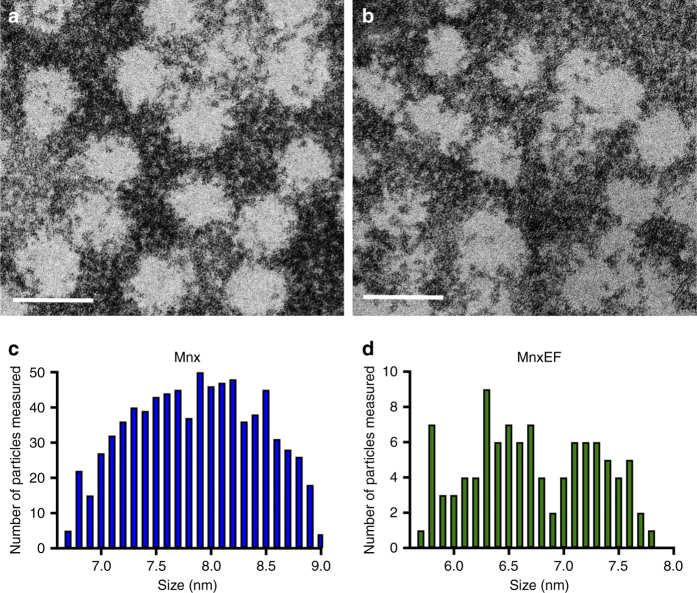
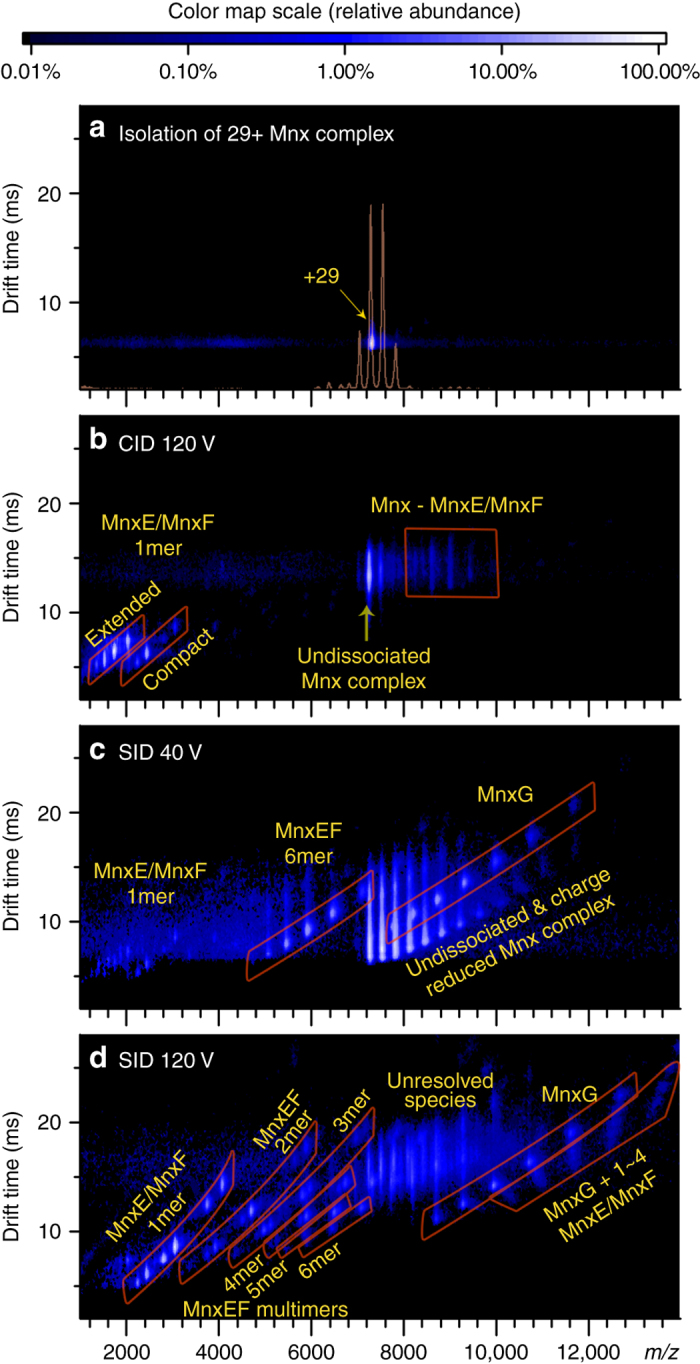
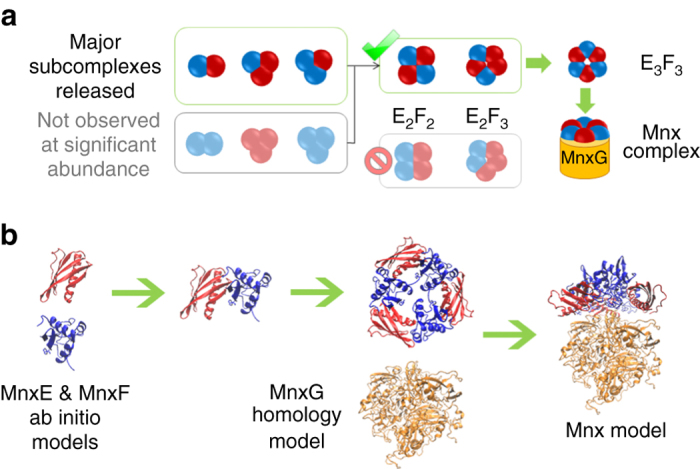
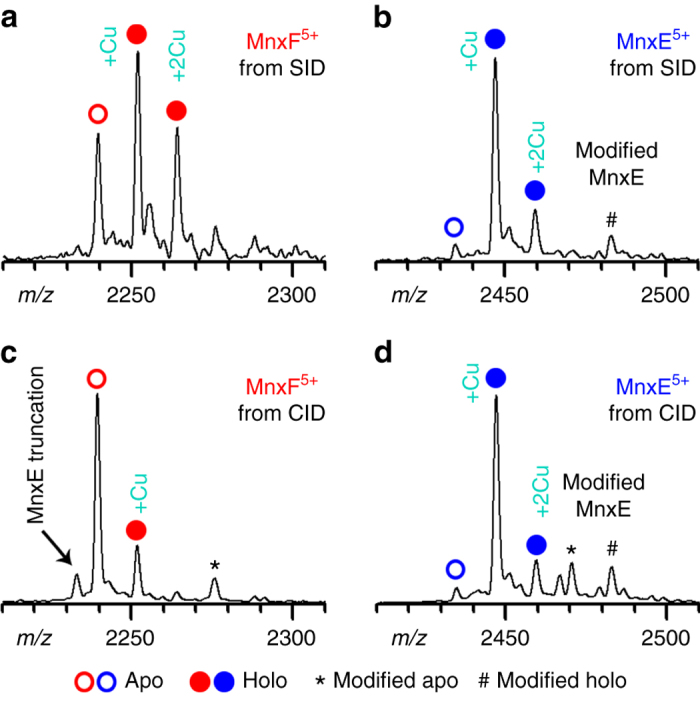
Bacteria that produce Mn oxides are extraordinarily skilled engineers of nanomaterials that contribute significantly to global biogeochemical cycles. Their enzyme-based reaction mechanisms may be genetically tailored for environmental remediation applications or bioenergy production. However, significant challenges exist for structural characterization of the enzymes responsible for biomineralization. The active Mn oxidase in Bacillus sp. PL-12, Mnx, is a complex composed of a multicopper oxidase (MCO), MnxG, and two accessory proteins, MnxE and MnxF. MnxG shares sequence similarity with other, structurally characterized MCOs. MnxE and MnxF have no similarity to any characterized proteins. The ~200 kDa complex has been recalcitrant to crystallization, so its structure is unknown. Here, we show that native mass spectrometry defines the subunit topology and copper binding of Mnx, while high-resolution electron microscopy visualizes the protein and nascent Mn oxide minerals. These data provide critical structural information for understanding Mn biomineralization by such unexplored enzymes.Significant challenges exist for structural characterization of enzymes responsible for biomineralization. Here the authors show that native mass spectrometry and high resolution electron microscopy can define the subunit topology and copper binding of a manganese oxidizing complex, and describe early stage formation of its mineral products.
产生锰氧化物的细菌是纳米材料方面极为出色的工程师,对全球生物地球化学循环有重大贡献。它们基于酶的反应机制可能经过基因定制,用于环境修复应用或生物能源生产。然而,负责生物矿化的酶的结构表征存在重大挑战。芽孢杆菌属PL - 12中的活性锰氧化酶Mnx是一种复合物,由多铜氧化酶(MCO)MnxG和两种辅助蛋白MnxE和MnxF组成。MnxG与其他已确定结构的MCO具有序列相似性。MnxE和MnxF与任何已鉴定的蛋白质都没有相似性。这个约200 kDa的复合物难以结晶,因此其结构未知。在这里,我们表明,原生质谱法确定了Mnx的亚基拓扑结构和铜结合情况,而高分辨率电子显微镜则可视化了该蛋白质和新生的锰氧化物矿物质。这些数据为理解此类未被探索的酶的锰生物矿化提供了关键的结构信息。负责生物矿化的酶的结构表征存在重大挑战。在这里,作者表明,原生质谱法和高分辨率电子显微镜可以确定锰氧化复合物的亚基拓扑结构和铜结合情况,并描述其矿物产物的早期形成过程。