Morales Elisa, Shaner Sarah E, Stone Kari L
Department of Chemistry, Lewis University, Romeoville, IL 60446, USA.
Department of Chemistry and Physics, Southeast Missouri State University, Cape Girardeau, MO 63701, USA.
Life (Basel). 2024 Jan 24;14(2):171. doi: 10.3390/life14020171.
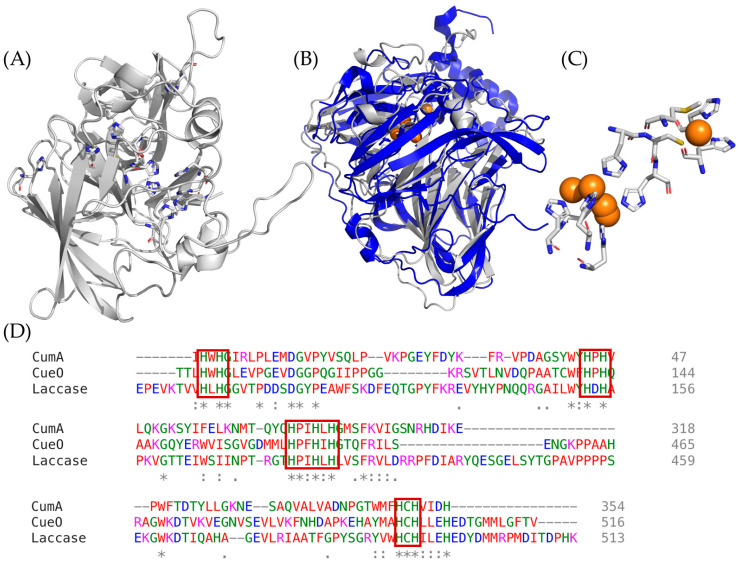
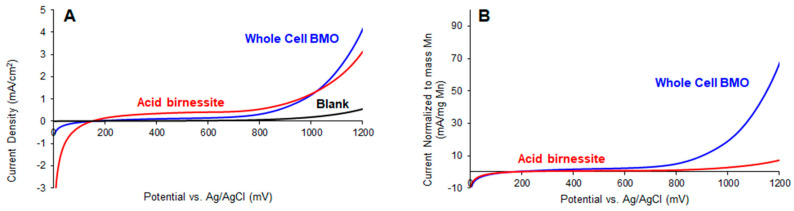
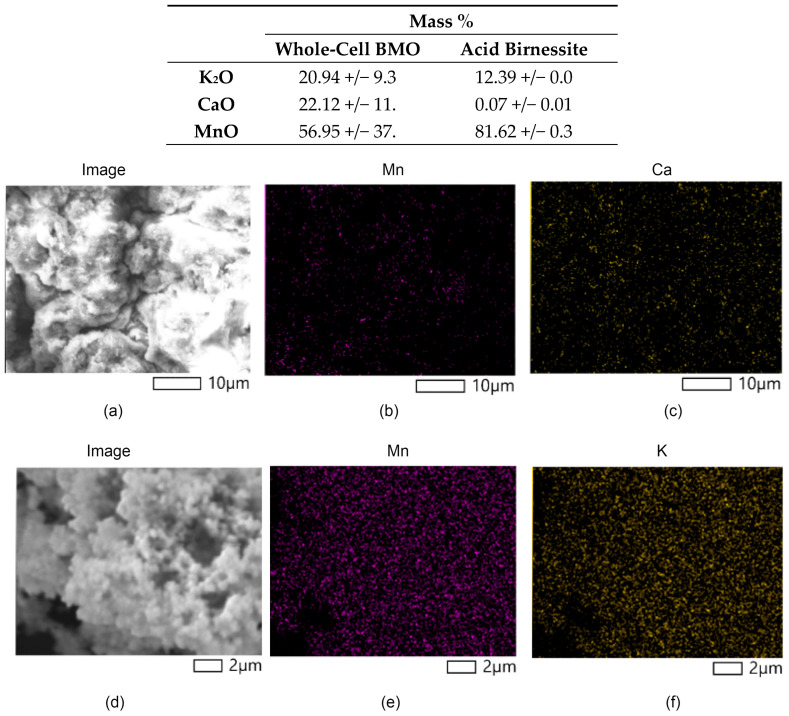
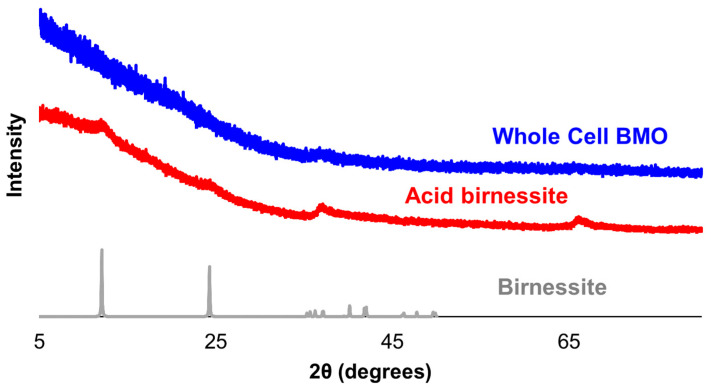
Mn-oxidizing microorganisms oxidize environmental Mn(II), producing Mn(IV) oxides. MnB1 is a widely studied organism for the oxidation of manganese(II) to manganese(IV) by a multi-copper oxidase. The biogenic manganese oxides (BMOs) produced by MnB1 and similar organisms have unique properties compared to non-biological manganese oxides. Along with an amorphous, poorly crystalline structure, previous studies have indicated that BMOs have high surface areas and high reactivities. It is also known that abiotic Mn oxides promote oxidation of organics and have been studied for their water oxidation catalytic function. MnB1 was grown and maintained and subsequently transferred to culturing media containing manganese(II) salts to observe the oxidation of manganese(II) to manganese(IV). The structures and compositions of these manganese(IV) oxides were characterized using scanning electron microscopy, energy dispersive X-ray spectroscopy, inductively coupled plasma optical emission spectroscopy, and powder X-ray diffraction, and their properties were assessed regarding catalytic functionality towards water oxidation in comparison to abiotic acid birnessite. Water oxidation was accomplished through the whole-cell catalysis of MnB1, the results for which compare favorably to the water-oxidizing ability of abiotic Mn(IV) oxides.
锰氧化微生物氧化环境中的二价锰,生成四价锰氧化物。MnB1是一种被广泛研究的通过多铜氧化酶将二价锰氧化为四价锰的微生物。与非生物锰氧化物相比,由MnB1及类似微生物产生的生物源锰氧化物(BMOs)具有独特的性质。除了具有无定形、结晶性差的结构外,先前的研究表明BMOs具有高比表面积和高反应活性。还已知非生物锰氧化物能促进有机物的氧化,并对其水氧化催化功能进行了研究。培养并维持MnB1,随后将其转移至含有二价锰盐的培养基中,以观察二价锰向四价锰的氧化过程。使用扫描电子显微镜、能量色散X射线光谱、电感耦合等离子体发射光谱和粉末X射线衍射对这些四价锰氧化物的结构和组成进行了表征,并与非生物酸性水钠锰矿相比,评估了它们对水氧化的催化功能。水氧化通过MnB1的全细胞催化完成,其结果与非生物四价锰氧化物的水氧化能力相比具有优势。