CAS Key Laboratory of Standardization and Measurement for Nanotechnology, CAS Key Laboratory for Biomedical Effects of Nanomaterials and Nanosafety, CAS Center for Excellence in Nanoscience, National Center for Nanoscience and Technology of China, Beijing, 100190, China.
Department of Chemistry, Stanford University, Stanford, CA, 94305, USA.
Nat Commun. 2017 Sep 29;8(1):737. doi: 10.1038/s41467-017-00917-6.
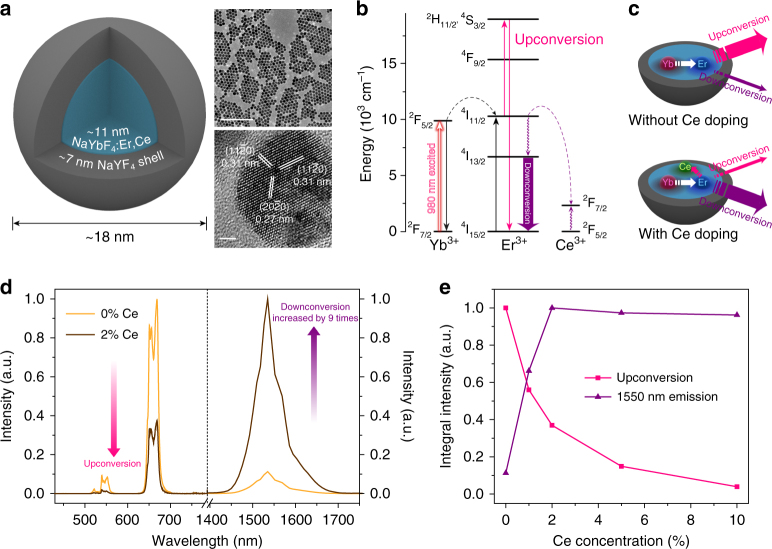
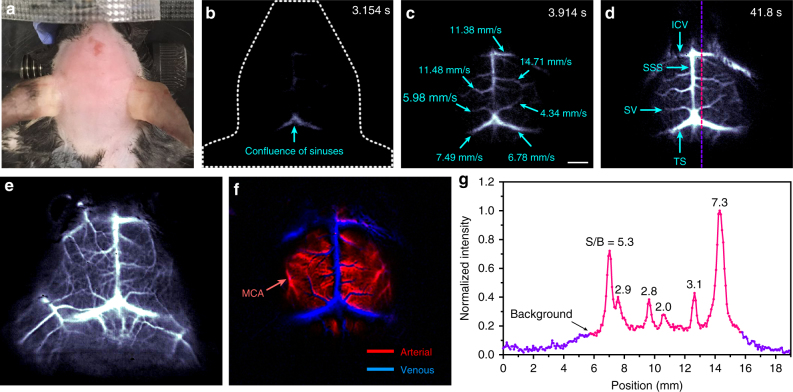
In vivo fluorescence imaging in the near-infrared region between 1500-1700 nm (NIR-IIb window) affords high spatial resolution, deep-tissue penetration, and diminished auto-fluorescence due to the suppressed scattering of long-wavelength photons and large fluorophore Stokes shifts. However, very few NIR-IIb fluorescent probes exist currently. Here, we report the synthesis of a down-conversion luminescent rare-earth nanocrystal with cerium doping (Er/Ce co-doped NaYbF nanocrystal core with an inert NaYF shell). Ce doping is found to suppress the up-conversion pathway while boosting down-conversion by ~9-fold to produce bright 1550 nm luminescence under 980 nm excitation. Optimization of the inert shell coating surrounding the core and hydrophilic surface functionalization minimize the luminescence quenching effect by water. The resulting biocompatible, bright 1550 nm emitting nanoparticles enable fast in vivo imaging of blood vasculature in the mouse brain and hindlimb in the NIR-IIb window with short exposure time of 20 ms for rare-earth based probes.Fluorescence imaging in the near-infrared window between 1500-1700 nm (NIR-IIb window) offers superior spatial resolution and tissue penetration depth, but few NIR-IIb probes exist. Here, the authors synthesize rare earth down-converting nanocrystals as promising fluorescent probes for in vivo imaging in this spectral region.
在 1500-1700nm 近红外区域(NIR-IIb 窗口)进行体内荧光成像是一种新方法,它提供了高空间分辨率、深组织穿透能力和减少的自发荧光,这是由于长波长光子的散射被抑制和大荧光体斯托克斯位移所致。然而,目前存在的 NIR-IIb 荧光探针非常少。在这里,我们报告了一种具有铈掺杂的下转换发光稀土纳米晶体的合成(具有惰性 NaYF 壳的 Er/Ce 共掺杂 NaYbF 纳米晶核)。发现 Ce 掺杂抑制了上转换途径,同时将下转换提高了约 9 倍,在 980nm 激发下产生明亮的 1550nm 发光。优化核周围的惰性壳涂层和亲水性表面功能化,最大限度地减少了水对发光的猝灭效应。由此产生的生物相容性、明亮的 1550nm 发射纳米粒子使得能够在 NIR-IIb 窗口中快速进行小鼠大脑和后肢的血管成像,基于稀土的探针的曝光时间仅为 20ms。