Centre of Endocrinology, William Harvey Research Institute, Barts and the London School of Medicine and Dentistry, Queen Mary University of London, Charterhouse Square, London, EC1M 6BQ, UK.
Rev Endocr Metab Disord. 2017 Dec;18(4):499-515. doi: 10.1007/s11154-017-9430-3.
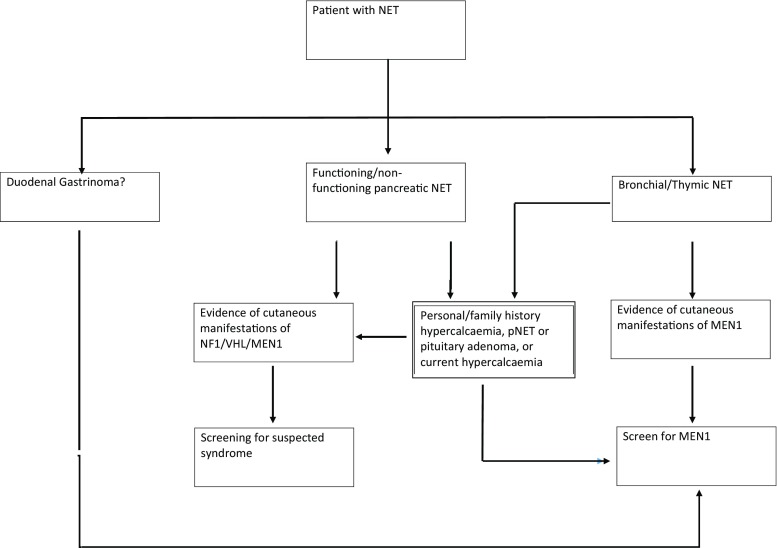
Neuroendocrine tumours (NETs) are a heterogenous group of tumours arising from neuroendocrine cells in several sites around the body. They include tumours of the gastroenteropancreatic system, phaeochromocytoma and paraganglioma and medullary thyroid cancer. In recent years, it has become increasingly apparent that a number of these tumours arise as a result of germline genetic mutations and are inherited in an autosomal dominant pattern. The number of genes implicated is increasing rapidly. Identifying which patients are likely to have a germline mutation enables clinicians to counsel patients adequately about their future disease risk, and allows for earlier detection of at-risk patients through family screening. The institution of screening and surveillance programmes may in turn lead to a major shift in presentation patterns for some of these tumours. In this review, we examine the features which may lead a clinician to suspect that a patient may have an inherited cause of a NET and we outline which underlying conditions should be suspected. We also discuss what type of screening may be appropriate in a variety of situations.
神经内分泌肿瘤(NET)是一组起源于体内多个部位神经内分泌细胞的异质性肿瘤。它们包括胃肠胰神经内分泌肿瘤、嗜铬细胞瘤和副神经节瘤以及甲状腺髓样癌。近年来,越来越明显的是,这些肿瘤中的许多是由于种系基因突变引起的,并以常染色体显性遗传模式遗传。涉及的基因数量正在迅速增加。确定哪些患者可能存在种系突变,使临床医生能够充分告知患者其未来的疾病风险,并通过家族筛查及早发现高危患者。筛查和监测计划的实施可能会反过来导致这些肿瘤中的一些肿瘤的表现模式发生重大转变。在这篇综述中,我们探讨了可能导致临床医生怀疑患者存在 NET 遗传病因的特征,并概述了应怀疑哪些潜在疾病。我们还讨论了在各种情况下进行何种类型的筛查可能是合适的。