Prakash Suman Susan, Rajshekar Deepashree, Cherian Anusha, Sastry Apurba Sankar
Department of Microbiology, Hospital Infection Control Committee, Jawaharlal Institute of Postgraduate Medical Education and Research, Puducherry, India.
Department of Anaesthesiology, Jawaharlal Institute of Postgraduate Medical Education and Research, Puducherry, India.
J Lab Physicians. 2017 Oct-Dec;9(4):273-278. doi: 10.4103/JLP.JLP_162_16.
The care bundle approach is a set of evidence-based practices that when performed collectively and reliably have been shown to improve the patient outcome.
To evaluate the impact of the bundle care approach on reducing device-associated infections (DAIs).
The study was conducted at a tertiary care hospital, South India. The study period was from January 2016 to September 2016 which was divided into three phases, each comprising 3 months.
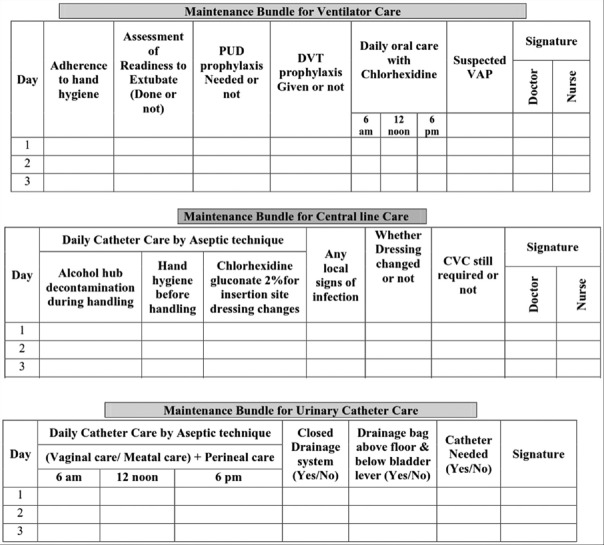
During the implementation phase, bundle care forms were implemented in all Intensive Care Units (ICUs) and the ICU staff were given a basic education on the importance of bundle care approach. The DAI rates (ventilator-associated pneumonia [VAP] rates, central line-associated bloodstream infection [CLABSI] rate, and catheter-associated urinary tract infection [CAUTI] rate) were calculated throughout the study period.
Statistical analysis was performed using SPSS 19 software.
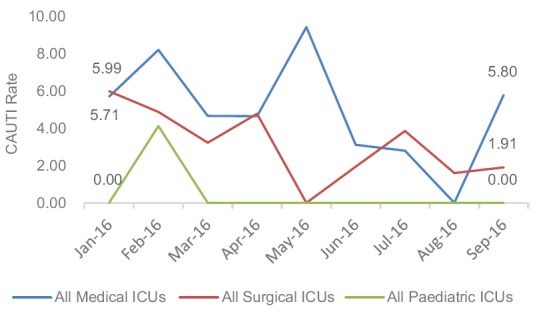
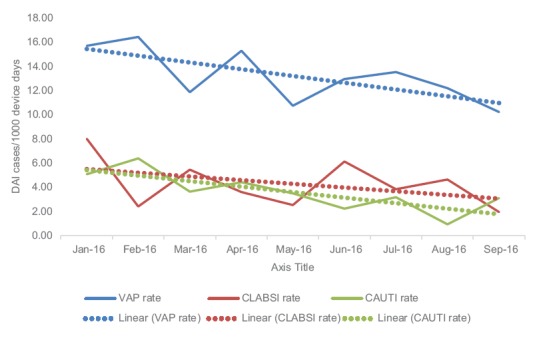
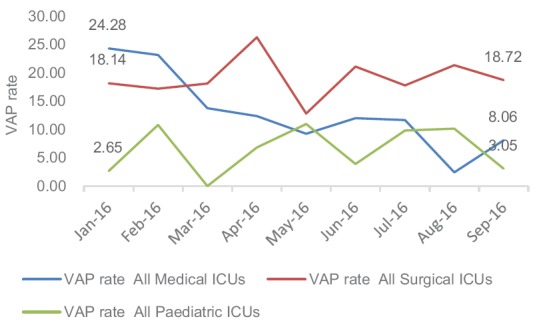
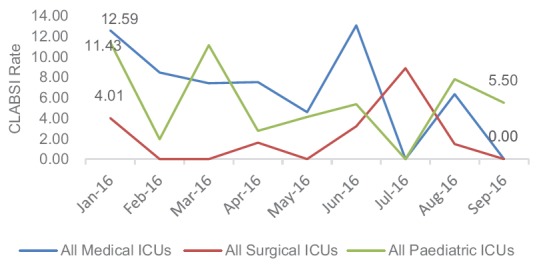
During preimplementation phase, the VAP rate, CLABSI rate, and CAUTI rate were 14.79, 4.98, and 4.86 per 1000 device days, respectively. Rates were reduced to 13.03, 3.98, and 3.39 per 1000 device days, respectively, during the implementation phase and further reduced into 11.91, 3.49, and 2.36 per 1000 device days during the postimplementation phase. The month-wise decreasing trend of DAI rates was significant for medical ICUs as compared to surgical and pediatric ICUs.
The month-wise decreasing trend of VAP rate, CLABSI rate, and CAUTI rate was noted, which signifies that the use of care bundle approach has a great impact on reducing DAIs.
护理集束化方法是一组基于证据的实践措施,当共同且可靠地实施时,已被证明可改善患者预后。
评估集束化护理方法对减少器械相关感染(DAIs)的影响。
该研究在印度南部的一家三级护理医院进行。研究期为2016年1月至2016年9月,分为三个阶段,每个阶段为期3个月。
在实施阶段,在所有重症监护病房(ICU)实施集束化护理表格,并对ICU工作人员进行集束化护理方法重要性的基础教育。在整个研究期间计算DAI率(呼吸机相关性肺炎[VAP]率、中心静脉导管相关血流感染[CLABSI]率和导尿管相关尿路感染[CAUTI]率)。
使用SPSS 19软件进行统计分析。
在实施前阶段,VAP率、CLABSI率和CAUTI率分别为每1000器械日14.79、4.98和4.86。在实施阶段,这些率分别降至每1000器械日13.03、3.98和3.39,在实施后阶段进一步降至每1000器械日11.91、3.49和2.36。与外科和儿科ICU相比,医疗ICU的DAI率逐月下降趋势显著。
观察到VAP率、CLABSI率和CAUTI率逐月下降趋势,这表明集束化护理方法的使用对减少DAIs有很大影响。