Kwan Terence T-L, Boutureira Omar, Frye Elizabeth C, Walsh Stephen J, Gupta Moni K, Wallace Stephen, Wu Yuteng, Zhang Fengzhi, Sore Hannah F, Galloway Warren R J D, Chin Jason W, Welch Martin, Bernardes Gonçalo J L, Spring David R
Department of Chemistry , University of Cambridge , Lensfield Rd , Cambridge CB2 1EW , UK . Email:
Medical Research Council , Laboratory of Molecular Biology , Francis Crick Avenue, Cambridge Biomedical Campus , Cambridge CB2 0QH , UK.
Chem Sci. 2017 May 1;8(5):3871-3878. doi: 10.1039/c6sc05313k. Epub 2017 Mar 14.
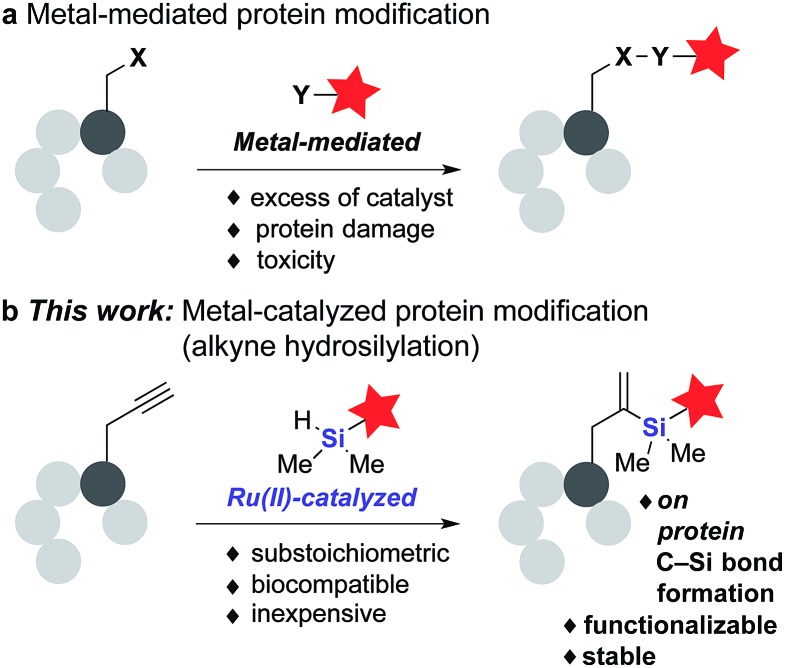
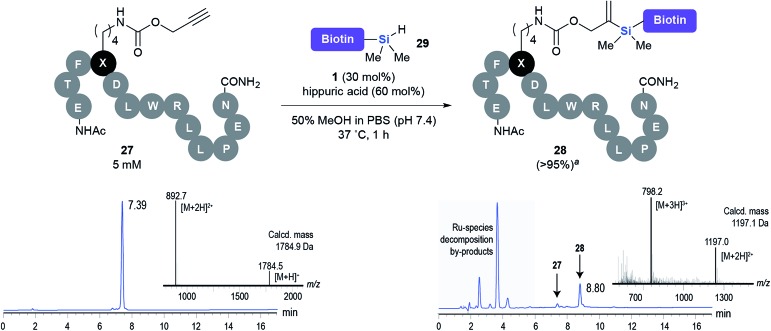
Transition metal catalysis has emerged as a powerful strategy to expand synthetic flexibility of protein modification. Herein, we report a cationic Ru(ii) system that enables the first example of alkyne hydrosilylation between dimethylarylsilanes and -propargyl-functionalized proteins using a substoichiometric amount or low-loading of Ru(ii) catalyst to achieve the first C-Si bond formation on full-length substrates. The reaction proceeds under physiological conditions at a rate comparable to other widely used bioorthogonal reactions. Moreover, the resultant -disubstituted vinylsilane linkage can be further elaborated through thiol-ene coupling or fluoride-induced protodesilylation, demonstrating its utility in further rounds of targeted modifications.
过渡金属催化已成为一种强大的策略,可扩展蛋白质修饰的合成灵活性。在此,我们报道了一种阳离子钌(II)体系,该体系首次实现了使用亚化学计量或低负载量的钌(II)催化剂,使二甲基芳基硅烷与炔丙基功能化蛋白质之间发生硅氢化反应,从而在全长底物上实现首个碳-硅键的形成。该反应在生理条件下进行,反应速率与其他广泛使用的生物正交反应相当。此外,所得的二取代乙烯基硅烷键可通过硫醇-烯偶联或氟化物诱导的原硅烷基化进一步修饰,证明了其在进一步靶向修饰中的实用性。