Vardon Ashley, Dandapani Madhumita, Cheng Daryl, Cheng Paul, De Santo Carmela, Mussai Francis
Institute of Immunology and Immunotherapy, University of Birmingham, Birmingham, United Kingdom.
Bio-Cancer Treatment International Ltd, Hong Kong, China.
Oncotarget. 2017 Jun 29;8(38):63506-63517. doi: 10.18632/oncotarget.18843. eCollection 2017 Sep 8.
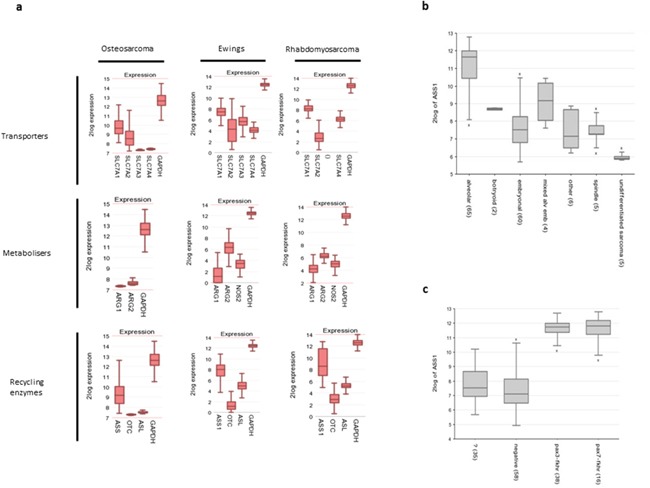
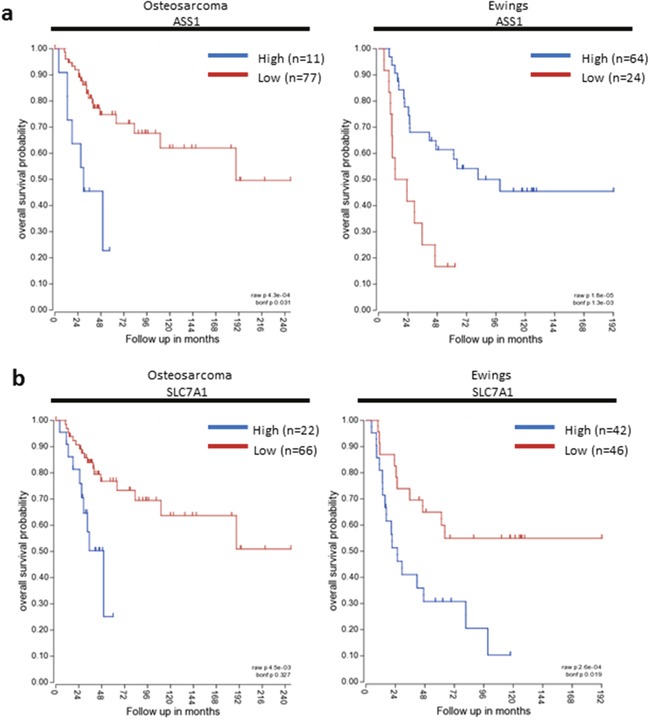
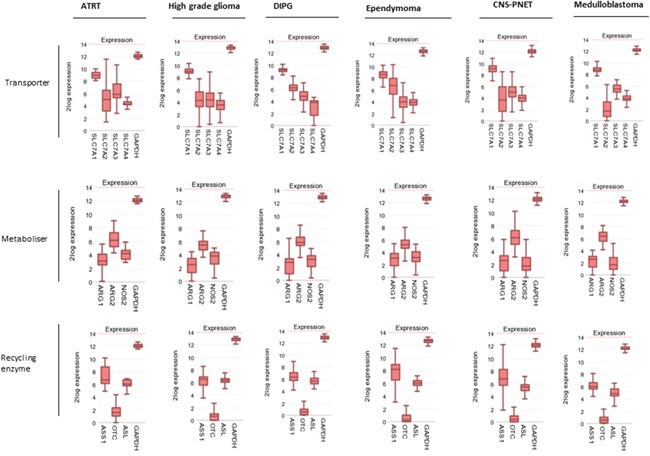
Paediatric sarcomas and brain tumours, remain cancers of significant unmet need, with a poor prognosis for patients with high risk disease or those who relapse, and significant morbidities from treatment for those that survive using standard treatment approaches. Novel treatment strategies, based on the underlying tumour biology, are needed to improve outcomes. Arginine is a semi-essential amino acid that is imported from the extracellular microenvironment or recycled from intracellular precursors through the combined expression of the enzymes ornithine transcarbamylase (OTC), argininosuccinate synthase (ASS) and argininosuccinate lyase (ASL) enzymes. The failure to express at least one of these recycling enzymes makes cells reliant on extracellular arginine - a state known as arginine auxotrophism. Here we show in large in silico patient cohorts that paediatric sarcomas and brain tumours express predominately the arginine transporter SLC7A1 and the arginine metabolising enzyme Arginase 2 (ARG2), but have low-absent expression of OTC. The arginine metabolic pathway correlated with the expression of genes associated with tumour pathogenesis, and overall survival in paediatric sarcomas. This gene signature of arginine auxotrophism indicates paediatric sarcomas and brain tumours are a viable target for therapeutic arginase drugs under current clinical trial development.
小儿肉瘤和脑肿瘤仍然是需求未得到充分满足的癌症,对于高危疾病患者或复发患者预后较差,而对于那些采用标准治疗方法存活下来的患者,治疗会带来显著的并发症。需要基于肿瘤生物学基础的新型治疗策略来改善治疗效果。精氨酸是一种半必需氨基酸,可从细胞外微环境中导入,或通过鸟氨酸转氨甲酰酶(OTC)、精氨琥珀酸合酶(ASS)和精氨琥珀酸裂解酶(ASL)的联合表达从细胞内前体中循环利用。无法表达这些循环利用酶中的至少一种会使细胞依赖细胞外精氨酸——这种状态称为精氨酸营养缺陷型。在这里,我们在大量的计算机模拟患者队列中表明,小儿肉瘤和脑肿瘤主要表达精氨酸转运蛋白SLC7A1和精氨酸代谢酶精氨酸酶2(ARG2),但OTC表达低或无表达。精氨酸代谢途径与小儿肉瘤中与肿瘤发病机制相关的基因表达以及总体生存率相关。这种精氨酸营养缺陷型的基因特征表明,小儿肉瘤和脑肿瘤是当前临床试验正在开发的治疗性精氨酸酶药物的可行靶点。