Wu Dapeng, Liu Liguo, Yan Xuebing, Wang Chunyan, Wang Yaling, Han Kun, Lin Shuchen, Gan Zhihua, Min Daliu
Department of Oncology, Shanghai Jiao Tong University Affiliated Sixth People's Hospital, Shanghai, China.
Department of General Surgery, Shanghai Jiao Tong University Affiliated Sixth People's Hospital, Shanghai, China.
Oncotarget. 2017 Jul 10;8(38):63857-63870. doi: 10.18632/oncotarget.19148. eCollection 2017 Sep 8.
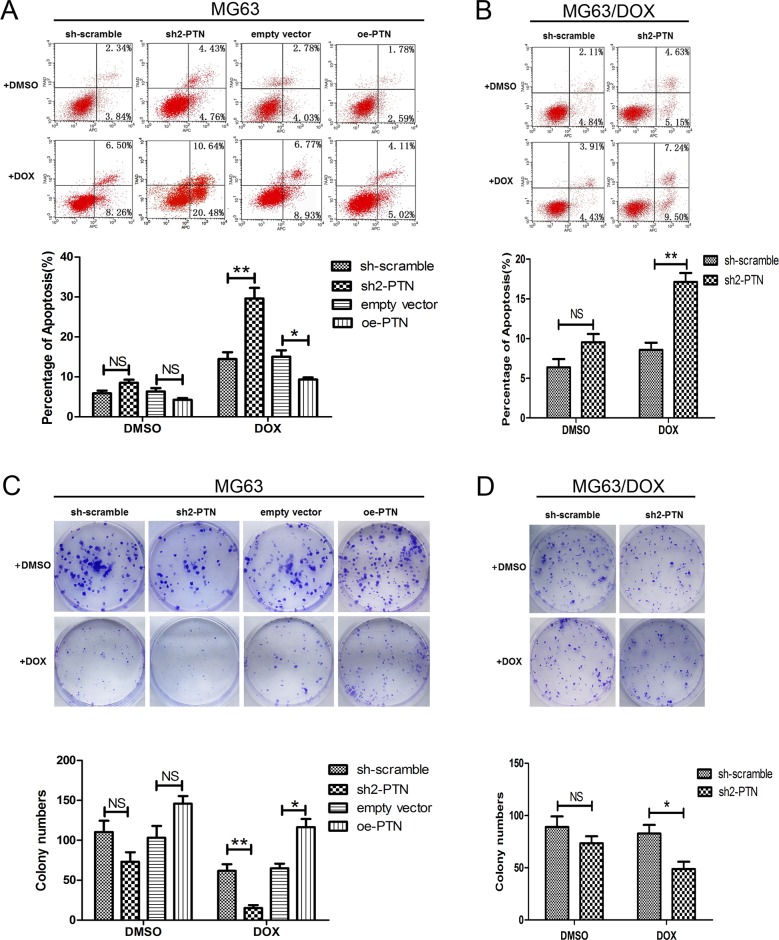
Chemoresistance is a major hindrance to successful treatment of osteosarcoma (OS). Pleiotrophin (PTN), a neurotrophic growth factor, has been linked to the malignant characteristics of various cancer types. We retrospectively examined the correlation between PTN expression and chemoresistance in OS in a cohort of 133 OS patients. Immunohistochemistry revealed that PTN expression correlated with the necrosis rate and local OS recurrence. In a prognostic analysis, high PTN expression was associated with poor overall and disease-free survival, and was an independent adverse prognostic factor for disease-free survival. In doxorubicin-treated OS cells, PTN knockdown enhanced cellular chemosensitivity, increased the apoptosis rate and inhibited clone formation, while PTN overexpression had the opposite effects. In a xenograft model, PTN knockdown and overexpression respectively enhanced and reduced cellular sensitivity to doxorubicin. PTN upregulated anaplastic lymphoma kinase (ALK), p-Glycogen Synthase Kinase (GSK)3β, β-catenin and multidrug resistance protein 1/P-glycoprotein (MDR1/P-gp). In rescue assays with the β-catenin inhibitor XAV939 and the MDR1/P-gp inhibitor verapamil, PTN promoted chemoresistance to doxorubicin in OS cells by activating ALK/GSK3β/β-catenin signaling, thereby upregulating MDR1/P-gp. Therefore, PTN could be used as a biomarker predicting chemotherapeutic responses, and downregulating PTN could be a promising therapeutic strategy to prevent chemoresistance in OS patients.
化疗耐药是骨肉瘤(OS)成功治疗的主要障碍。多效生长因子(PTN)是一种神经营养生长因子,与多种癌症类型的恶性特征有关。我们回顾性研究了133例OS患者队列中PTN表达与OS化疗耐药之间的相关性。免疫组织化学显示,PTN表达与坏死率和局部OS复发相关。在一项预后分析中,PTN高表达与总体生存率和无病生存率差相关,并且是无病生存率的独立不良预后因素。在阿霉素处理的OS细胞中,PTN敲低增强了细胞化学敏感性,增加了凋亡率并抑制了克隆形成,而PTN过表达则产生相反的效果。在异种移植模型中,PTN敲低和过表达分别增强和降低了细胞对阿霉素的敏感性。PTN上调间变性淋巴瘤激酶(ALK)、磷酸化糖原合酶激酶(GSK)3β、β-连环蛋白和多药耐药蛋白1/ P-糖蛋白(MDR1 / P-gp)。在用β-连环蛋白抑制剂XAV939和MDR1 / P-gp抑制剂维拉帕米进行的挽救试验中,PTN通过激活ALK / GSK3β/β-连环蛋白信号通路促进OS细胞对阿霉素的化疗耐药,从而上调MDR1 / P-gp。因此,PTN可作为预测化疗反应的生物标志物,下调PTN可能是预防OS患者化疗耐药的一种有前景的治疗策略。