Kim Sung Han, Joung Jae Young, Suh Yoon Seok, Kim Young Ae, Hong Jin Hyuk, Kuark Tong Sun, Lee Eun Sook, Lee Kang Hyun
Department of Urology, Center for Prostate Cancer, Research Institute and Hospital of National Cancer Center, Goyang, Korea.
Cancer Policy Branch, National Cancer Control Institute, National Cancer Center, Goyang, Korea.
Oncotarget. 2017 Jul 22;8(38):64250-64262. doi: 10.18632/oncotarget.19453. eCollection 2017 Sep 8.
The study was aimed to evaluate the prevalence and prognosis of prostate cancer (PC) and end-stage renal disease (ESRD), determine the risk factors for overall survival (OS) and PC-specific survival (CSS), and evaluate differences in PC-related clinical therapeutic patterns between patients with and without PC-ESRD.
This observational population study, performed at the National Cancer Center and Cancer Research Institute in Korea, included patients with PC and ESRD from the nationwide Korean Health Insurance System and Korean Central Cancer Registry data. Five-year overall and cancer-specific survival. A joinpoint regression analysis was performed to predict incidence and mortality of PC. Survival was analyzed using Kaplan-Meir curves with log rank tests of patients with dialysis or transplantation.
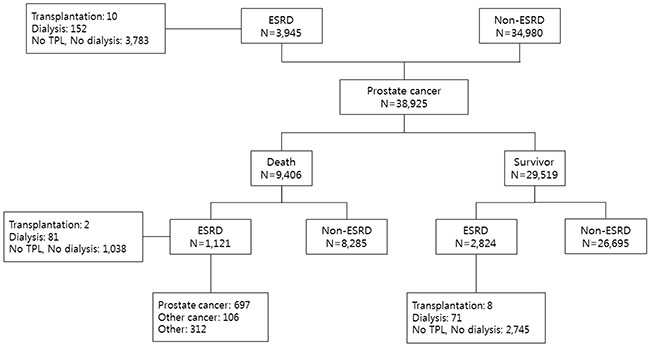
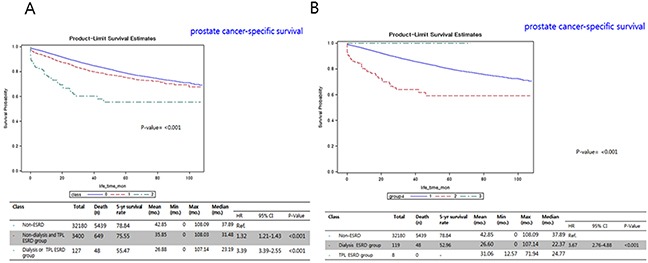
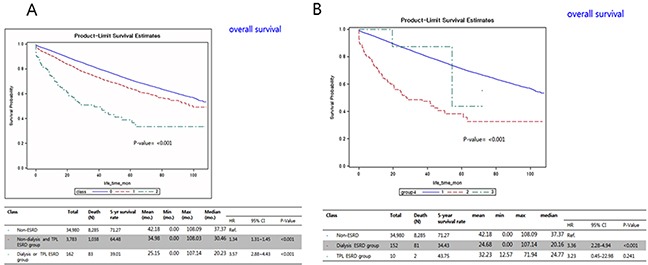
Of 3945 patients with PC-ESRD, 3.9% were on dialysis (N=152), 0.2% had kidney transplantation (N=10, D-TPL group); 3783 (95.9%) had neither dialysis nor transplantation (non-D-TPL ESRD group). There were 697 PC-specific deaths. The median respective OS, PC-specific survival, and 5-year survival rates in the non-ESRD, non-D-TPL ESRD, dialysis ESRD, and transplantation ESRD groups were significantly different (p<0.001). Presence of ESRD, age, body mass index, SEER stage, no treatment within 6 months after diagnosis, no surgery, chemotherapy, radiotherapy or hormonal therapy, non-adenocarcinoma pathology, and Charlson comorbidity index were independent risk factors for OS and CSS.
With a 10.1% nationwide prevalence of PC-ESRD, the presence of ESRD was a significant survival factor along with other significant clinicopathological factors.
本研究旨在评估前列腺癌(PC)和终末期肾病(ESRD)的患病率及预后,确定总生存期(OS)和PC特异性生存期(CSS)的危险因素,并评估合并和未合并PC-ESRD患者之间PC相关临床治疗模式的差异。
这项在韩国国立癌症中心和癌症研究所进行的观察性人群研究,纳入了来自全国韩国健康保险系统和韩国中央癌症登记数据中的PC和ESRD患者。计算5年总生存期和癌症特异性生存期。采用Joinpoint回归分析预测PC的发病率和死亡率。使用Kaplan-Meir曲线和对数秩检验分析透析或移植患者的生存期。
在3945例PC-ESRD患者中,3.9%接受透析(n = 152),0.2%接受肾移植(n = 10,D-TPL组);3783例(95.9%)既未接受透析也未接受移植(非D-TPL ESRD组)。有697例PC特异性死亡。非ESRD、非D-TPL ESRD、透析ESRD和移植ESRD组的中位OS、PC特异性生存期和5年生存率有显著差异(p<0.001)。ESRD的存在、年龄、体重指数、SEER分期、诊断后6个月内未治疗、未进行手术、化疗、放疗或激素治疗、非腺癌病理以及Charlson合并症指数是OS和CSS的独立危险因素。
PC-ESRD在全国的患病率为10.1%,ESRD的存在与其他重要的临床病理因素一样,是一个重要的生存因素。