Jin Xi, Yu Mo-Sang, Huang Yue, Xiang Zun, Chen Yi-Peng
Department of Gastroenterology, The First Affiliated Hospital, School of Medicine, Zhejiang University, Hangzhou, Zhejiang, China.
Oncotarget. 2017 Jul 31;8(38):64294-64302. doi: 10.18632/oncotarget.19729. eCollection 2017 Sep 8.
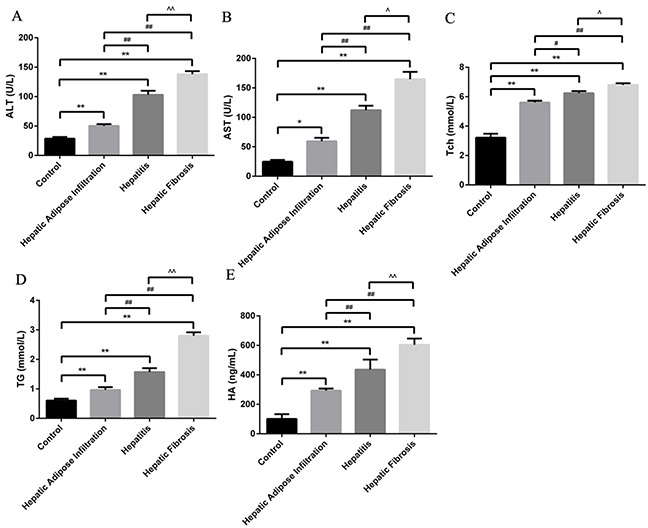
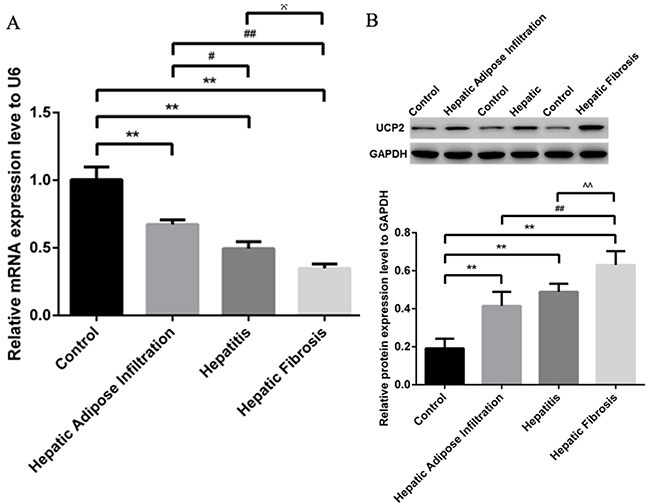
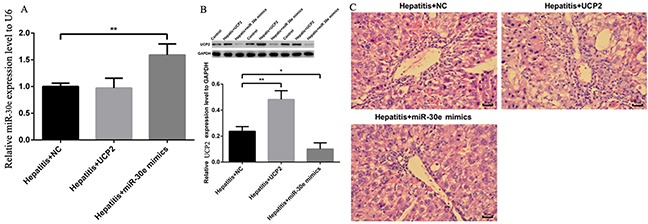
To investigate the expression of miR-30e-UCP2 pathway in different stages of alcoholic liver disease (ALD) and its capacity and mechanism in regulating alcoholic hepatitis (AH) progress. C57BL/6 mice were fed with Lieber-DeCaril (LD) diet for 4 and 12 weeks to establish models of alcoholic fat infiltration (AFI) and AH. Based on AFI feeding, the alcoholic hepatic fibrosis (AHF) was set up with additional 4 weeks 5% carbon tetrachloride intra-abdominal injection twice per week. Serum lipid and inflammation related makers were detected while H-E staining for hepatic steatosis/ inflammation and Sirius staining for hepatic fibrosis were conducted. The apoptosis degree was tested by TUNEL plot while the hydrogen peroxide (HO) and ATP levels were tested by colorimetric method. MiR-30e and UCP2 over-expression were carried out by synthesizing miR-30e mimic and inserting UCP2 sequence into pCDNA3.1 plasmid. Different stages of ALD were established as indicated by increased serum TG, Tch, ALT, AST, apoptosis degree and hyaluronic acid levels as well as the typical lipid deposition, inflammatory cell infiltration and fibrosis formation in AFI, AH and AHF stages. A stepwise decreased miR-30e and increased UCP2 level was identified from AFI to AHF (p<0.05). MiR-30e over-expression significantly decreased UCP2 level. After successful miR-30e over-expression in AH, its inflammation level was decreased, followed by significantly increased ATP and HO levels. Therefore, MiR-30e-UCP2 pathway participates in different stages of ALD and its therapeutic effect on AH may be through influencing oxidative stress and energy metabolism.
探讨miR-30e-UCP2通路在酒精性肝病(ALD)不同阶段的表达及其调控酒精性肝炎(AH)进展的能力和机制。将C57BL/6小鼠用Lieber-DeCaril(LD)饮食喂养4周和12周,以建立酒精性脂肪浸润(AFI)和AH模型。在AFI喂养的基础上,通过每周两次额外腹腔注射5%四氯化碳建立酒精性肝纤维化(AHF)模型。检测血清脂质和炎症相关标志物,同时进行肝脏脂肪变性/炎症的苏木精-伊红(H-E)染色和肝纤维化的天狼星染色。通过TUNEL法检测凋亡程度,通过比色法检测过氧化氢(HO)和ATP水平。通过合成miR-30e模拟物并将UCP2序列插入pCDNA3.1质粒来实现miR-30e和UCP2的过表达。血清甘油三酯(TG)、总胆固醇(Tch)、谷丙转氨酶(ALT)、谷草转氨酶(AST)、凋亡程度和透明质酸水平升高,以及AFI、AH和AHF阶段典型的脂质沉积、炎性细胞浸润和纤维化形成,表明建立了ALD的不同阶段。从AFI到AHF,miR-30e呈逐步下降,UCP2水平升高(p<0.05)。miR-30e过表达显著降低UCP2水平。在AH中成功过表达miR-30e后,其炎症水平降低,随后ATP和HO水平显著升高。因此,miR-30e-UCP2通路参与ALD的不同阶段,其对AH的治疗作用可能是通过影响氧化应激和能量代谢实现的。