Tsvetkova Anastasia, Ozerov Ivan V, Pustovalova Margarita, Grekhova Anna, Eremin Petr, Vorobyeva Natalia, Eremin Ilya, Pulin Andrey, Zorin Vadim, Kopnin Pavel, Leonov Sergey, Zhavoronkov Alex, Klokov Dmitry, Osipov Andreyan N
Lomonosov Moscow State University, Moscow 119991, Russia.
State Research Center - Burnasyan Federal Medical Biophysical Center of Federal Medical Biological Agency (SRC-FMBC), Moscow 123098, Russia.
Oncotarget. 2017 Jul 12;8(38):64317-64329. doi: 10.18632/oncotarget.19203. eCollection 2017 Sep 8.
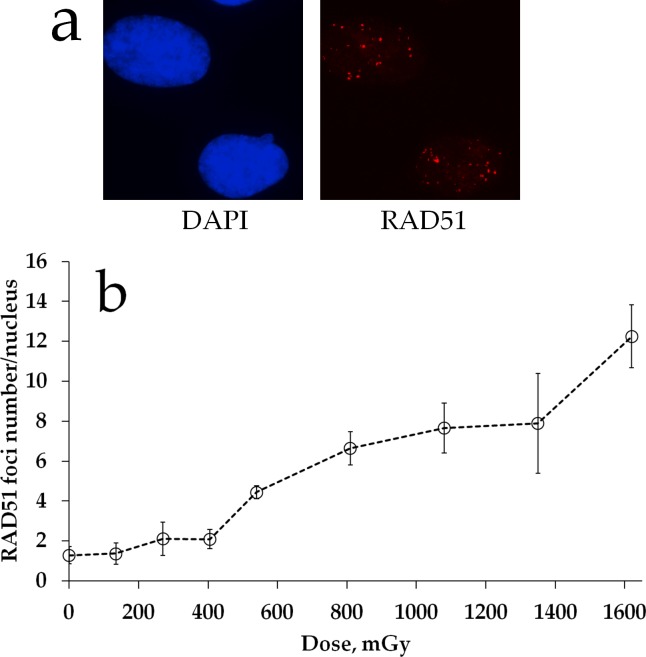
At high exposure levels ionizing radiation is a carcinogen. Little is known about how human stem cells, which are known to contribute to tumorigenesis, respond to prolonged radiation exposures. We studied formation of DNA double strand breaks, accessed as γH2AX and 53BP1 foci, in human mesenchymal stem cells (MSCs) exposed to either acute (5400 mGy/h) or prolonged (270 mGy/h) X-irradiation. We show a linear γH2AX and 53BP1 dose response for acute exposures. In contrast, prolonged exposure resulted in a dose-response curve that had an initial linear portion followed by a plateau. Analysis of Rad51 foci, as a marker of homologous recombination, in cells exposed to prolonged irradiation revealed a threshold in a dose response. Using Ki67 as a marker of proliferating cells, we show no difference in the γH2AX distribution in proliferating vs. quiescent cells. However, Rad51 foci were found almost exclusively in proliferating cells. Concurrent increases in the fraction of S/G2 cells were detected in cells exposed to prolonged irradiation by scoring CENPF-positive cells. Our data suggest that prolonged exposure of MSCs to ionizing radiation leads to cell cycle redistribution and associated activation of homologous recombination. Also, proliferation status may significantly affect the biological outcome, since homologous repair is not activated in resting MSCs.
在高暴露水平下,电离辐射是一种致癌物。人们对已知会促进肿瘤发生的人类干细胞如何应对长时间辐射暴露知之甚少。我们研究了暴露于急性(5400 mGy/h)或长时间(270 mGy/h)X射线照射下的人间充质干细胞(MSC)中DNA双链断裂的形成情况,通过γH2AX和53BP1焦点来评估。我们发现急性暴露时γH2AX和53BP1的剂量反应呈线性。相比之下,长时间暴露导致的剂量反应曲线有一个初始线性部分,随后是一个平台期。对暴露于长时间照射的细胞中作为同源重组标志物的Rad51焦点进行分析,发现剂量反应存在一个阈值。使用Ki67作为增殖细胞的标志物,我们发现增殖细胞与静止细胞中γH2AX的分布没有差异。然而,Rad51焦点几乎只在增殖细胞中发现。通过对CENPF阳性细胞进行评分,发现在暴露于长时间照射的细胞中S/G2期细胞比例同时增加。我们的数据表明,间充质干细胞长时间暴露于电离辐射会导致细胞周期重新分布以及相关的同源重组激活。此外,增殖状态可能会显著影响生物学结果,因为静止的间充质干细胞中同源修复未被激活。