Queensland Alliance for Agriculture and Food Innovation, University of Queensland, Brisbane, St Lucia, Qld, Australia.
Division of Genomic Resources, ICAR-National Bureau of Plant Genetic Resources, New Delhi, 110012, India.
Sci Rep. 2017 Oct 2;7(1):12539. doi: 10.1038/s41598-017-12845-y.
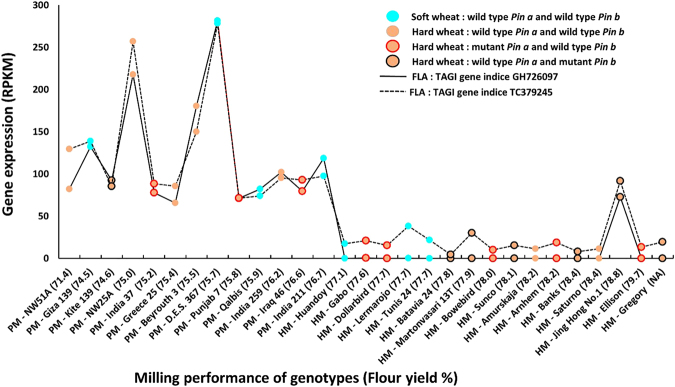
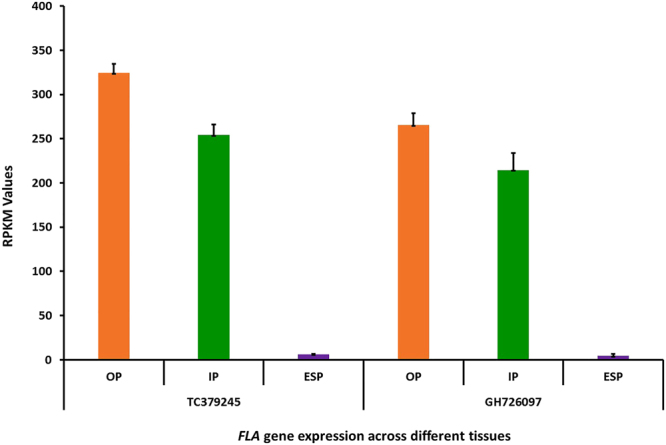
A large portion of the global wheat crop is milled to produce flour for use in the production of foods such as bread. Pressure to increase food supplies sustainably can be address directly by reducing post-harvest losses during processes such as flour milling. The recovery of flour in the milling of wheat is genetically determined but difficult to assess in wheat breeding due to the requirement for a large sample. Here we report the discovery that human selection for altered expression of putative cell adhesion proteins is associated with wheats that give high yields of flour on milling. Genes encoding fasciclin-like arabinogalactan proteins are expressed at low levels in high milling wheat genotypes at mid grain development. Thirty worldwide wheat genotypes were grouped into good and poor millers based flour yield obtained from laboratory scale milling of mature seeds. Differentially expressed genes were identified by comparing transcript profiles at 14 and 30 days post anthesis obtained from RNA-seq data of all the genotypes. Direct selection for genotypes with appropriate expression of these genes will greatly accelerate wheat breeding and ensure high recoveries of flour from wheat by resulting in grains that break up more easily on milling.
全球很大一部分小麦作物被磨成面粉,用于生产面包等食品。通过减少面粉加工等过程中的收获后损失,可以直接解决可持续增加粮食供应的压力。在小麦育种中,由于需要大量样本,因此,面粉在磨粉过程中的回收率是由遗传决定的,但很难评估。在这里,我们报告了一个发现,即人类选择改变假定的细胞粘附蛋白的表达与磨粉时出粉率高的小麦有关。在籽粒发育中期,高出粉率小麦基因型中编码纤维蛋白样阿拉伯半乳聚糖蛋白的基因表达水平较低。根据从成熟种子的实验室规模磨粉获得的面粉产量,将 30 个全球小麦基因型分为好磨粉和差磨粉。通过比较所有基因型的 RNA-seq 数据在授粉后 14 天和 30 天获得的转录谱,鉴定了差异表达的基因。直接选择这些基因表达适当的基因型将极大地加速小麦育种,并确保从小麦中获得高回收率的面粉,从而使谷物在磨粉时更容易破碎。