Mostafavi Lab, Department of Statistics, University of British Columbia, Vancouver, BC, Canada.
Parietal team, INRIA Saclay, Gif-sur-Yvette, France.
Neuroimage Clin. 2017 Sep 6;16:575-585. doi: 10.1016/j.nicl.2017.09.004. eCollection 2017.
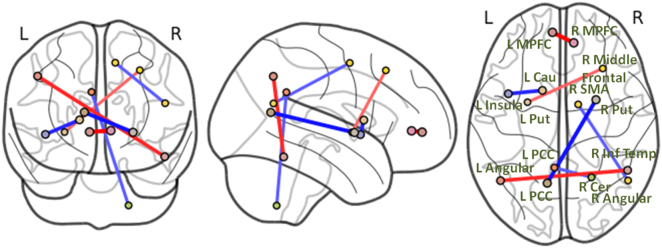
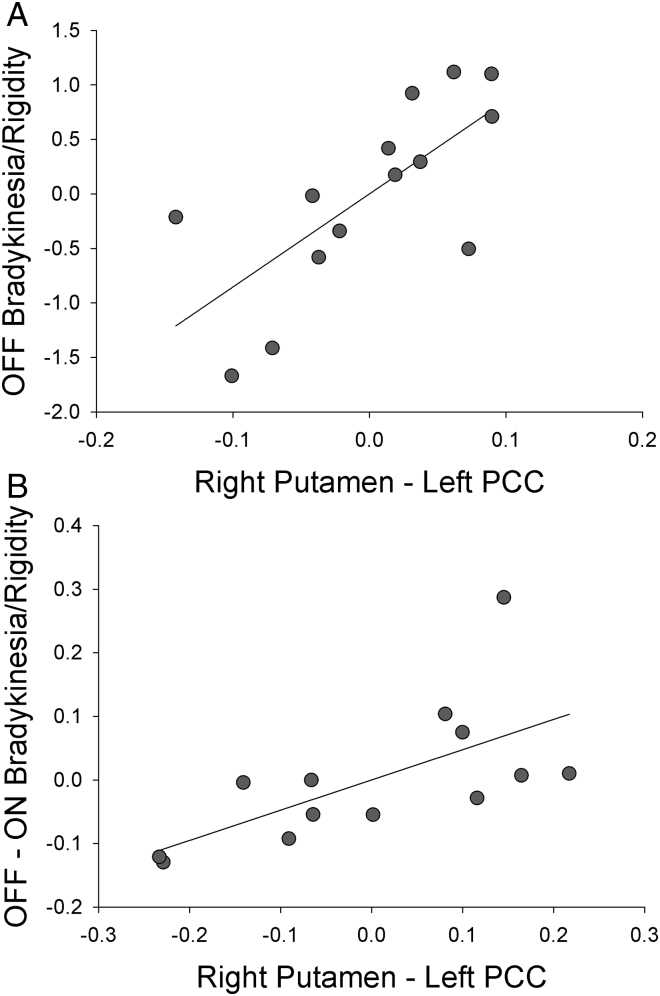
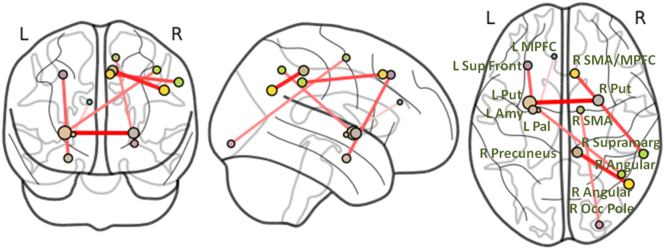
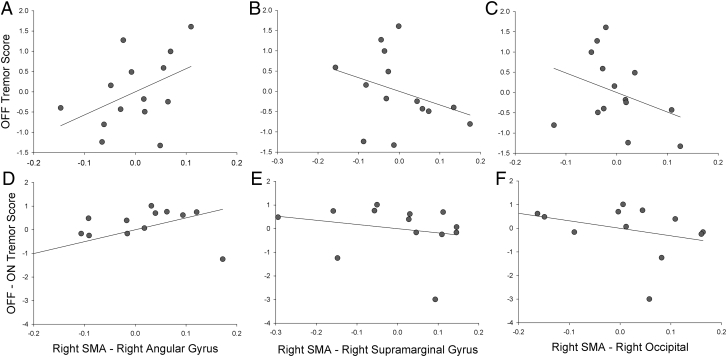
Altered brain connectivity has been described in people with Parkinson's disease and in response to dopaminergic medications. However, it is unclear whether dopaminergic medications primarily 'normalize' disease related connectivity changes or if they induce unique alterations in brain connectivity. Further, it is unclear how these disease- and medication-associated changes in brain connectivity relate differently to specific motor manifestations of disease, such as bradykinesia/rigidity and tremor. In this study, we applied a novel covariance projection approach in combination with a bootstrapped permutation test to resting state functional MRI data from 57 Parkinson's disease and 20 healthy control participants to determine the Parkinson's medication-state and disease-state connectivity changes associated with different motor manifestations of disease. First, we identified brain connections that best classified Parkinson's disease ON versus OFF dopamine and Parkinson's disease versus healthy controls, achieving 96.9 ± 5.9% and 72.7 ± 12.4% classification accuracy, respectively. Second, we investigated the connections that significantly contribute to the classifications. We found that the connections greater in Parkinson's disease OFF compared to ON dopamine are primarily between motor (cerebellum and putamen) and posterior cortical regions, such as the posterior cingulate cortex. By contrast, connections that are greater in ON compared to OFF dopamine are between the right and left medial prefrontal cortex. We also identified the connections that are greater in healthy control compared to Parkinson's disease and found the most significant connections are associated with primary motor regions, such as the striatum and the supplementary motor area. Notably, these are different connections than those identified in Parkinson's disease OFF compared to ON. Third, we determined which of the Parkinson's medication-state and disease-state connections are associated with the severity of different motor symptoms. We found two connections correlate with both bradykinesia/rigidity severity and tremor severity, whereas four connections correlate with only bradykinesia/rigidity severity, and five connections correlate with only tremor severity. Connections that correlate with only tremor severity are anchored by the cerebellum and the supplemental motor area, but only those connections that include the supplemental motor area predict dopaminergic improvement in tremor. Our results suggest that dopaminergic medications do not simply 'normalize' abnormal brain connectivity associated with Parkinson's disease, but rather dopamine drives distinct connectivity changes, only some of which are associated with improved motor symptoms. In addition, the dissociation between of connections related to severity of bradykinesia/rigidity versus tremor highlights the distinct abnormalities in brain circuitry underlying these specific motor symptoms.
大脑连接已经在帕金森病患者和对多巴胺能药物治疗有反应的患者中被描述。然而,尚不清楚多巴胺能药物治疗是主要“正常化”与疾病相关的连接变化,还是诱导大脑连接的独特改变。此外,尚不清楚这些与疾病和药物相关的脑连接变化如何与疾病的特定运动表现(如运动徐缓和僵硬和震颤)不同地相关。在这项研究中,我们应用了一种新的协方差投影方法,结合自举置换检验,对 57 名帕金森病患者和 20 名健康对照组的静息状态功能磁共振成像数据进行分析,以确定与疾病不同运动表现相关的帕金森病药物状态和疾病状态的连接变化。首先,我们确定了最佳分类帕金森病 ON 与 OFF 多巴胺和帕金森病与健康对照组的大脑连接,分别达到 96.9±5.9%和 72.7±12.4%的分类准确率。其次,我们研究了对分类有显著贡献的连接。我们发现,与帕金森病 OFF 相比,与多巴胺相比,帕金森病 OFF 时增加的连接主要位于运动(小脑和壳核)和后皮质区域,如后扣带皮质。相比之下,ON 与 OFF 相比,多巴胺时增加的连接位于右侧和左侧内侧前额叶皮质之间。我们还确定了与健康对照组相比增加的连接,发现最显著的连接与主要运动区域相关,如纹状体和补充运动区。值得注意的是,这些与帕金森病 OFF 相比,与 ON 相比,连接不同。第三,我们确定了帕金森病药物状态和疾病状态的哪些连接与不同运动症状的严重程度相关。我们发现有两个连接与运动徐缓和僵硬的严重程度和震颤的严重程度相关,而四个连接仅与运动徐缓和僵硬的严重程度相关,五个连接仅与震颤的严重程度相关。与震颤严重程度仅相关的连接以小脑和补充运动区为基础,但仅包含补充运动区的那些连接可预测震颤的多巴胺能改善。我们的结果表明,多巴胺能药物治疗并非简单地“正常化”与帕金森病相关的异常大脑连接,而是驱动独特的连接变化,其中只有一些与运动症状的改善相关。此外,与运动徐缓和僵硬的严重程度相关的连接与震颤的严重程度相关的连接之间的分离突出了这些特定运动症状的大脑回路的独特异常。