Division of Molecular Psychiatry, Laboratory of Translational Neuroscience, Department of Psychiatry, Psychosomatics and Psychotherapy, Center of Mental Health, University of Wuerzburg, Wuerzburg, Germany.
Institute of Physiology I, Westfaelische Wilhelms-Universität Muenster, Muenster, Germany.
Transl Psychiatry. 2017 Oct 3;7(10):e1246. doi: 10.1038/tp.2017.209.
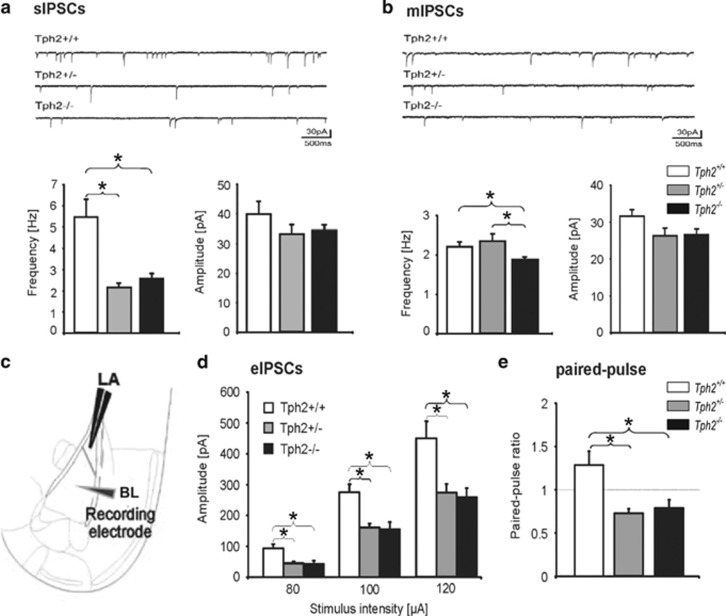
Multiple lines of evidence implicate brain serotonin (5-hydroxytryptamine; 5-HT) system dysfunction in the pathophysiology of stressor-related and anxiety disorders. Here we investigate the influence of constitutively deficient 5-HT synthesis on stressor-related anxiety-like behaviors using Tryptophan hydroxylase 2 (Tph2) mutant mice. Functional assessment of c-Fos after associated foot shock, electrophysiological recordings of GABAergic synaptic transmission, differential expression of the Slc6a4 gene in serotonergic neurons were combined with locomotor and anxiety-like measurements in different contextual settings. Our findings indicate that constitutive Tph2 inactivation and consequential lack of 5-HT synthesis in Tph2 null mutant mice (Tph2) results in increased freezing to associated foot shock and a differential c-Fos activity pattern in the basolateral complex of the amygdala. This is accompanied by altered GABAergic transmission as observed by recordings of inhibitory postsynaptic currents on principal neurons in the basolateral nucleus, which may explain increased fear associated with hyperlocomotion and escape-like responses in aversive inescapable contexts. In contrast, lifelong 5-HT deficiency as observed in Tph2 heterozygous mice (Tph) is able to be compensated through reduced GABAergic transmission in the basolateral nucleus of the amygdala based on Slc6a4 mRNA upregulation in subdivisions of dorsal raphe neurons. This results in increased activity of the basolateral nucleus of the amygdala due to associated foot shock. In conclusion, our results reflect characteristic syndromal dimensions of panic disorder and agoraphobia. Thus, constitutive lack of 5-HT synthesis influence the risk for anxiety- and stressor-related disorders including panic disorder and comorbid agoraphobia through the absence of GABAergic-dependent compensatory mechanisms in the basolateral nucleus of the amygdala.
多种证据表明,脑内 5-羟色胺(5-HT)系统功能障碍与应激相关和焦虑障碍的病理生理学有关。在这里,我们使用色氨酸羟化酶 2(Tph2)突变小鼠研究了 5-HT 合成持续不足对与应激相关的焦虑样行为的影响。在相关足底电击后对 c-Fos 进行功能评估、GABA 能突触传递的电生理记录、5-HT 能神经元中 Slc6a4 基因的差异表达,结合不同环境下的运动和焦虑样测量。我们的研究结果表明,组成型 Tph2 失活和随之而来的 Tph2 缺失突变小鼠(Tph2)中 5-HT 合成缺乏导致与相关足底电击相关的冻结增加,以及杏仁基底外侧复合体中 c-Fos 活性模式的差异。这伴随着 GABA 能传递的改变,如在基底外侧核的主神经元上记录的抑制性突触后电流所观察到的,这可能解释了在逃避不可避免的厌恶环境中与恐惧相关的过度运动和逃避样反应增加。相比之下,在 Tph2 杂合子小鼠(Tph)中观察到的终身 5-HT 缺乏能够通过杏仁基底外侧核中 GABA 能传递的减少得到补偿,这是基于背侧中缝神经元亚区中 Slc6a4 mRNA 的上调。这导致由于相关足底电击,杏仁基底外侧核的活动增加。总之,我们的研究结果反映了惊恐障碍和广场恐怖症的典型综合征维度。因此,组成型 5-HT 合成缺乏通过杏仁基底外侧核中 GABA 能依赖性补偿机制的缺失,影响与焦虑和应激相关的疾病的风险,包括惊恐障碍和共病广场恐怖症。