Department of Neurosurgery, Salford Royal NHS Foundation Trust, Salford, United Kingdom.
Institute of Cardiovascular Sciences, Centre for Vascular and Stroke Research, University of Manchester, Manchester, United Kingdom.
Oper Neurosurg (Hagerstown). 2018 Jun 1;14(6):603-610. doi: 10.1093/ons/opx163.
Following the International Subarachnoid Aneurysm Trial (ISAT), evolving treatment modalities for acute aneurysmal subarachnoid hemorrhage (aSAH) has changed the case mix of patients undergoing urgent surgical clipping.
To update our knowledge on outcome predictors by analyzing admission parameters in a pure surgical series using variable importance ranking and machine learning.
We reviewed a single surgeon's case series of 226 patients suffering from aSAH treated with urgent surgical clipping. Predictions were made using logistic regression models, and predictive performance was assessed using areas under the receiver operating curve (AUC). We established variable importance ranking using partial Nagelkerke R2 scores. Probabilistic associations between variables were depicted using Bayesian networks, a method of machine learning.
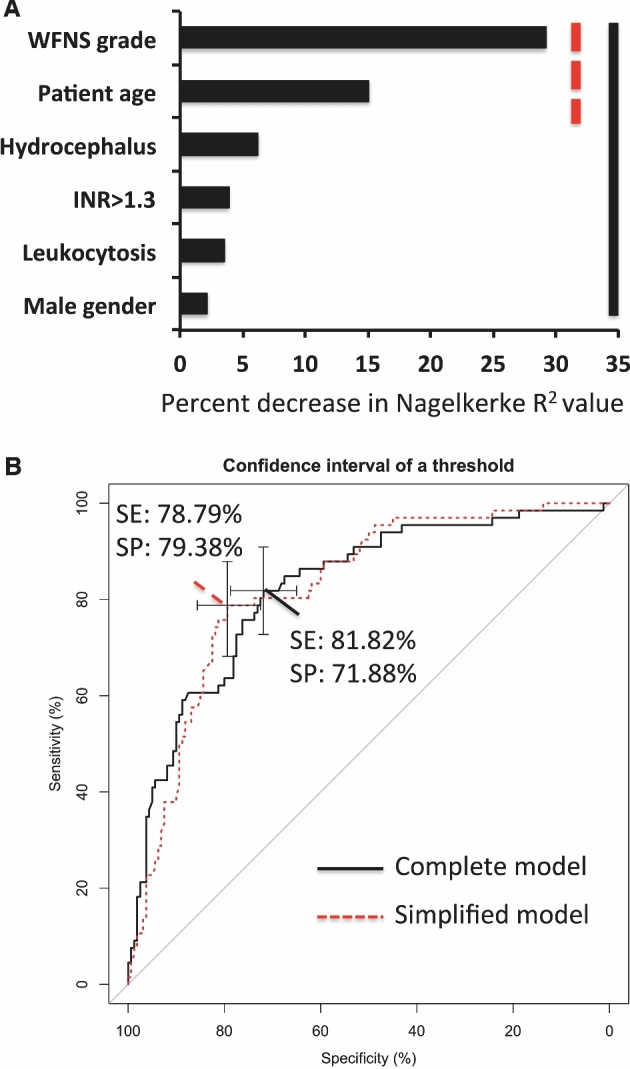
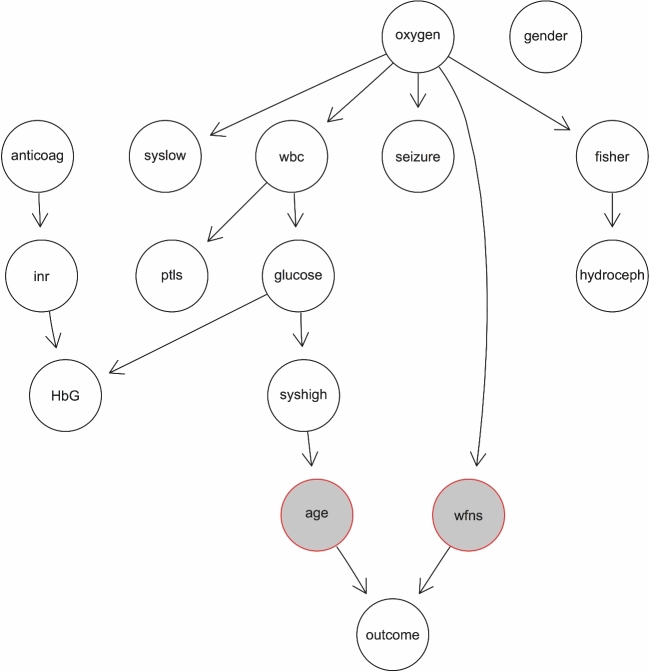
Importance ranking showed that World Federation of Neurosurgical Societies (WFNS) grade and age were the most influential outcome prognosticators. Inclusion of only these 2 predictors was sufficient to maintain model performance compared to when all variables were considered (AUC = 0.8222, 95% confidence interval (CI): 0.7646-0.88 vs 0.8218, 95% CI: 0.7616-0.8821, respectively, DeLong's P = .992). Bayesian networks showed that age and WFNS grade were associated with several variables such as laboratory results and cardiorespiratory parameters.
Our study is the first to report early outcomes and formal predictor importance ranking following aSAH in a post-ISAT surgical case series. Models showed good predictive power with fewer relevant predictors than in similar size series. Bayesian networks proved to be a powerful tool in visualizing the widespread association of the 2 key predictors with admission variables, explaining their importance and demonstrating the potential for hypothesis generation.
国际蛛网膜下腔动脉瘤试验(ISAT)之后,急性蛛网膜下腔出血(aSAH)的治疗方式不断发展,改变了接受紧急手术夹闭的患者的病例组合。
通过使用重要性排序和机器学习分析纯手术系列中的入院参数,更新我们对预后预测因子的认识。
我们回顾了一位外科医生治疗的 226 例 aSAH 患者的病例系列,这些患者接受了紧急手术夹闭。使用逻辑回归模型进行预测,并使用接收者操作特征曲线(ROC)下面积(AUC)评估预测性能。我们使用部分 Nagelkerke R2 评分建立了变量重要性排序。使用贝叶斯网络(机器学习的一种方法)描绘变量之间的概率关联。
重要性排序显示,世界神经外科学会(WFNS)分级和年龄是最具影响力的预后预测因子。与考虑所有变量时相比,仅纳入这 2 个预测因子就足以维持模型性能(AUC = 0.8222,95%置信区间(CI):0.7646-0.88 与 0.8218,95%CI:0.7616-0.8821,DeLong 的 P =.992)。贝叶斯网络显示,年龄和 WFNS 分级与实验室结果和心肺参数等几个变量有关。
我们的研究是第一个在 ISAT 后手术病例系列中报告 aSAH 后早期结果和正式预测因子重要性排序的研究。与类似大小的系列相比,模型显示出良好的预测能力,所需的相关预测因子更少。贝叶斯网络证明是一种强大的工具,可用于直观显示这 2 个关键预测因子与入院变量的广泛关联,解释其重要性,并展示生成假设的潜力。