Schönbach Etienne M, Ibrahim Mohamed A, Kong Xiangrong, Strauss Rupert W, Muñoz Beatriz, Birch David G, Sunness Janet S, West Sheila K, Scholl Hendrik P N
Wilmer Eye Institute, Johns Hopkins University School of Medicine, Baltimore, Maryland, United States.
Department of Biostatistics and Epidemiology, University of Massachusetts-Amherst, Amherst, Massachusetts, United States.
Invest Ophthalmol Vis Sci. 2017 May 1;58(6):BIO268-BIO276. doi: 10.1167/iovs.17-21710.
To compare different metrics and acquisition modes of fixation stability as a new visual function biomarker in a large cohort of patients with ABCA4-related Stargardt disease from the multicenter prospective ProgStar study.
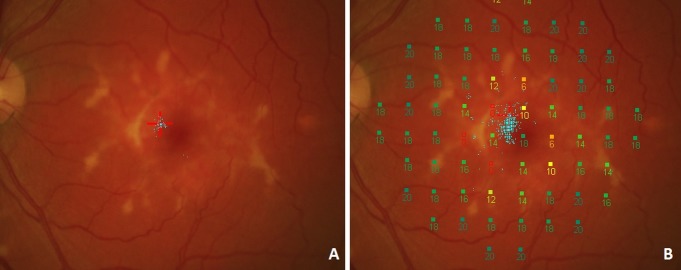
Fixation was tested during a separate fixation exam and also dynamically during a sensitivity exam, using fundus-tracking microperimetry (Nidek MP-1). Fixation data were analyzed using the bivariate contour ellipse area (BCEA), the 2/4 degree method, and the Fujii classification.
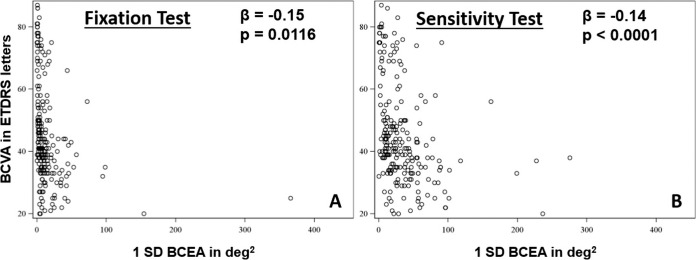
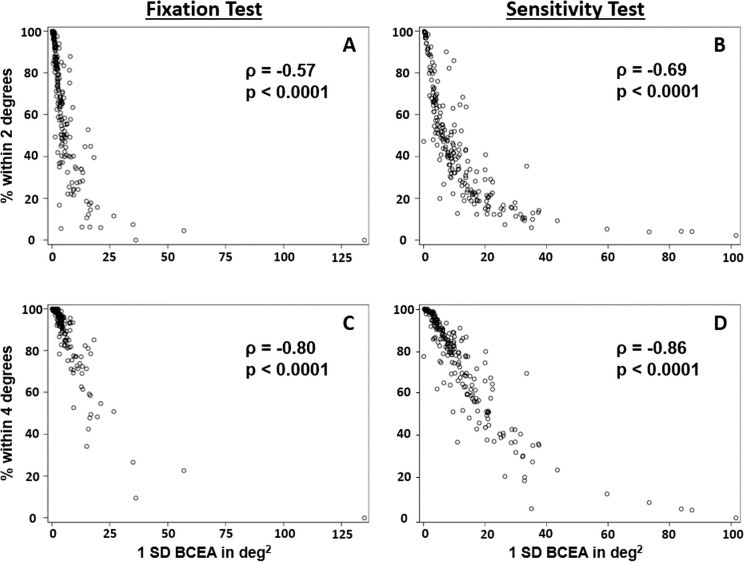
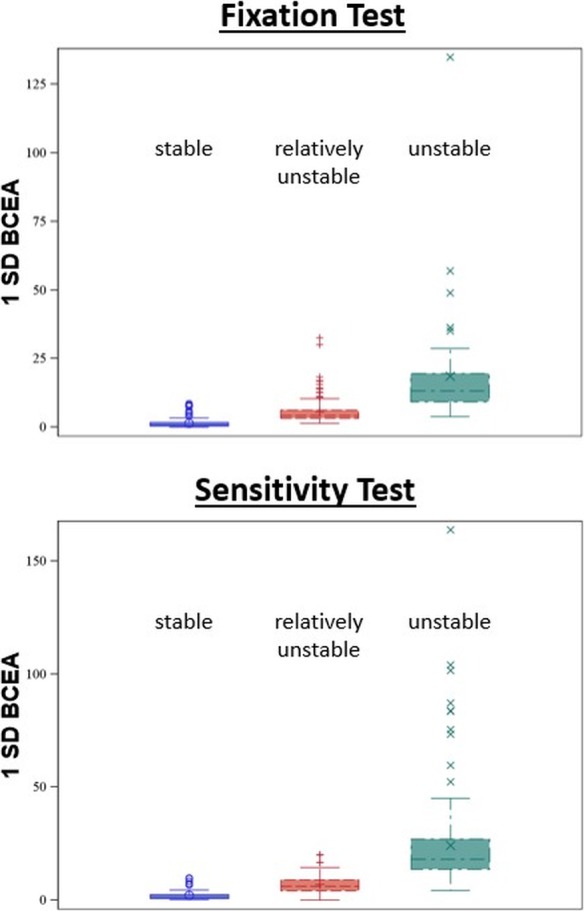
In a total of 235 patients, the mean BCEA was larger when measured during the sensitivity exam (418 eyes; 12.5 vs. 4.6 deg2 during the fixation task in 427 eyes). Correlations between the two tests were generally weak. Fixation stability during the sensitivity test was significantly correlated with visual acuity. Comparing the BCEA values and the corresponding Fujii categories for these eyes revealed ranges of overlap where an eye with one defined BCEA value can fall into each of the three Fujii categories.
Patients may have limited ability to fixate over defined time periods, which leads to significant differences between shorter and longer measurements of fixation stability. The most appropriate way to use this functional biomarker appears to be using continuous metrics for fixation stability, such as the BCEA, during a macular sensitivity test.
在多中心前瞻性ProgStar研究中,比较不同指标和采集模式下的注视稳定性,将其作为一大群ABCA4相关斯塔加特病患者的一种新的视觉功能生物标志物。
使用眼底跟踪微视野计(尼德克MP-1)在单独的注视检查期间以及在敏感度检查期间动态测试注视。使用双变量等高椭圆面积(BCEA)、2/4度法和藤井分类法分析注视数据。
在总共235名患者中,在敏感度检查期间测量时,平均BCEA更大(418只眼;在427只眼中,注视任务期间为12.5度²,而在敏感度检查期间为4.6度²)。两项测试之间的相关性通常较弱。敏感度测试期间的注视稳定性与视力显著相关。比较这些眼睛的BCEA值和相应的藤井类别,发现存在重叠范围,即具有一个定义的BCEA值的眼睛可以落入三个藤井类别中的每一个。
患者在规定时间段内的注视能力可能有限,这导致了注视稳定性的短期和长期测量之间存在显著差异。使用这种功能生物标志物的最合适方法似乎是在黄斑敏感度测试期间使用连续的注视稳定性指标,如BCEA。