Bai Yanhua, Niu Dongfeng, Huang Xiaozheng, Jia Ling, Kang Qiang, Dou Fangyuan, Ji Xinqiang, Xue Weicheng, Liu Yiqiang, Li Zhongwu, Feng Qin, Lin Dongmei, Kakudo Kennichi
Key Laboratory of Carcinogenesis and Translational Research (Ministry of Education), Department of Pathology, Peking University Cancer Hospital & Institute, No. 52 Fucheng Road, Haidian District, Beijing, 100142, China.
Key Laboratory of Carcinogenesis and Translational Research (Ministry of Education), Department of Medical Statistics, Peking University Cancer Hospital & Institute, No. 52 Fucheng Road, Haidian District, Beijing, 100142, China.
Diagn Pathol. 2017 Oct 3;12(1):72. doi: 10.1186/s13000-017-0662-z.
Immune checkpoint blockade targeting PD-1/PD-L1 has shown efficacy in several types of cancers. However, the correlation between PD-L1/PD-1 expression and the specific clinicopathological features in papillary thyroid carcinoma (PTC) has not been investigated.
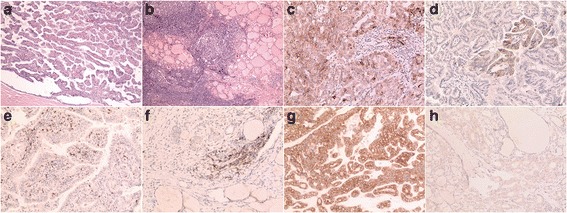
We examined the immunohistochemical expression of PD-L1, PD-1, and BRAF V600E on whole-tissue sections from 126 cases of primary PTC more than 1 cm in size. The correlation between the PD-L1/PD-1 expression and the clinicopathological features was evaluated.
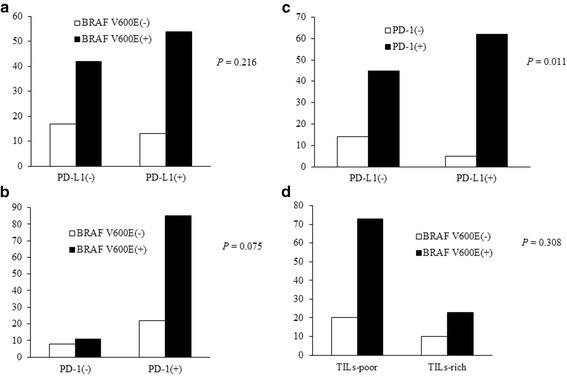
PD-L1 was positively expressed in 53.2% PTCs, and its expression was positively correlated with rich tumor-infiltrating lymphocytes (TILs), background chronic lymphocytic thyroiditis (CLT), female gender, absence of psammoma bodies, and PD-1 expression. Among these parameters, rich TILs, female gender, and absence of psammoma bodies were independent factors affecting PD-L1 expression on the multivariate logistic regression analysis. PD-1 expression was detected in the TILs and was positively correlated with rich TILs, background CLT, and absence of stromal calcification. Lack of stromal calcification was an independent factor affecting PD-1 expression. Neither PD-L1 nor PD-1 expression showed significant correlation with BRAF V600E expression.
Our results show that the distinctive pathological features of PTCs, including TILs, background CLT, female gender, psammoma bodies, and stromal calcification, are useful parameters for predicting PD-L1 or PD-1 expression.
靶向PD-1/PD-L1的免疫检查点阻断在多种癌症中已显示出疗效。然而,甲状腺乳头状癌(PTC)中PD-L1/PD-1表达与特定临床病理特征之间的相关性尚未得到研究。
我们检测了126例直径大于1 cm的原发性PTC全组织切片上PD-L1、PD-1和BRAF V600E的免疫组化表达。评估了PD-L1/PD-1表达与临床病理特征之间的相关性。
53.2%的PTC中PD-L1呈阳性表达,其表达与丰富的肿瘤浸润淋巴细胞(TILs)、背景慢性淋巴细胞性甲状腺炎(CLT)、女性、无砂粒体以及PD-1表达呈正相关。在这些参数中,丰富的TILs、女性和无砂粒体是多因素逻辑回归分析中影响PD-L1表达的独立因素。PD-1表达在TILs中被检测到,并且与丰富的TILs、背景CLT和无基质钙化呈正相关。无基质钙化是影响PD-1表达的独立因素。PD-L1和PD-1表达均与BRAF V600E表达无显著相关性。
我们的结果表明,PTC的独特病理特征,包括TILs、背景CLT、女性、砂粒体和基质钙化,是预测PD-L1或PD-1表达的有用参数。