Beslic Nermina, Licina Sabrina, Sadija Amera, Milardovic Renata
Clinic of Nuclear Medicine and Endocrinology, University Clinical Center Sarajevo, Sarajevo, Bosnia and Herzegovina.
Department of Ginecology and Obstetrics, General Hospital, Novi Pazar, Novi Pazar, Serbia.
Med Arch. 2017 Aug;71(4):270-273. doi: 10.5455/medarh.2017.71.270-273.
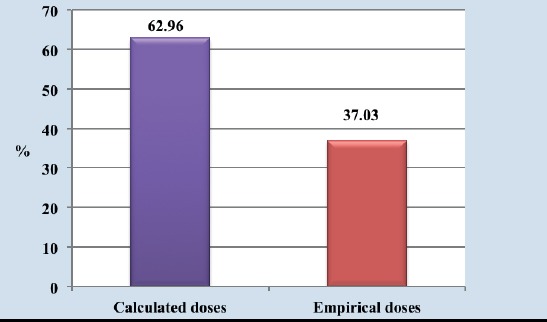
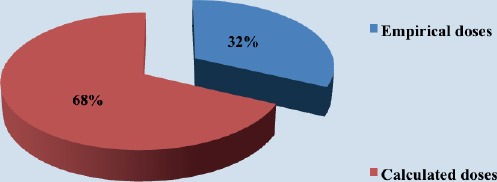
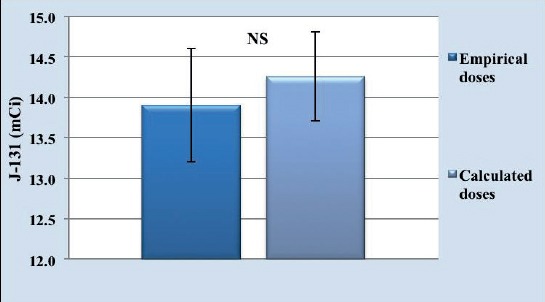
Consensus hasn't been yet achieved about optimal dose quantity that could prevent post therapy hypothyroidism, thus dosing approach varies among different centers. I131 doses can be fixed or calculated, although treatment outcomes don't differ significantly according to recent acknowledgments.
Determination of the incidence of hypothyroidism after radioiodine treatment (I131) in dependence of hyperthyroidism etiology and quantity of applied doses.
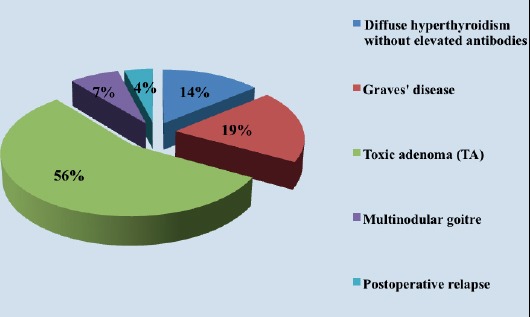
The study included 100 patients which have had radioiodine treatment, with a three year post-treatment follow up. The study was conducted at the Nuclear Medicine Department, University Clinical Center of Sarajevo. Data were provided from the patient medical histories. Research is designed as a retrospective, descriptive study. All data were analyzed using Microsoft Excel and the statistical program SPSS 13.0.
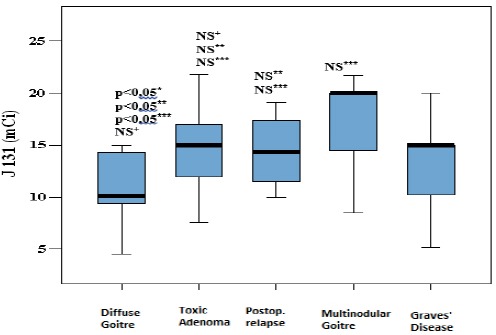
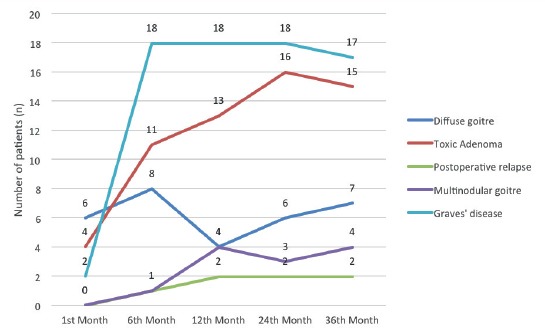
After the three year follow up, incidence of hypothyroidism within patients with Graves' disease was 89.5%, with diffuse goiter 50%, with toxic adenoma (TA) 26.8%, and with multinodulare goitre (MNG) 57.1%. Hypothyreoidism in patients with diffuse goiter, Graves' disease and TA was mostly developed after I131 therapy with a dose quantity of 10.1-15 mCi and in MNG patients after RAI therapy with applied doses of 15.1-20 mCi.
The hypothyroidism incidence rate is the highest among patients with Graves' diseases and the lowest among the TA patients. It's mostly developed after dose quantity of 10.1-15mCi and it is rare at dose quantity less than 5mCi. 50% of hypothyroidism were developed among patients with diffuse goiter, Graves'disease.
关于能够预防治疗后甲状腺功能减退的最佳剂量尚未达成共识,因此不同中心的给药方法各不相同。尽管根据最近的认识,治疗结果并无显著差异,但碘-131剂量可以是固定的或计算得出的。
确定放射性碘治疗(碘-131)后甲状腺功能减退的发生率与甲状腺功能亢进病因及应用剂量的关系。
该研究纳入了100例接受放射性碘治疗的患者,并进行了三年的治疗后随访。研究在萨拉热窝大学临床中心核医学科进行。数据来自患者病历。该研究设计为回顾性描述性研究。所有数据均使用Microsoft Excel和统计程序SPSS 13.0进行分析。
经过三年随访,格雷夫斯病患者中甲状腺功能减退的发生率为89.5%,弥漫性甲状腺肿患者为50%,毒性腺瘤(TA)患者为26.8%,多结节性甲状腺肿(MNG)患者为57.1%。弥漫性甲状腺肿、格雷夫斯病和TA患者的甲状腺功能减退大多在碘-131治疗后,剂量为10.1-15毫居里时发生,而MNG患者在放射性碘治疗后,应用剂量为15.1-20毫居里时发生。
格雷夫斯病患者中甲状腺功能减退的发生率最高,TA患者中最低。大多在剂量为10.1-15毫居里后发生,而在剂量小于5毫居里时很少见。弥漫性甲状腺肿、格雷夫斯病患者中有50%发生甲状腺功能减退。