Khneizer Gebran, Al-Taee Ahmad, Bastani Bahar
Department of Internal Medicine, Saint Louis University School of Medicine, Saint Louis, Missouri, USA.
J Nephropathol. 2017 Jul;6(3):134-137. doi: 10.15171/jnp.2017.23. Epub 2017 Feb 5.
Monoclonal antibodies targeting vascular endothelial growth factor (VEGF), such as bevacizumab, are administered intravitreally for the treatment of wet or exudative age-related macular degeneration (ARMD). Systemic use of bevacizumab has been linked to a wide range of renal adverse effects including proteinuria and hypertension.
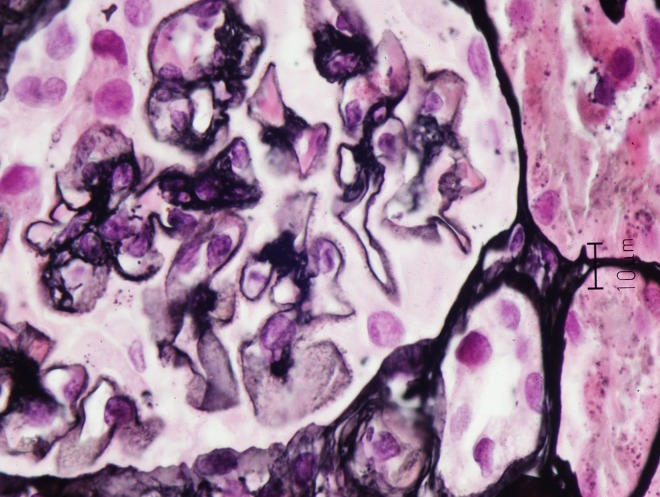
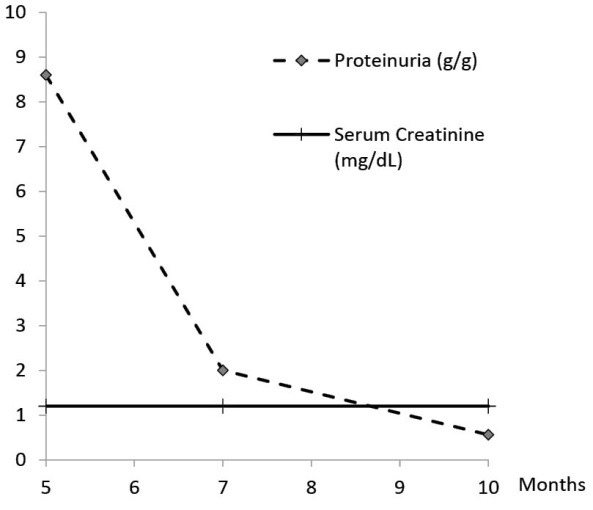
We present the case of a 77-year-old Caucasian male with a past medical history of hypertension, vitamin D deficiency and paroxysmal atrial fibrillation who presented to primary care clinic with a 2-week history of bilateral lower extremity edema, 2 months after completing four monthly intravitreal injections of bevacizumab for ARMD. Examination was remarkable for blood pressure of 187/91 mm Hg and severe bilateral lower extremity edema. Work up revealed unremarkable complete blood count (CBC), comprehensive metabolic panel (CMP), lipid panel, and echocardiography, except for 491 mg/dL albuminuria. Metoprolol and furosemide were added to hydrochlorothiazide and lisinopril. Work up by nephrology consult team five months later was notable for a urinalysis revealing 3 red blood cells/high power field (RBC/HPF), 24-hour urine protein of 8.6 g, and serum creatinine of 1.2 mg/dL. Viral hepatitis panel, total complement activity (CH50), C3, C4, anti-nuclear antibody (ANA), anti-neutrophil cytoplasmic antibody (ANCA), serum and urine protein electrophoresis were all unremarkable. Renal biopsy was consistent with membranous nephropathy. Age-appropriate cancer screening was negative. Random urine protein-to-creatinine ratio declined to 2 g/g and then to 0.56 g/g at 7 and 10 months follow up, respectively. Serum blood urea nitrogen (BUN) and creatinine remained normal throughout the course of illness and patient did not require any immunosuppressive treatment.
The wide range of nephrotoxicity after systemic bevacizumab has been well documented. Our case describes a self-limited biopsy-proven membranous nephropathy after intravitreal bevacizumab injections.
靶向血管内皮生长因子(VEGF)的单克隆抗体,如贝伐单抗,通过玻璃体腔内注射用于治疗湿性或渗出性年龄相关性黄斑变性(ARMD)。贝伐单抗的全身使用与多种肾脏不良反应有关,包括蛋白尿和高血压。
我们报告了一例77岁的白种男性病例,该患者有高血压、维生素D缺乏和阵发性心房颤动病史,在完成4次每月一次的玻璃体腔内注射贝伐单抗治疗ARMD 2个月后,因双侧下肢水肿2周就诊于初级保健诊所。检查结果显示血压为187/91 mmHg,双侧下肢严重水肿。检查发现全血细胞计数(CBC)、综合代谢指标(CMP)、血脂指标和超声心动图均无异常,但蛋白尿为491 mg/dL。在氢氯噻嗪和赖诺普利的基础上加用了美托洛尔和速尿。五个月后,肾病咨询团队的检查结果显示尿常规有异常,每高倍视野有3个红细胞(RBC/HPF),24小时尿蛋白为8.6 g,血清肌酐为1.2 mg/dL。病毒性肝炎指标、总补体活性(CH50)、C3、C4、抗核抗体(ANA)、抗中性粒细胞胞浆抗体(ANCA)、血清和尿蛋白电泳均无异常。肾活检符合膜性肾病。适龄癌症筛查结果为阴性。在随访7个月和10个月时,随机尿蛋白与肌酐比值分别降至2 g/g和0.56 g/g。在整个病程中,血清血尿素氮(BUN)和肌酐保持正常,患者无需任何免疫抑制治疗。
贝伐单抗全身使用后广泛的肾毒性已有充分记录。我们的病例描述了玻璃体腔内注射贝伐单抗后经活检证实的自限性膜性肾病。