Ramos João Gabriel Rosa, Passos Rogerio da Hora, Baptista Paulo Benigno Pena, Forte Daniel Neves
Programa de Pós-Graduação em Ciências Médicas, Faculdade de Medicina, Universidade de São Paulo - São Paulo (SP), Brasil.
Unidade de Terapia Intensiva, Hospital São Rafael - Salvador (BA), Brasil.
Rev Bras Ter Intensiva. 2017 Apr-Jun;29(2):154-162. doi: 10.5935/0103-507X.20170025.
To evaluate the factors potentially associated with the decision of admission to the intensive care unit in Brazil.
An electronic survey of Brazilian physicians working in intensive care units. Fourteen variables that were potentially associated with the decision of admission to the intensive care unit were rated as important (from 1 to 5) by the respondents and were later grouped as "patient-related," "scarcity-related" and "administrative-related" factors. The workplace and physician characteristics were evaluated for correlation with the factor ratings.
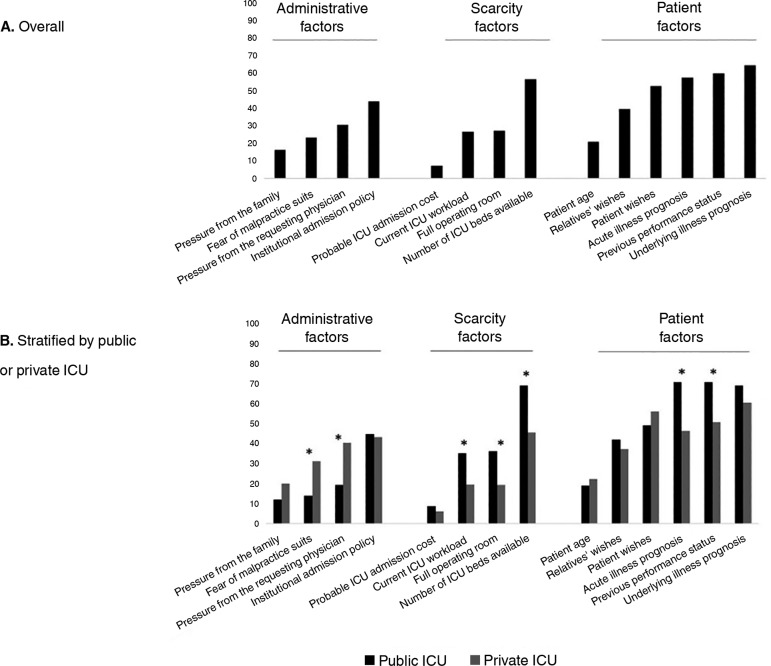
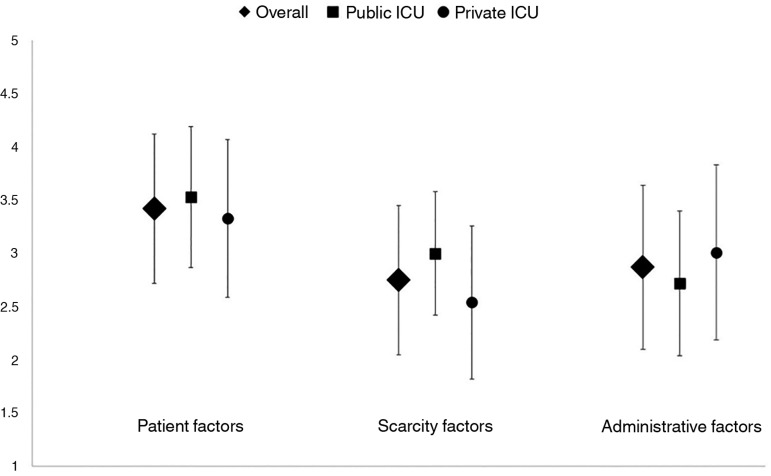
During the study period, 125 physicians completed the survey. The scores on patient-related factors were rated higher on their potential to affect decisions than scarcity-related or administrative-related factors, with a mean ± SD of 3.42 ± 0.7, 2.75 ± 0.7 and 2.87 ± 0.7, respectively (p < 0.001). The patient's underlying illness prognosis was rated by 64.5% of the physicians as always or frequently affecting decisions, followed by acute illness prognosis (57%), number of intensive care unit beds available (56%) and patient's wishes (53%). After controlling for confounders, receiving specific training on intensive care unit triage was associated with higher ratings of the patient-related factors and scarcity-related factors, while working in a public intensive care unit (as opposed to a private intensive care unit) was associated with higher ratings of the scarcity-related factors.
Patient-related factors were more frequently rated as potentially affecting intensive care unit admission decisions than scarcity-related or administrative-related factors. Physician and workplace characteristics were associated with different factor ratings.
评估巴西重症监护病房收治决策的潜在相关因素。
对巴西重症监护病房工作的医生进行电子调查。14个可能与重症监护病房收治决策相关的变量由受访者评为重要程度(1至5分),随后分为“患者相关”、“资源稀缺相关”和“行政相关”因素。评估工作场所和医生特征与因素评分的相关性。
在研究期间,125名医生完成了调查。患者相关因素在影响决策的潜在性方面得分高于资源稀缺相关或行政相关因素,其均值±标准差分别为3.42±0.7、2.75±0.7和2.87±0.7(p<0.001)。64.5%的医生认为患者的基础疾病预后总是或经常影响决策,其次是急性疾病预后(57%)、可用重症监护病床数量(56%)和患者意愿(53%)。在控制混杂因素后,接受重症监护病房分诊的特定培训与患者相关因素和资源稀缺相关因素的较高评分相关,而在公立重症监护病房工作(相对于私立重症监护病房)与资源稀缺相关因素的较高评分相关。
与资源稀缺相关或行政相关因素相比,患者相关因素更常被评为可能影响重症监护病房收治决策。医生和工作场所特征与不同的因素评分相关。