Yu Dahai, Jordan Kelvin P, Bedson John, Englund Martin, Blyth Fiona, Turkiewicz Aleksandra, Prieto-Alhambra Daniel, Peat George
Research Institute for Primary Care & Health Sciences, Keele University, Keele, UK.
Clinical Epidemiology Unit, Orthopaedics, Department of Clinical Sciences Lund, Lund University, Lund, Sweden.
Rheumatology (Oxford). 2017 Nov 1;56(11):1902-1917. doi: 10.1093/rheumatology/kex270.
To determine recent trends in the rate and management of new cases of OA presenting to primary healthcare using UK nationally representative data.
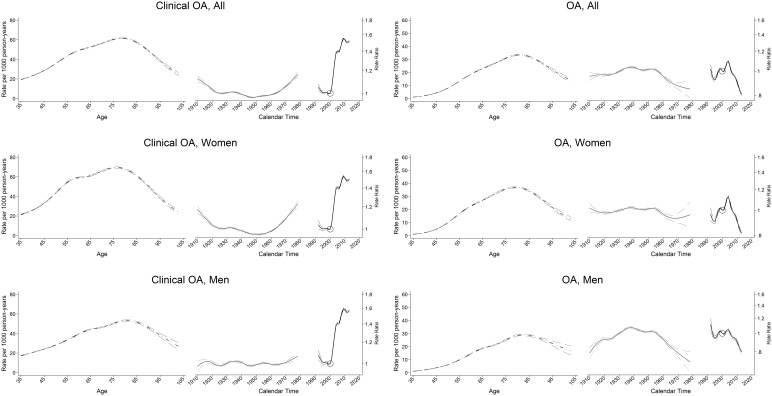
Using the Clinical Practice Research Datalink we identified new cases of diagnosed OA and clinical OA (including OA-relevant peripheral joint pain in those aged over 45 years) using established code lists. For both definitions we estimated annual incidence density using exact person-time, and undertook descriptive analysis and age-period-cohort modelling. Demographic characteristics and management were described for incident cases in each calendar year. Sensitivity analyses explored the robustness of the findings to key assumptions.
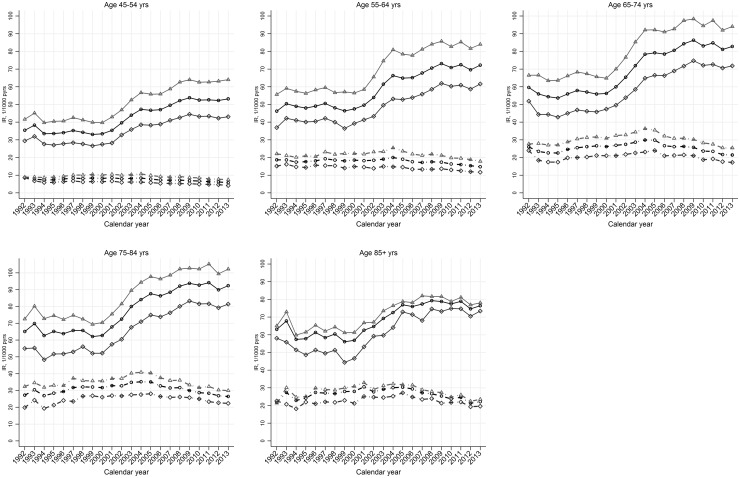
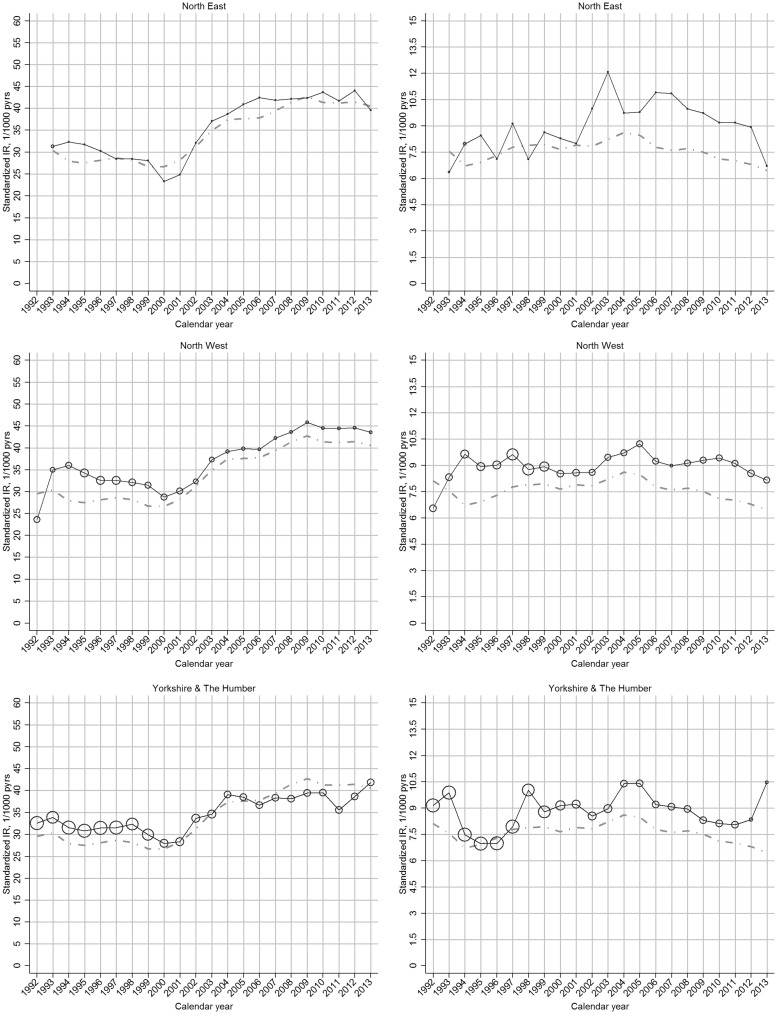
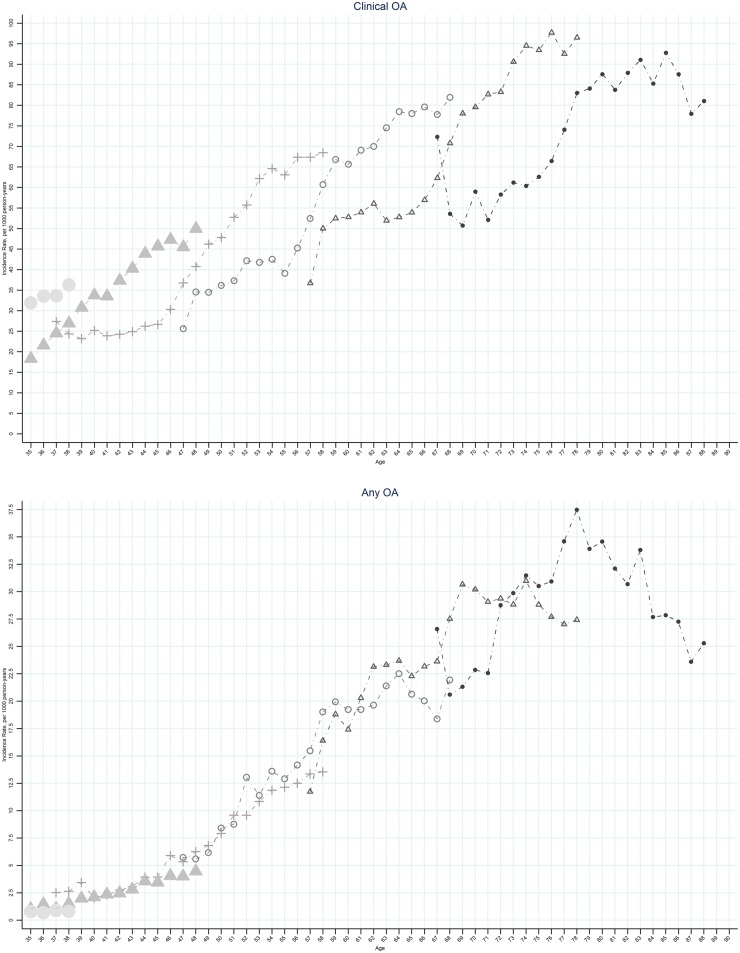
Between 1992 and 2013 the annual age-sex standardized incidence rate for clinical OA increased from 29.2 to 40.5/1000 person-years. After controlling for period effects, the consultation incidence of clinical OA was higher for successive cohorts born after the mid-1950s, particularly women. In contrast, with the exception of hand OA, we observed no increase in the incidence of diagnosed OA: 8.6/1000 person-years in 2004 down to 6.3 in 2013. In 2013, 16.4% of clinical OA cases had an X-ray referral. While NSAID prescriptions fell from 2004, the proportion prescribed opioid analgesia rose markedly (0.1% of diagnosed OA in 1992 to 1.9% in 2013).
Rising rates of clinical OA, continued use of plain radiography and a shift towards opioid analgesic prescription are concerning. Our findings support the search for policies to tackle this common problem that promote joint pain prevention while avoiding excessive and inappropriate health care.
利用英国具有全国代表性的数据,确定初级医疗保健机构中骨关节炎(OA)新发病例的发病率及管理方面的近期趋势。
利用临床实践研究数据链,我们通过既定的编码列表识别出已确诊OA和临床OA的新病例(包括45岁以上人群中与OA相关的外周关节疼痛)。对于这两种定义,我们使用精确的人时估计年发病率密度,并进行描述性分析和年龄-时期-队列建模。描述了每个日历年中发病病例的人口统计学特征和管理情况。敏感性分析探讨了研究结果对关键假设的稳健性。
1992年至2013年期间,临床OA的年龄-性别标准化年发病率从29.2/1000人年增至40.5/1000人年。在控制时期效应后,20世纪50年代中期以后出生的连续队列中临床OA的会诊发病率更高,尤其是女性。相比之下,除手部OA外,我们未观察到确诊OA的发病率增加:2004年为8.6/1000人年,2013年降至6.3/1000人年。2013年,16.4%的临床OA病例接受了X线检查转诊。虽然非甾体抗炎药处方量自2004年起下降,但开具阿片类镇痛药的比例显著上升(1992年确诊OA患者中的比例为0.1%,2013年为1.9%)。
临床OA发病率上升、普通X线摄影的持续使用以及向阿片类镇痛药处方的转变令人担忧。我们的研究结果支持寻求政策来解决这一常见问题,即在避免过度和不适当医疗保健的同时促进关节疼痛预防。