Limoge Michelle, Safina Alfiya, Truskinovsky Alexander M, Aljahdali Ieman, Zonneville Justin, Gruevski Aleksandar, Arteaga Carlos L, Bakin Andrei V
Department of Cancer Genetics, Roswell Park Cancer Institute, Buffalo, New York, USA.
Department of Cell Stress Biology, Roswell Park Cancer Institute, Buffalo, New York, USA.
Oncotarget. 2017 Jun 28;8(37):61969-61981. doi: 10.18632/oncotarget.18755. eCollection 2017 Sep 22.
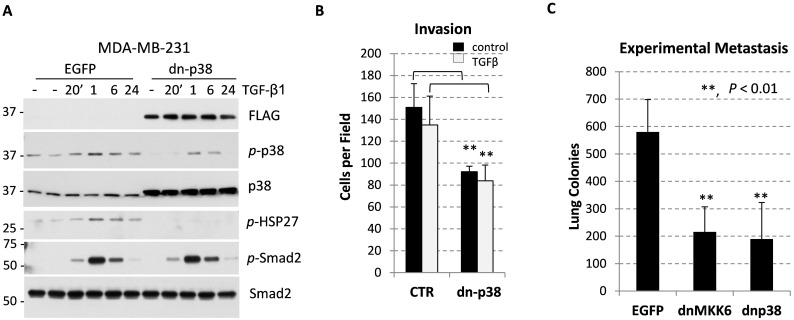
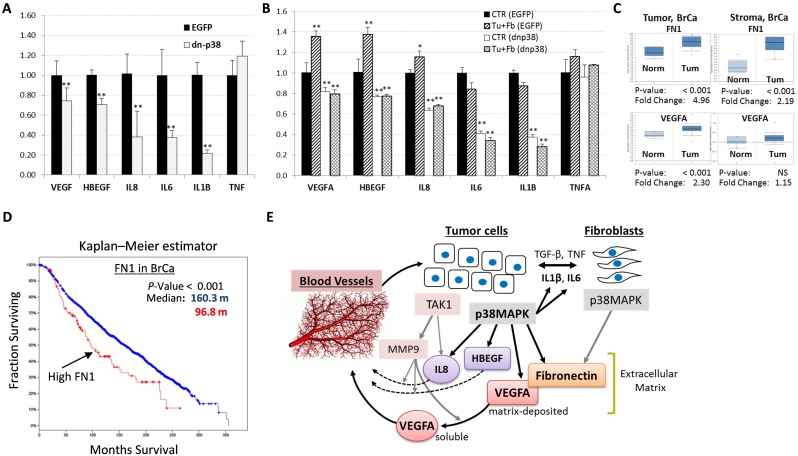
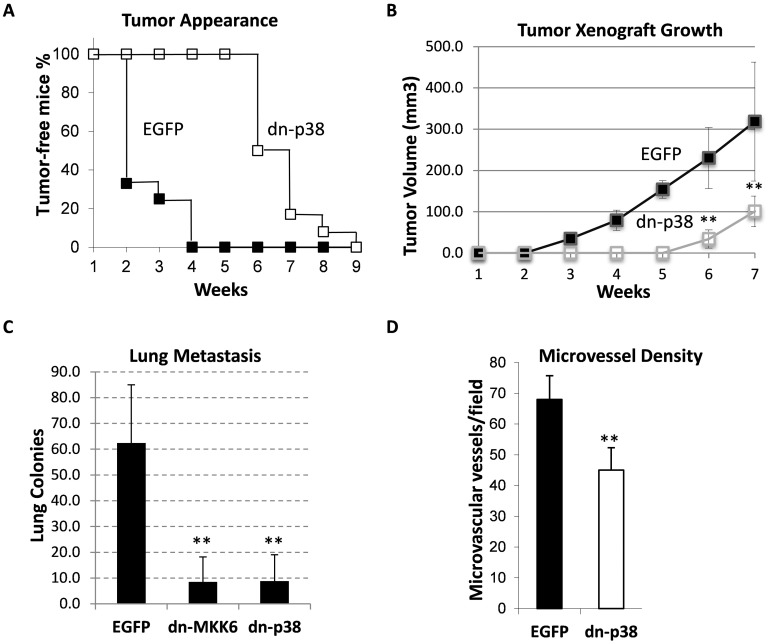
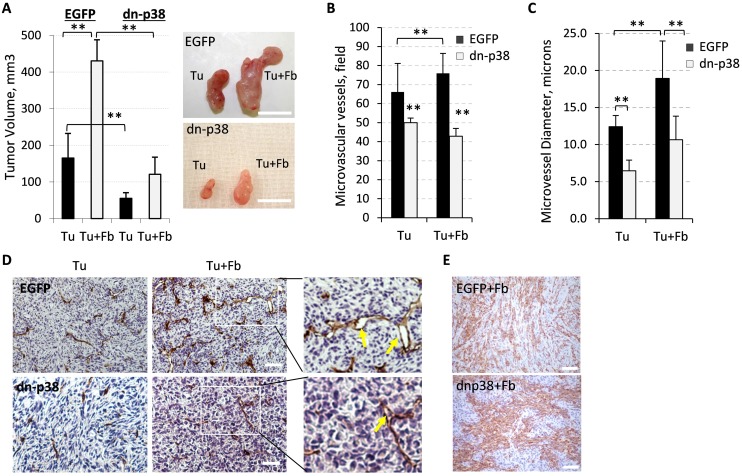
The breast carcinoma microenvironment strikingly influences cancer progression and response to therapy. Various cell types in the carcinoma microenvironment show significant activity of p38 mitogen-activated protein kinase (MAPK), although the role of p38MAPK in breast cancer progression is still poorly understood. The present study examined the contribution of tumor p38MAPK to breast carcinoma microenvironment and metastatic capacity. Inactivation of p38MAPK signaling in metastatic breast carcinoma cells was achieved by forced expression of the kinase-inactive mutant of p38/MAPK14 (a dominant-negative p38, dn-p38). Disruption of tumor p38MAPK signaling reduced growth and metastases of breast carcinoma xenografts. Importantly, dn-p38 markedly decreased tumor blood-vessel density and lumen sizes. Mechanistic studies revealed that p38 controls expression of pro-angiogenic extracellular factors such as matrix protein Fibronectin and cytokines VEGFA, IL8, and HBEGF. Tumor-associated fibroblasts enhanced tumor growth and vasculature as well as increased expression of the pro-angiogenic factors. These effects were blunted by dn-p38. Metadata analysis showed elevated expression of p38 target genes in breast cancers and this was an unfavorable marker of disease recurrence and poor-outcome. Thus, our study demonstrates that tumor p38MAPK signaling promotes breast carcinoma growth, invasive and metastatic capacities. Importantly, p38 enhances carcinoma vascularization by facilitating expression and deposition of pro-angiogenic factors. These results argue that p38MAPK is a valuable target for anticancer therapy affecting tumor vasculature. Anti-p38 drugs may provide new therapeutic strategies against breast cancer, including metastatic disease.
乳腺癌微环境对癌症进展和治疗反应有显著影响。癌微环境中的各种细胞类型显示出p38丝裂原活化蛋白激酶(MAPK)的显著活性,尽管p38MAPK在乳腺癌进展中的作用仍知之甚少。本研究探讨了肿瘤p38MAPK对乳腺癌微环境和转移能力的作用。通过强制表达p38/MAPK14的激酶失活突变体(显性负性p38,dn-p38),实现转移性乳腺癌细胞中p38MAPK信号的失活。肿瘤p38MAPK信号的破坏减少了乳腺癌异种移植瘤的生长和转移。重要的是,dn-p38显著降低了肿瘤血管密度和管腔大小。机制研究表明,p38控制促血管生成细胞外因子的表达,如基质蛋白纤连蛋白和细胞因子VEGFA、IL8和HBEGF。肿瘤相关成纤维细胞增强了肿瘤生长和血管生成,并增加了促血管生成因子的表达。dn-p38减弱了这些作用。元数据分析显示,p38靶基因在乳腺癌中表达升高,这是疾病复发和不良预后的不利标志物。因此,我们的研究表明,肿瘤p38MAPK信号促进乳腺癌的生长、侵袭和转移能力。重要的是,p38通过促进促血管生成因子的表达和沉积来增强癌血管生成。这些结果表明,p38MAPK是影响肿瘤血管生成的抗癌治疗的一个有价值的靶点。抗p38药物可能为乳腺癌,包括转移性疾病提供新的治疗策略。