Feng Fan, Tian Yangzi, Yang Xuewen, Sun Li, Hong Liu, Yang Jianjun, Guo Man, Lian Xiao, Fan Daiming, Zhang Hongwei
Division of Digestive Surgery, Xijing Hospital of Digestive Disease, Fourth Military Medical University, Xi'an, Shaanxi, China.
Department of Dermatology, Xijing Hospital, Fourth Military Medical University, Xi'an, Shaanxi, China.
Oncotarget. 2017 Mar 7;8(37):62622-62629. doi: 10.18632/oncotarget.15979. eCollection 2017 Sep 22.
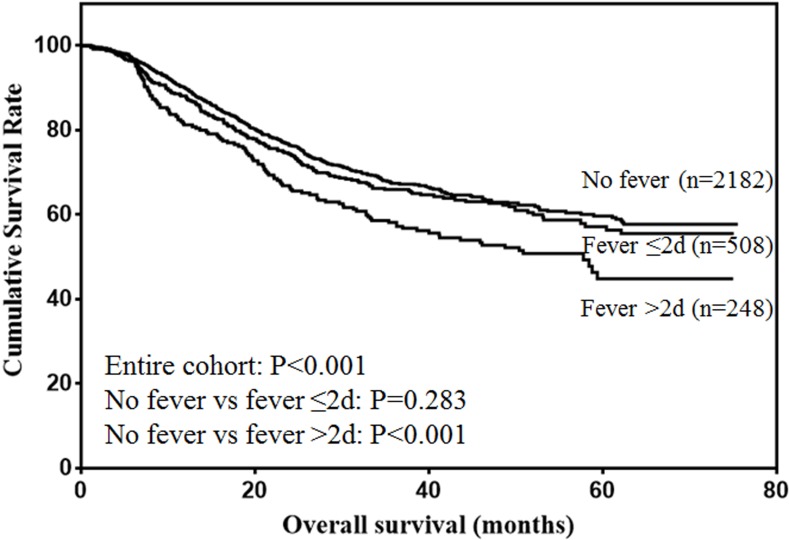
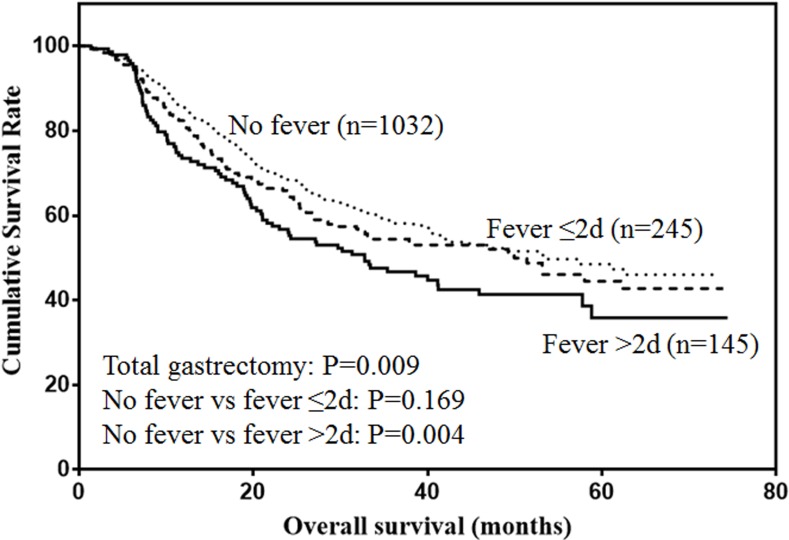
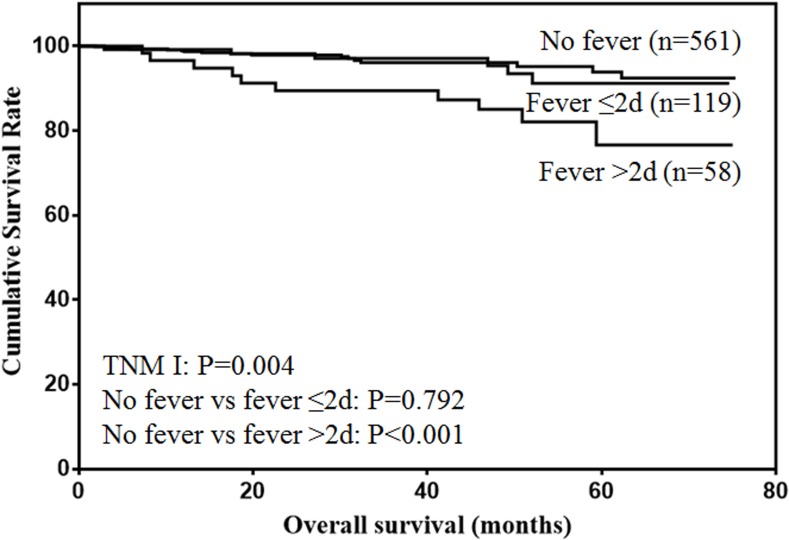
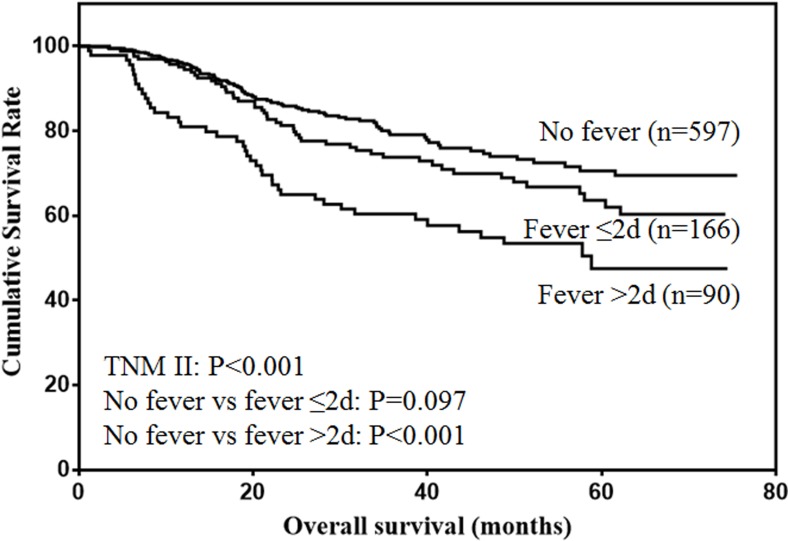
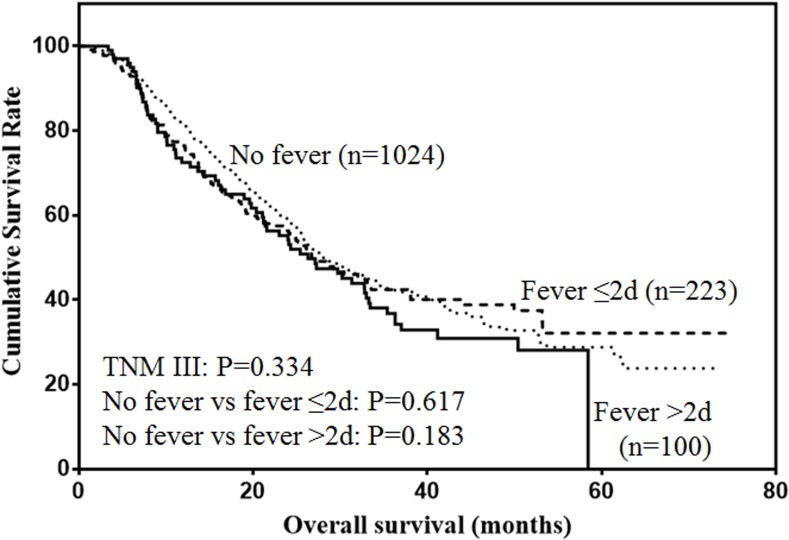
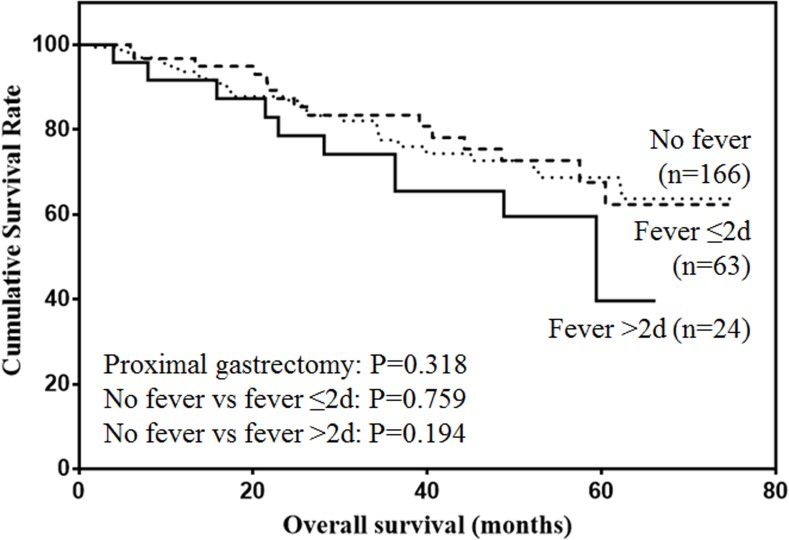
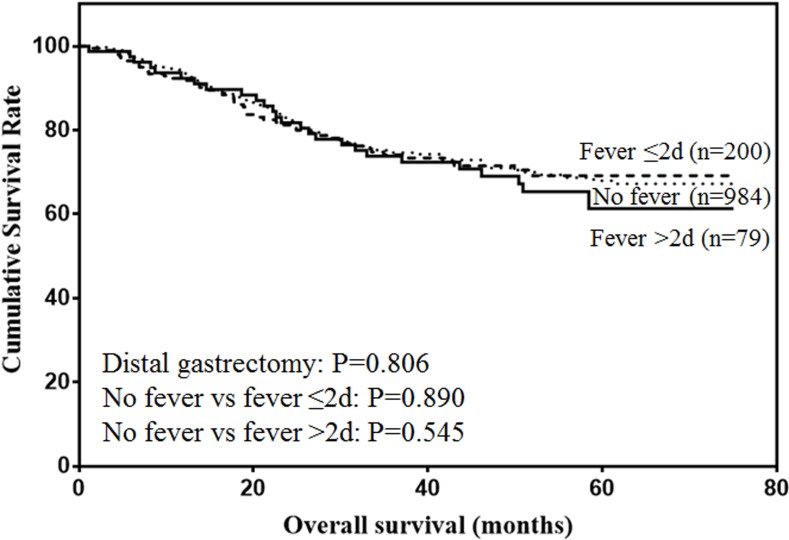
Data about prognostic value of postoperative fever in gastric cancer was lacking. Thus, the present study aims to investigate the prognostic value of postoperative fever in gastric cancer. From September 2008 to March 2015, 2938 gastric cancer patients were enrolled in the present study. Clinicopathological features were recoded. The association between postoperative fever and prognosis of gastric cancer were analyzed. There were 2294 male (78.1%) and 644 female (21.9%). Seven hundred and fifty-six patients suffered from fever. Among them, the duration of fever less than 48h occurred in 508 cases, and duration of fever over 48h occurred in 248 cases. Univariate and multivariate analysis showed that postoperative fever was an independent risk factor for prognosis of gastric cancer ( < 0.001). For the entire cohort, duration of fever over 48h was significantly associated with decreased survival ( < 0.001). In subgroup analysis, duration of fever over 48h was significantly associated with poor prognosis of stage I and II gastric cancer (both < 0.001). However, postoperative fever was not associated with the prognosis of stage III gastric cancer ( = 0.334). Considering the type of gastrectomy, postoperative fever was not associated with the prognosis of patients with proximal ( = 0.318) and distal gastrectomy ( = 0.806), but duration of fever over 48h was significantly associated with poor prognosis of patients with total gastrectomy ( = 0.004). In conclusion, postoperative fever was associated with poor prognosis of gastric cancer.
关于胃癌术后发热的预后价值的数据尚缺乏。因此,本研究旨在探讨胃癌术后发热的预后价值。2008年9月至2015年3月,本研究纳入了2938例胃癌患者。记录了临床病理特征。分析了术后发热与胃癌预后之间的关联。男性2294例(78.1%),女性644例(21.9%)。756例患者出现发热。其中,发热持续时间小于48小时的有508例,发热持续时间超过48小时的有248例。单因素和多因素分析表明,术后发热是胃癌预后的独立危险因素(<0.001)。对于整个队列,发热持续时间超过48小时与生存率降低显著相关(<0.001)。在亚组分析中,发热持续时间超过48小时与Ⅰ期和Ⅱ期胃癌的不良预后显著相关(均<0.001)。然而,术后发热与Ⅲ期胃癌的预后无关(=0.334)。考虑到胃切除术的类型,术后发热与近端胃切除术(=0.318)和远端胃切除术(=0.806)患者的预后无关,但发热持续时间超过48小时与全胃切除术患者的不良预后显著相关(=0.004)。总之,术后发热与胃癌的不良预后相关。